As speech-enabled technologies become more sophisticated, businesses are collecting enormous volumes of audio data from customer conversations, voice assistants, healthcare systems, connected devices, meetings, vehicles, and other applications. But raw audio alone is not enough to train reliable AI models. It must be converted, structured, and enriched according to the requirements of the intended machine learning application.
This is where audio transcription and audio annotation become important. Although the two terms are sometimes used interchangeably, they represent different levels of audio data preparation. Transcription primarily focuses on converting spoken language into text, while audio annotation can add multiple layers of information that help AI systems interpret speech, speakers, sounds, emotions, and context.
Understanding the distinction can help organizations choose the right data preparation strategy for their AI projects.
What Is Audio Transcription?
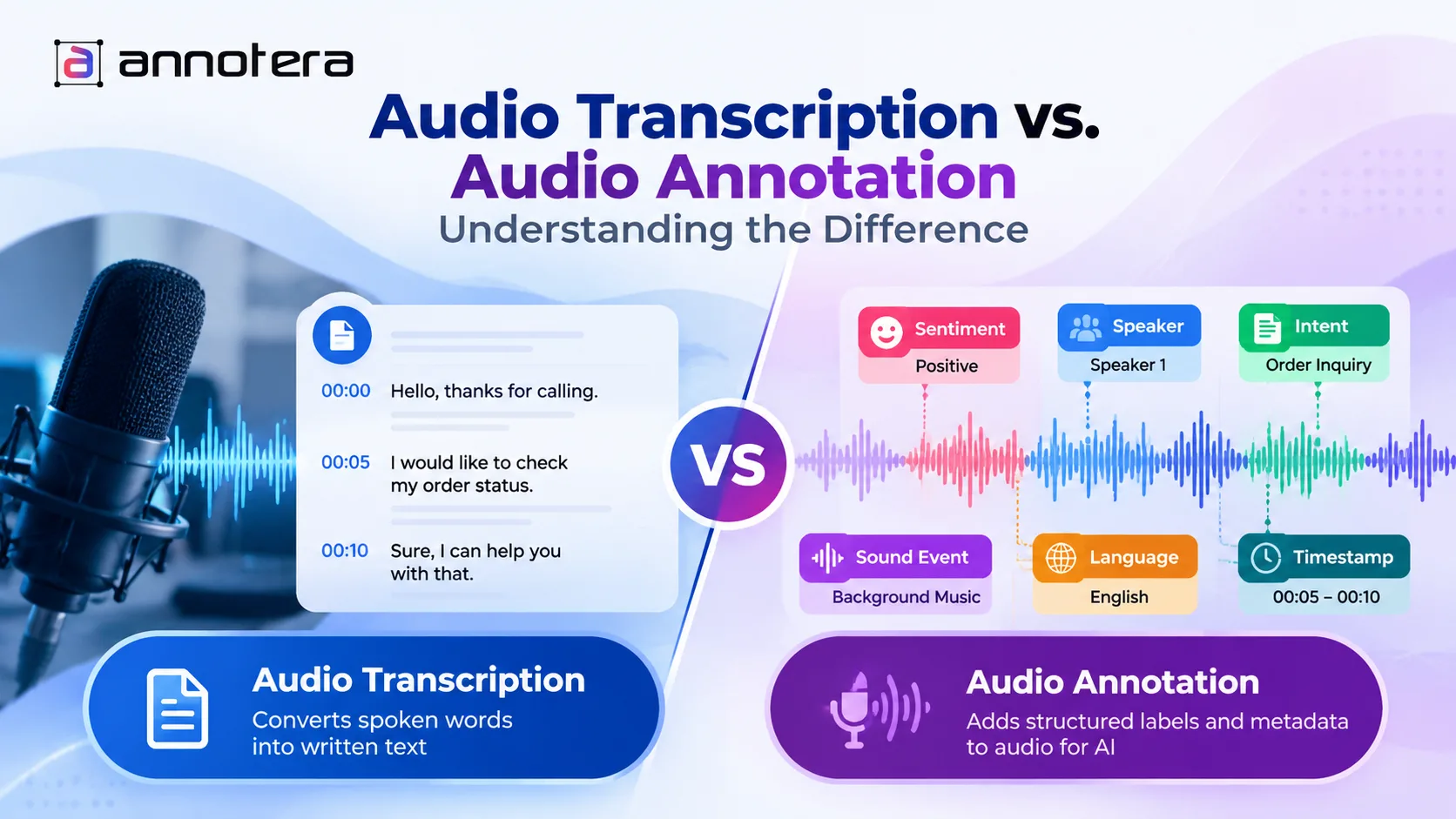
Audio transcription is the process of converting spoken words from an audio recording into written text. The primary objective is to accurately represent what was said.
For example, a customer might say:
“I received the wrong product and would like to exchange it.”
A basic transcript would capture those spoken words in written form.
Depending on the project requirements, transcription may include additional conventions such as punctuation, timestamps, speaker turns, filler words, or verbal disfluencies. Transcription is particularly valuable for applications involving automatic speech recognition (ASR), searchable audio archives, meeting documentation, call analysis, subtitles, and voice-based interfaces.
However, a transcript by itself does not necessarily explain the broader characteristics of the recording. It may not identify the speaker's emotional state, distinguish background sounds, classify the speaker's intent, or identify exactly when particular acoustic events occur.
What Is Audio Annotation?
Audio annotation is a broader process in which audio recordings are enriched with structured labels and metadata for machine learning.
Instead of simply asking, “What was said?”, annotation can answer several additional questions:
- Who said it?
- When did the speaker begin and stop talking?
- What emotion or sentiment is being expressed?
- What is the speaker's intent?
- Which language or accent is being used?
- Is there background noise?
- Are multiple people speaking simultaneously?
- Did a particular sound event occur?
- Where does a specific word or sound occur within the recording?
Depending on the AI application, annotation may include transcription, speaker diarization, timestamps, sentiment labels, intent classification, language identification, accent classification, phoneme labeling, and environmental sound tagging.
In other words, transcription can be one component of audio annotation, while audio annotation encompasses a much wider range of labeling tasks.
Audio Transcription vs. Audio Annotation: Key Differences
The simplest way to understand the difference is to compare their objectives.
Audio TranscriptionAudio AnnotationConverts speech into written textAdds structured information to audioPrimarily focuses on spoken languageCan cover speech, speakers, emotions, sounds, and eventsCommonly used for ASR trainingUsed across speech AI and broader audio intelligenceMay produce a transcript as the main outputCan produce multiple layers of metadataAnswers “What was said?”Can answer “What was said, who said it, when, and under what conditions?”Usually has a narrower scopeCan be customized for specific AI objectivesFor example, consider a customer support recording containing two speakers. Transcription can establish the words spoken by both participants. Annotation can additionally identify the customer and agent, mark speaker changes, classify customer sentiment, identify the customer's intent, and label background noise.
This additional context can make the dataset considerably more useful for sophisticated AI applications.
Why Transcription Alone May Not Be Enough for AI
Modern AI systems increasingly need to understand audio rather than simply convert it into text.
Consider a conversational AI model designed for customer service. Knowing that a customer said, “I have been waiting for three days” is useful, but additional labels could indicate that the speaker is frustrated and that the intent relates to a delayed order.
Similarly, a voice assistant may need to distinguish speech from television noise, keyboard sounds, music, or another person speaking in the background. A surveillance system may need to identify alarms, glass breaking, shouting, or other acoustic events.
These use cases require more than words. They require contextual audio intelligence.
High-quality annotation allows developers to create datasets aligned with these specific requirements, helping models learn distinctions that a simple transcript cannot represent.
Common Types of Audio Annotation
An audio annotation project can contain one or several annotation layers depending on the intended application.
1. Speaker Diarization
Diarization identifies different speakers and determines who spoke when. It is particularly useful for meetings, interviews, podcasts, customer service calls, and conversational AI.
2. Timestamp Annotation
Timestamping associates words, phrases, speaker segments, or acoustic events with precise points in the recording. This helps models learn the temporal relationship between audio and labels.
3. Emotion and Sentiment Annotation
Annotators can classify vocal characteristics associated with emotions or sentiment, depending on the project's guidelines. These datasets can support emotion-aware conversational systems and customer experience analytics.
4. Intent Annotation
Intent labels identify the purpose behind an utterance, such as requesting information, making a complaint, cancelling a service, or scheduling an appointment.
5. Sound Event Annotation
Non-speech sounds can also be labeled. These may include alarms, footsteps, machinery, traffic, coughing, music, door sounds, or other environmental events.
6. Language and Accent Annotation
For multilingual AI systems, audio can be labeled according to language, dialect, or accent categories defined by the project. This helps teams develop speech technologies that perform across diverse populations and acoustic environments.
When Should Businesses Choose Transcription or Full Annotation?
The appropriate approach depends on the intended AI application.
If the primary objective is creating searchable text, generating meeting records, producing subtitles, or building basic ASR training data, transcription may be sufficient.
However, projects involving conversational intelligence, speaker recognition, emotion detection, sound event recognition, voice analytics, or context-aware AI typically require additional annotation layers.
In many cases, the most effective workflow combines both. A project may begin with accurate transcription and subsequently enrich the same audio with speaker, timestamp, sentiment, intent, or acoustic-event labels.
Why Businesses Consider Audio Annotation Outsourcing
Building an internal annotation operation can require specialized annotators, annotation platforms, detailed guidelines, quality assurance procedures, and workforce management. These requirements become increasingly complex when datasets involve multiple languages, accents, speakers, or annotation layers.
Using audio annotation outsourcing services can give AI teams access to trained annotation professionals and scalable production capacity without requiring them to build the entire operation internally.
An experienced provider can support:
- Customized annotation guidelines
- Human-in-the-loop validation
- Speaker diarization
- Transcription and timestamping
- Emotion and sentiment labeling
- Intent classification
- Multilingual audio annotation
- Acoustic event labeling
- Multi-stage quality assurance
- Scalable dataset production
Outsourcing can therefore allow internal AI teams to concentrate on model development while specialized professionals manage data preparation.
Why Choose Annotera for Audio Annotation?
Annotera helps organizations transform raw audio into structured, AI-ready training data. As an experienced audio annotation company, we support projects requiring transcription as well as more sophisticated annotation layers.
Our workflows can be tailored to applications including conversational AI, speech recognition, customer experience analytics, voice assistants, healthcare AI, automotive systems, and other speech-driven technologies.
By combining trained human annotators, project-specific guidelines, and quality control processes, Annotera helps organizations build datasets that are consistent with their model-development objectives.
Conclusion
Audio transcription and audio annotation are closely related, but they are not the same. Transcription primarily converts spoken language into written text, while audio annotation can enrich recordings with speaker identity, timing, emotion, intent, language, background sounds, and other contextual information.
For straightforward speech-to-text requirements, transcription may be sufficient. For AI systems that need to interpret conversations and real-world acoustic environments, a broader annotation strategy is often necessary.
Choosing the right approach ultimately depends on what the AI model needs to learn. With professional audio annotation outsourcing services, businesses can develop structured, high-quality datasets without having to manage every aspect of annotation internally.
Annotera combines audio expertise, scalable workflows, and human-led quality assurance to help businesses turn complex audio into valuable training data for next-generation AI.