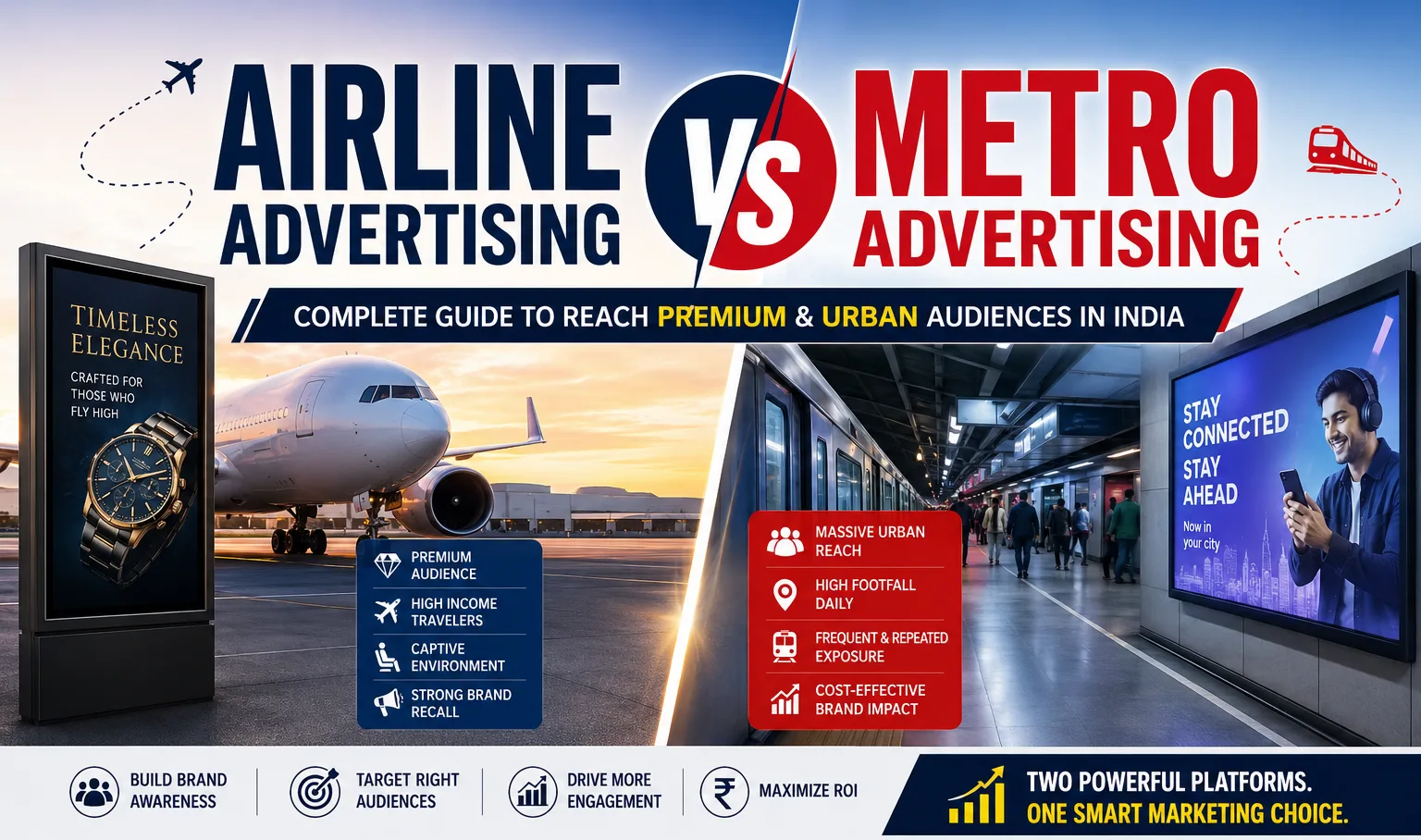
Airline Advertising vs Metro Advertising: Which Advertising Platform Delivers Better Results?
In today’s competitive marketing environment, brands have more choices than ever when it comes to offline advertising. Businesses can advertise through airports, airlines, metro trains, metro stations, digital screens, magazines, outdoor displays, and other high-visibility media channels. Among these options, airline advertising and metro advertising are two powerful platforms that can help brands achieve large-scale visibility and build strong brand recall.
However, these two advertising channels serve very different purposes. Airline and airport media can provide access to travellers, business professionals, affluent consumers, and international audiences, while metro advertising can deliver repeated exposure among daily commuters across major urban markets.
For businesses deciding between the two, the important question is not simply which medium is cheaper. The better question is: Which advertising platform reaches the right audience for your business, campaign objective, geography, and budget?
This comprehensive guide compares airline advertising vs metro advertising, explains the role of an airline advertising agency and metro advertising agency, and explores opportunities such as airline advertising in India, airport advertising, IndiGo magazine advertising, Air India magazine advertising, Delhi Metro advertisement, and Noida Metro advertisement.
What Is Airline Advertising?
Airline advertising refers to advertising opportunities offered through airline-related media and passenger touchpoints. It can include advertisements appearing in inflight magazines, inflight entertainment environments, airline digital platforms, branded content, loyalty-program communications, and other permitted airline media properties.
The key advantage of airline advertising is the ability to communicate with people during their travel journey. Depending on the selected format, passengers may spend considerable time interacting with airline-related content.
Airline advertising can be particularly relevant for brands targeting:
- Business travellers
- Corporate executives
- Entrepreneurs
- Affluent consumers
- Frequent flyers
- International travellers
- Tourists
- Premium customers
- Decision-makers
- High-value consumers
Because of this audience profile, airline media can be especially useful for premium positioning, corporate branding, luxury products, hospitality, real estate, finance, automobiles, tourism, education, healthcare, and technology brands.
What Is Metro Advertising?
Metro advertising is an outdoor advertising channel that uses advertising spaces across metro stations, trains, platforms, concourses, pillars, escalators, corridors, entry and exit areas, and other approved media locations.
Metro networks operate through densely populated urban areas, making them valuable for brands that want frequent exposure among local commuters.
Unlike airline advertising, which can be associated with travel and premium audiences, metro advertising is particularly effective for building mass urban awareness and repeated local visibility.
Metro passengers may include:
- Office employees
- Students
- Business owners
- Professionals
- Shoppers
- Tourists
- Families
- Daily commuters
- Local residents
This makes metro advertising highly versatile for both national and regional brands.
Airline Advertising vs Metro Advertising: Key Difference
The biggest difference between airline advertising and metro advertising is audience context.
Airline advertising reaches people in a travel environment. Metro advertising reaches people during their everyday urban commute.
Airline advertising can therefore be valuable for premium audience targeting and national or international brand positioning, while metro advertising can be highly effective for local market penetration, frequency, and mass urban awareness.
The right choice depends on the marketing objective.
Factor of Airline Advertising vs Metro Advertising
Primary Audience:
Airline Advertising — Travellers and premium consumers
Metro Advertising — Urban commuters
Environment:
Airline Advertising — Travel and aviation
Metro Advertising — Daily urban transportation
Geographic Reach:
Airline Advertising — Domestic/international depending on media
Metro Advertising — Primarily city/metro region
Frequency:
Airline Advertising — Depends on campaign and passenger exposure
Metro Advertising — Often high among regular commuters
Premium Positioning:
Airline Advertising — Strong potential
Metro Advertising — Strong potential with large-format branding
Local Targeting:
Airline Advertising — Limited to selected travel audiences
Metro Advertising — Strong station/route targeting
Brand Awareness:
Airline Advertising — Excellent
Metro Advertising — Excellent
B2B Potential:
Airline Advertising — Strong for relevant audiences
Metro Advertising — Strong in business corridors
Product Launches:
Airline Advertising — Highly suitable
Metro Advertising — Highly suitable
Mass Local Awareness:
Airline Advertising — Moderate to high
Metro Advertising — Very strong
International Audience:
Airline Advertising — Potentially strong
Metro Advertising — Generally limited
Best Use:
Airline Advertising — Premium and travel-oriented campaigns
Metro Advertising — Urban reach and frequency
Airline Advertising in India
Airline advertising in India has significant potential for brands looking to connect with travellers across major domestic and international routes.
India has a large and growing aviation ecosystem, with passengers travelling for business, tourism, education, employment, family visits, and other purposes.
Airline media can therefore provide advertisers with opportunities to reach audiences beyond a single city.
For example, a brand expanding from Delhi to other Indian markets may use airline media to communicate with travellers from multiple regions.
Similarly, tourism companies, hotels, real estate developers, financial institutions, luxury brands, and educational organizations can use airline advertising to build awareness among travellers.
The value of airline advertising is not simply the number of passengers reached. Advertisers should also consider who those passengers are, where they are travelling, and whether they match the target customer profile.
Airport Advertising vs Airline Advertising
Airport advertising and airline advertising are related but different media channels.
Airport advertising places advertisements within the airport environment, such as:
- Terminal displays
- Digital screens
- Arrival areas
- Departure areas
- Baggage-claim zones
- Security-area media
- Passenger walkways
- Airport lounges
- Large-format branding
- Experiential installations
Airline advertising, on the other hand, is associated with the airline's passenger communication ecosystem.
Airport advertising can reach passengers before or after a flight, while airline media can communicate with passengers as part of their airline journey.
For brands with sufficient budgets, combining airport and airline advertising can create a stronger travel-media strategy.
IndiGo Magazine Advertising
IndiGo magazine advertising can be considered by brands interested in reaching airline passengers through inflight publication environments and related media opportunities, subject to the airline's current commercial inventory and policies.
Inflight publications can provide a different advertising experience compared with outdoor media.
A passenger may browse a magazine during the flight, providing an opportunity for detailed visual storytelling.
Industries that may find inflight magazine environments relevant include:
- Tourism
- Hotels
- Luxury brands
- Real estate
- Financial services
- Automobiles
- Education
- Healthcare
- Retail
- Lifestyle brands
- Technology
The key advantage of magazine advertising is the ability to communicate more information than a short outdoor advertisement.
For example, a luxury property developer can use a full-page creative to present project imagery, amenities, location advantages, and contact information.
Air India Magazine Advertising
Air India magazine advertising is another potential opportunity for brands seeking access to airline audiences.
Airline publications can provide a premium editorial environment where advertising can be integrated alongside travel, lifestyle, destination, business, and cultural content, depending on the publication and current media offering.
Brands considering Air India magazine advertising should evaluate the current publication format, readership profile, circulation, advertising inventory, available editions, placement options, and commercial terms before finalizing a campaign.
A professional media agency can help advertisers determine whether the audience matches their campaign objectives.
Benefits of Airline Advertising
There are several reasons brands choose airline media.
1. Premium Audience Exposure
Airline passengers can include professionals, executives, entrepreneurs, tourists, and affluent consumers.
For premium products and services, audience quality can be more important than raw impressions.
2. Travel Mindset
People travelling for business or leisure may be more receptive to travel-related products, hospitality, real estate, financial services, automobiles, and lifestyle brands.
3. Geographic Expansion
Airline networks connect different cities and regions. This makes airline advertising useful for companies entering new markets.
4. Strong Brand Positioning
The aviation environment can support a premium perception when the creative strategy and media placement are appropriate.
5. Storytelling Opportunities
Inflight magazine advertising can provide space for detailed messaging, high-quality visuals, product information, and storytelling.
What Is an Airline Advertising Agency?
An airline advertising agency specializes in helping brands plan and execute advertising campaigns across airline and aviation-related media.
Depending on its capabilities and available inventory, an agency may assist with:
- Airline media planning
- Audience research
- Publication selection
- Inflight advertising
- Airport media
- Creative development
- Media buying
- Campaign scheduling
- Production coordination
- Artwork specifications
- Campaign documentation
An experienced airline advertising agency can also help businesses compare airline media with other advertising channels.
Rather than simply selling advertising space, a good agency should focus on matching the media property with the client's target audience and marketing objectives.
Benefits of Metro Advertising
Metro advertising has a different set of advantages.
1. High Frequency
Daily commuters may travel on the same route repeatedly, creating multiple opportunities to see the same advertisement.
Frequency can be particularly valuable for brand recall.
2. Urban Reach
Metro systems connect residential areas, business districts, educational hubs, shopping destinations, and transport centres.
This provides advertisers with access to a broad urban audience.
3. Geographic Targeting
Brands can select stations and routes based on their target market.
For example, a local real estate project can focus on stations located near its customer base.
4. Large-Format Visibility
Train wraps, station branding, platform displays, and other large-format media can create significant visual impact.
5. Local Market Penetration
Businesses targeting a particular city can use metro advertising to establish strong local visibility.
Metro Advertising Agency: Why Professional Planning Matters
A metro advertising agency can help businesses plan and execute campaigns across available metro media.
An agency may assist with:
- Station selection
- Route selection
- Media planning
- Advertising format selection
- Campaign duration
- Creative specifications
- Printing
- Fabrication
- Installation
- Campaign documentation
- Budget planning
Metro campaigns can involve multiple operational requirements. Working with an experienced agency can reduce execution complexity.
Delhi Metro Advertisement vs Noida Metro Advertisement
Delhi and Noida metro advertising can serve different geographic marketing objectives.
A Delhi Metro campaign may provide access to a broader Delhi/NCR commuter audience, while a Noida-focused campaign can be useful for businesses whose customer base is concentrated in Noida and nearby areas.
The decision should be based on:
- Target geography
- Customer location
- Business locations
- Passenger profile
- Campaign objectives
- Available advertising inventory
- Budget
- Desired frequency
Businesses should not automatically select the larger network. Audience relevance should be the primary consideration.
Delhi Metro Advertisement Opportunities
A Delhi Metro advertisement can be an effective way to reach commuters across Delhi and the National Capital Region.
Delhi Metro connects important residential, commercial, educational, business, shopping, and transportation areas.
Depending on available inventory, advertisers may explore:
- Station branding
- Platform advertising
- Pillar branding
- Escalator advertising
- Concourse displays
- Digital screens
- Train advertising
- Train wraps
- Entry and exit branding
- Wall panels
The best format depends on the campaign objective.
A product launch may benefit from high-impact station branding, while a local service provider may prefer advertising around selected stations.
Noida Metro Advertisement Opportunities
A Noida Metro advertisement can help businesses reach commuters across Noida and surrounding urban markets.
Noida has developed into an important commercial, residential, technology, education, and business destination.
Businesses operating in or targeting Noida can consider metro advertising for:
- Real estate
- Education
- Healthcare
- Retail
- Restaurants
- Financial services
- Technology
- Automobile
- Entertainment
- Local services
A carefully selected station strategy can help businesses focus their advertising investment on areas where their target customers are most likely to travel.
Also Read: Namaste.ai Magazine vs Hello 6E Magazine | Inflight Advertising Guide
Airline Advertising vs Metro Advertising: Which Is Better?
There is no universal winner.
The better medium depends on the brand.
Choose Airline Advertising When:
- You target premium consumers.
- Your customers travel frequently.
- You want national or international visibility.
- You operate in luxury, hospitality, tourism, finance, or premium real estate.
- You want to associate your brand with a travel environment.
- Your campaign requires detailed inflight storytelling.
- You are expanding into multiple markets.
Choose Metro Advertising When:
- You target urban commuters.
- Your business is city-focused.
- You want repeated exposure.
- You want strong local visibility.
- Your audience regularly uses public transportation.
- You are promoting a local product, service, property, institution, or retail outlet.
- You want high-frequency outdoor exposure.
Can Brands Use Both Airline and Metro Advertising?
Yes. For some businesses, combining both channels can create a powerful media strategy.
Consider a real estate developer launching a premium residential project.
The company could use:
Airline advertising: Reach business travellers and affluent consumers travelling between major cities.
Airport advertising: Build visibility among passengers arriving in the target market.
Metro advertising: Reach local residents and daily commuters around the project location.
This creates a multi-stage customer journey:
Travel Audience → Airport Audience → Local Urban Audience → Potential Customer
A similar strategy could work for educational institutions, healthcare brands, financial companies, automobile manufacturers, tourism businesses, and national consumer brands.
How to Decide Between Airline and Metro Advertising
Before choosing a medium, answer five questions.
1. Who Is Your Target Customer?
Define the audience by age, profession, location, income profile, interests, and purchasing behaviour.
2. Where Does Your Customer Travel?
If your customers frequently fly, airline advertising may be more relevant.
If they commute daily through metro networks, metro advertising may provide greater frequency.
3. What Is Your Geographic Objective?
For multi-city expansion, airline media can potentially provide broader geographic exposure.
For city-specific campaigns, metro advertising can provide stronger local targeting.
4. What Is Your Campaign Objective?
Brand awareness, lead generation, product launch, premium positioning, and local market penetration may require different media strategies.
5. What Is Your Budget?
Do not compare media solely by total price. Compare cost against audience relevance, exposure, frequency, and campaign objective.
Final Verdict: Airline Advertising or Metro Advertising?
Airline advertising and metro advertising are not direct substitutes in every situation. They are complementary advertising channels with different strengths.
Airline advertising can be highly suitable for brands seeking premium, travel-oriented, national, or international audiences. Airline advertising in India can support businesses looking to expand beyond a single city and communicate with travellers through airline and aviation media.
Airport advertising can further strengthen this strategy by reaching passengers before and after flights.
Metro advertising, meanwhile, is particularly powerful for city-level awareness, repeated exposure, and urban audience targeting. A Delhi Metro advertisement can help brands reach commuters across Delhi and NCR, while a Noida Metro advertisement can provide focused visibility among audiences travelling through Noida.
An experienced airline advertising agency can help brands evaluate airline and aviation media opportunities, while a professional metro advertising agency can assist with station, train, route, and outdoor media planning.
Ultimately, the right choice depends on four core factors:
Audience + Geography + Objective + Budget
If the target audience is premium travellers and the objective is broader brand positioning, airline advertising may be the stronger option.
If the goal is repeated exposure among urban commuters and strong local visibility, metro advertising may be more appropriate.
For ambitious brands, however, the most effective strategy may be to combine both. Airline, airport, and metro media can work together to create a broader offline customer journey—from travelling audiences to airport visitors and finally to local urban consumers.
The future of effective offline marketing is not about choosing one advertising medium simply because it is popular. It is about selecting the right audience, right location, right format, right message, and right frequency.
When these elements are aligned, both airline advertising and metro advertising can become powerful components of an integrated marketing strategy in India.
Also Read: Delhi Airport Advertising vs Delhi Metro Advertising: Complete Guide to Costs, Ads & Audience Reach