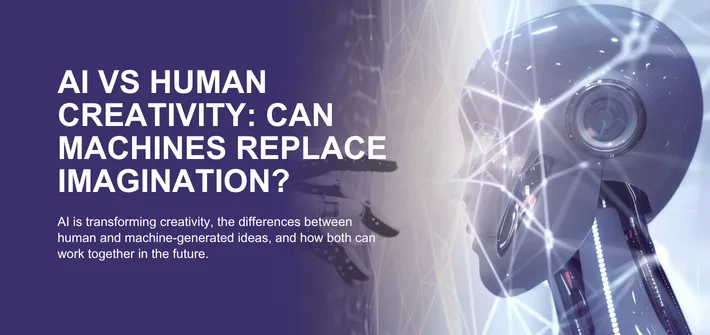
Creativity has been defined as very human and credited to emotion, experience and imagination. Whether in storytelling and music, in design and innovation, creativity is the way humans understand and communicate the world. However, the advent of AI has thrown this age-old belief into disarray. Machines are now able to compose music, write poetry and produce works of art in seconds.
This change poses a significant question, is it possible that AI can really substitute human imagination, or is it merely imitating it?
Understanding Human Creativity
The Role of Emotion and Experience
Human creativity does not only involve giving rise to something new; it involves meaning. Personal experiences and feelings, as well as culture, have an impact on all creative works. A painter can go through life's misfortunes on the canvas and a writer can go through any joy, sadness or interest in words.
So, a lot of emotions are the base of creativity. It allows people to make work that will add a personal flavor to what they are working on with people. In such cases, creativity is not just product, it's expression.
Creativity as a Cognitive Process
Human imagination is a very complex thinking process which involves problem solving, intuition and abstract thinking. It has the ability to connect disjunctive ideas together to produce something new.
Studies indicate that, although AI does a good job at more creative tasks, it cannot handle more in-depth cognitive processes such as idea selection and evaluation, which are the main constituents of genuine creativity.
How AI Generates “Creativity”
Pattern Recognition, Not Imagination
Artificial intelligence is a process that relies on analyzing massive amounts of information that is available. Identifies patterns, structures and relationships; applies to generate new outputs. As an example, AI can make paintings based on thousands of existing paintings.
But this process is totally different to the imagination of man. AI does not learn a meaning, or an intent, it predicts the next event, as per probability.
Performance in Creative Tasks
AI has proven its creativity in some kind of creativity tests. As an example, AI models have generated more original and elaborate answers than average human participants in divergent thinking tasks, which require participants to generate several ideas.
At the same time, research also shows that the most creative of humanity are more productive when compared to AI, at least in performing complex tasks such as storytelling and creative expression.
AI and human creativity differ in several ways.There are some differences between AI and human creativity.
Original Thought vs. Generated Output
Intentionality and originality serve as motivation to human creativity. The intentional creation of people is to communicate, resolve issues, or identify oneself.
Instead, AI produces outputs as a result of learned data. Does not have independent thinking or self-initiative.
Emotional Depth vs. Technical Accuracy
Technically dazzling things can be produced by AI, but lacking in emotional authenticity. The research and opinions of experts suggest that the artificial work carried out by AI can be repeated or insufficient, especially compared to the work done by a human.
Humans add a touch, feeling, and narrative to what they create, which machines simply cannot imitate.
Diversity of Ideas
As much as AI can produce a lot of ideas in a short time, the ideas might lack diversity. Studies have established that outputs of AI tend to approach similar patterns or themes.
On the other hand, contingencies and personal perspectives carry a lot of creativity in human existence.
Can AI Replace Human Creativity?
Where AI Excels
Where speed, efficiency and a lot of ideas are required, AI can work very efficiently. It is able to aid in brainstorming, mechanize habitual creative endeavors, and even give inspiration.
In most instances, AI is a potent instrument that promotes human creativity and not its elimination.
Where Humans Still Lead
Despite its capabilities, AI lacks key elements that define true creativity:
- Emotional intelligence
- Personal experience
- Intentional storytelling
- Cultural understanding
There is a difference between being creative and making something new, and knowing why and how, experts say. AI is not able to reproduce this more profound motive.
The emergence of human-AI collaboration.New dawn of human-AI collaboration.
The Rise of Human-AI Collaboration
A New Creative Partnership
Rather than looking at AI as a substitute, various industries are adopting it as a joint partner. AI is used by designers, writers, and artists to help them brainstorm, experiment, and speed up their creative processes.
This collaboration makes it possible for humans to be more creative and for machines to more easily complete repetitive or time-consuming tasks.
AI enhances, rather than replaces, creativity.
Recent studies show that AI can indeed stimulate human creativity in its application. AI can prompt people to think outside the box by providing them with suggestions and alternative viewpoints, including innovative solutions to challenges.
But, in the end, it's a matter of judgment and intuition.
Ethical and Philosophical Questions
Who Owns AI-Generated Work?
With AI taking a bigger part in the creative processes, questions of ownership and originality appear. If based on available information, can we say that the creation of a work of art by a machine is original?
These questions upset traditional definitions of creativity and authorship.
Redefining Creativity in the AI Era
With the advent of AI, creativity is redefined. Does creativity have an emotional and human dimension or is it only a matter of new ideas and useful ideas?
It could be somewhere in the middle.
Conclusion: Machines vs. Imagination
Undoubtedly, AI has transformed creativity. It can create great works, facilitate ideation and even outperform humans in a certain well-defined activity. But creativity is not only a product, it is an feeling, a goal and an experience.
Although machines are able to imitate creativity, they cannot really substitute imagination.
The creative process is not a battle between humans and AI, it's a partnership. Those who have the privilege of learning how to combine art and technology will shape the future of art.