Imagine a team spending hours answering customer questions, sorting invoices, or searching reports. AI can handle parts of that work, giving people more time for judgment and creativity. That is where AI services can help.
For businesses, AI is no longer only about futuristic robots. It can support everyday work, improve decisions, and create better customer experiences. Rubixe helps businesses explore practical ways to use AI without treating it as a magic fix.
What are AI services and why do businesses use them?
AI services are solutions that use artificial intelligence to perform tasks, find patterns, create content, or support decisions. Businesses use them to save time, reduce repetitive work, and make better use of their data.
Common goals include:
• Automating repetitive tasks
• Improving customer support
• Finding useful patterns in data
• Creating content faster
• Supporting decisions
McKinsey research shows growing generative AI use in marketing, software development, and customer operations. Adoption works best when it connects to a clear business need.
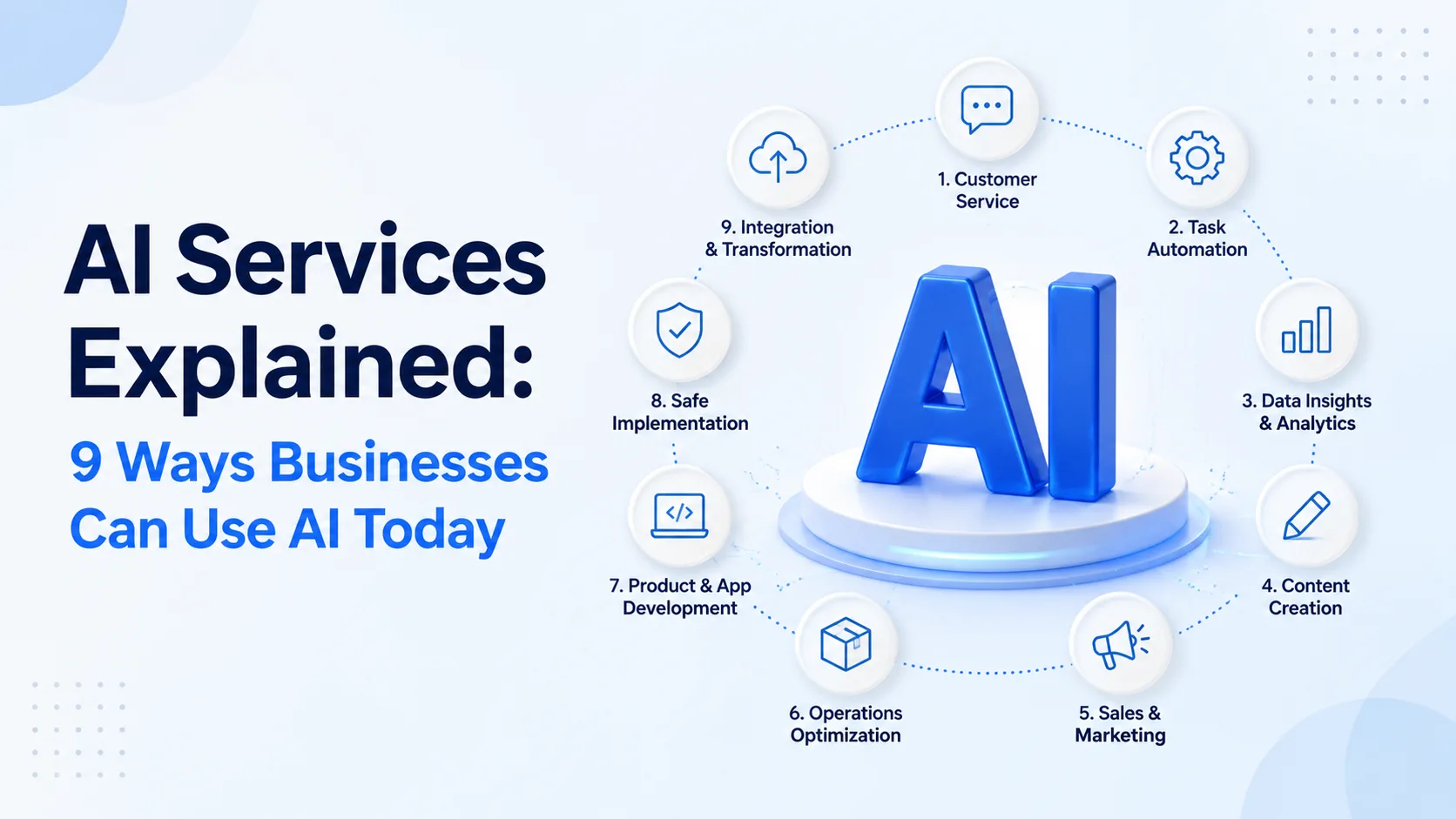
How can AI improve customer service?
AI can improve customer service by answering common questions, routing requests, and helping support teams find information quickly. It can provide faster responses while keeping human agents involved when a problem is complex.
For example, a retailer can use an AI assistant for order status, returns, and product questions. Sensitive complaints can still go to a human agent.
Generative AI solutions can also summarize long customer conversations and suggest useful replies. These tools are most effective when businesses set clear rules for accuracy, privacy, and escalation.
How can AI automate everyday business tasks?
AI can automate repetitive work such as document processing, invoice checks, email sorting, and data entry. This is a common starting point for ai services. This gives employees more time for tasks that need judgment.
AI application development services let a business build around its own workflow.
An accounts team could use AI to read invoices and flag unusual entries. People can still make the final financial decision.
How can AI help businesses understand their data?
AI can help businesses turn large amounts of data into useful insights. It can identify patterns, spot unusual activity, and support forecasting.
AI software solutions can bring these capabilities into dashboards and internal systems. A sales team could identify customers likely to stop buying.
AI output depends on data quality. Poor data can produce poor recommendations, so human review remains important for high impact decisions.
Business needPossible AI useExpected benefitCustomer supportAI assistantFaster responsesFinanceInvoice processingLess manual workSalesCustomer predictionBetter follow upMarketingContent assistanceFaster productionOperationsForecastingBetter planningHow can AI create better content and ideas?
AI can help teams draft product descriptions, summarize research, create marketing ideas, and adapt content for different audiences. It does not replace the need for human editing.
Gen AI services help when a company produces lots of content. Well planned gen AI services can also support research and internal knowledge tasks. A marketing team might create a first draft with AI, while an employee checks facts, tone, and brand requirements.
Generative AI solutions can help employees explore ideas. Businesses can combine generative AI solutions with review rules. Well designed generative AI solutions should also protect sensitive information. Businesses should still check facts, privacy risks, and generic sounding content.
How can AI support sales and marketing?
AI can help sales and marketing teams understand customer behavior, prioritize leads, personalize messages, and measure campaign performance. This can make outreach more relevant.
AI solutions can connect customer data with business rules. For example, a software company could flag engaged trial users and invite them to a sales conversation.
AI integration services matter when capabilities must work across customer systems, analytics tools, websites, and other platforms. Good integration prevents disconnected information.
How can AI improve business operations?
AI can support operations by predicting demand, identifying delays, and helping teams plan resources.
AI transformation services focus on using AI across broader business processes, rather than adding one isolated tool. Strong AI transformation services usually begin with a small workflow and expand after results are proven. Practical ai transformation services also align people, processes, and technology.
A logistics company could combine demand forecasts and delivery data to improve planning.
The goal should be practical. Businesses should start with a measurable problem, test it, and expand when results are clear.
How can AI help build new products and applications?
AI can become part of a product, portal, mobile app, or internal platform for search, recommendations, document analysis, and assistants.
AI development services can move an idea to a working application. Experienced AI development services teams can also help with testing and maintenance. Reliable AI development services also include monitoring.
AI application development services can create industry specific tools. These ai application development services are useful when off the shelf tools do not fit. A healthcare company might use AI to summarize documents while professionals make important decisions.
How can businesses implement AI safely?
AI implementation services help businesses move from experiments to reliable systems. Good AI implementation services also define ownership, testing, and monitoring. Strong ai implementation services keep those checks active after launch.
This usually involves choosing a use case, preparing data, testing performance, connecting the system to existing tools, and monitoring results.
AI integration services can connect AI with current systems. Reliable ai integration services also reduce duplicate data and manual switching. Security and privacy should be considered from the beginning, especially with customer or employee data.
A sensible implementation process includes:
- Define the business problem and success measure.
- Check whether the required data is available and reliable.
- Build a small pilot before making a large investment.
- Test accuracy, security, and user experience.
- Measure results and improve the system over time.
AI has limits. It can make mistakes, inherit bias, and produce confident but incorrect answers.
What should businesses consider before choosing AI?
Businesses should choose AI based on business value, not hype. The right solution should solve a clear problem and have a success measure.
Before starting, ask:
• What task are we improving?
• What time or money could be saved?
• What data is needed?
• Who will review AI output?
• How will privacy be managed?
• What result would justify continuing?
AI software solutions deliver more value when these questions are answered early. The right AI software solutions should fit the users who rely on them. A project can teach more than a large experiment with unclear goals.
What are the most common questions about AI services?
Can small businesses use AI?
Yes. Small businesses can start with customer support, content creation, document processing, or data analysis.
Does AI replace employees?
Not always. AI can handle repetitive tasks while people manage decisions, relationships, and creative work.
How long does AI implementation take?
It depends on the use case, data, integrations, and customization. A simple pilot can be faster than a large system.
Is generative AI safe for business use?
Yes, with suitable security controls, data policies, and human review for important decisions.
How should a business start with AI?
Start with one measurable problem, test a practical solution, learn from the results, and expand gradually.
What is the next step for businesses exploring AI?
The best AI journey starts with a business problem, not a trend. The solution should be practical and measurable.
Rubixe can help businesses evaluate opportunities, plan the right approach, and turn promising ideas into AI solutions. Start small, measure the outcome, and build from what works.