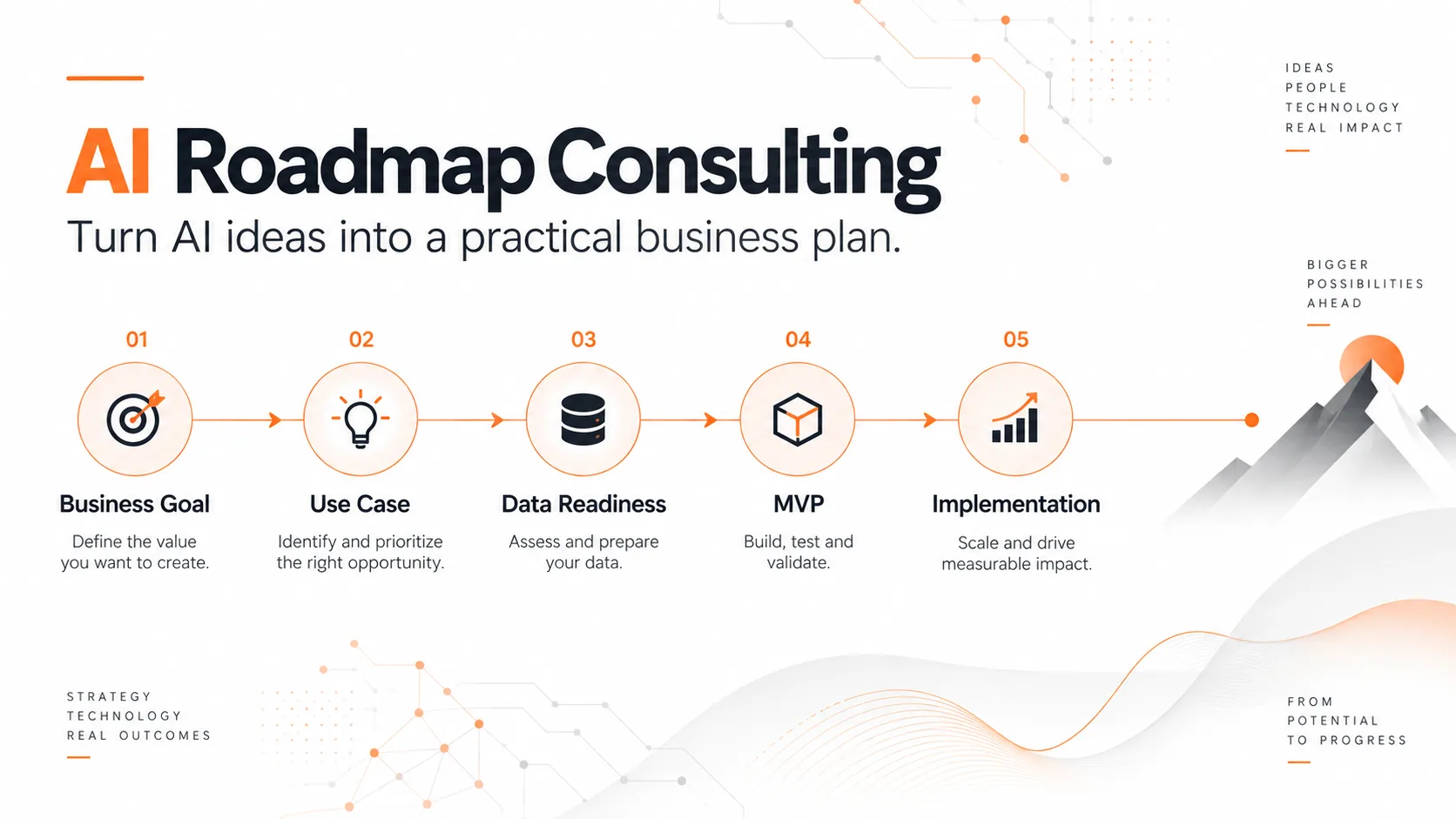
Artificial intelligence is creating new opportunities for startups, small businesses, and growing companies. Businesses are exploring AI for customer support, document processing, forecasting, lead scoring, automation, and internal knowledge management.
But choosing an AI idea is easy. Deciding which idea is worth building, what data it needs, how much it may cost, and how success should be measured is much harder.
This is where ai roadmap consulting becomes valuable. It gives businesses a structured way to evaluate AI opportunities before committing to development.
What Is an AI Roadmap?
An AI roadmap is a practical plan that connects business goals with realistic AI initiatives. It identifies valuable use cases, technical requirements, data needs, implementation priorities, risks, and expected outcomes.
Effective ai roadmap consulting starts with a business problem, not a technology. A company may want to reduce repetitive support work, improve sales qualification, automate document review, forecast demand, or make company knowledge easier to access.
The roadmap helps determine which use case offers the best balance of business value and technical feasibility.
Why Businesses Need an AI Roadmap
Many AI initiatives begin with excitement around a particular tool, model, or trend. Teams may decide they need a chatbot, AI assistant, or automated system before clearly defining what problem it should solve.
With ai roadmap development consulting, the process works in the opposite direction. Business challenges and measurable objectives come first. AI is then assessed as a possible solution.
This approach helps businesses avoid projects that lack useful data, do not fit existing workflows, or have no clear return on investment. It also helps align leadership, product teams, and developers around the same priorities.
1. Identify High-Value AI Use Cases
The first stage of ai roadmap consulting is identifying where AI can create measurable value.
Possible use cases may include:
- Customer support automation
- AI lead scoring
- Document extraction
- Personalized recommendations
- Demand forecasting
- Internal knowledge assistants
- Repetitive workflow automation
However, not every AI idea should become a project.
Each opportunity should be evaluated based on expected business impact, implementation complexity, data availability, integration requirements, risk, and potential payback.
A major benefit of ai roadmap development consulting is that it helps companies prioritize one or two strong opportunities instead of trying to implement AI everywhere at once.
2. Evaluate Data and Technical Readiness
AI depends heavily on reliable data and suitable technology.
Before development starts, businesses should understand what data they currently have, where it is stored, how accurate it is, and whether it can be accessed securely.
During ai roadmap consulting, systems such as CRMs, databases, APIs, analytics platforms, cloud infrastructure, and internal software should also be reviewed.
The assessment may show that the business is ready to start development immediately.
In other cases, it may reveal that data cleanup, better tracking, system integrations, or workflow improvements need to happen first.
This is an important part of ai roadmap development consulting because identifying technical limitations early can prevent expensive problems later in the project.
3. Define the First AI MVP
After selecting the most valuable use case, the next step is defining a focused proof of concept or minimum viable product.
The first AI version should answer important questions without becoming unnecessarily large.
Can the solution achieve acceptable accuracy?
Can it work with existing systems?
Will employees or customers actually use it?
Can it reduce costs, save time, increase conversions, or improve another important business metric?
A focused roadmap helps define the smallest scope required to prove whether the AI idea delivers real value.
Success metrics should also be established before development begins. Depending on the project, these may include reduced handling time, increased conversions, lower manual workload, faster processing, improved forecast accuracy, or better customer response times.
4. Build a Practical Implementation Plan
Once the use case and MVP are clear, ai roadmap development consulting turns the strategy into an execution plan.
The roadmap should define:
- Project scope
- Required data
- Technology choices
- System integrations
- Development timeline
- Budget considerations
- Key risks
- Team responsibilities
- Success metrics
It should also answer one important question:
Should the company build, buy, or wait?
Sometimes custom AI development is the right approach. In other situations, an existing SaaS platform, AI API, or third-party solution may solve the problem faster and at a lower cost.
Strong ai roadmap consulting should recommend the approach that best fits the business rather than automatically recommending custom development.
When ai roadmap development consulting shows that a business is not ready, improving data quality or internal processes before starting development may be the better decision.
From AI Strategy to Execution
A useful AI roadmap should not remain a strategy document that nobody uses.
It should clearly explain what happens first, what resources are required, who is responsible, and how the company will determine whether the project is succeeding.
This is why ai roadmap development consulting should combine business priorities with technical planning. It creates a bridge between an AI idea and an executable project.
For growing businesses, ai roadmap consulting can also reduce uncertainty. Leadership gets a clearer understanding of investment requirements and expected outcomes, while development teams receive a more clearly defined scope.
Final Thoughts
Successful AI adoption is not about adding AI everywhere possible. It is about identifying a business problem where AI can create measurable value and then implementing the solution in a controlled and realistic way.
With ai roadmap consulting, businesses can prioritize the right use case, evaluate their readiness, define success metrics, and reduce unnecessary experimentation.
With ai roadmap development consulting, those decisions can be converted into a practical implementation plan covering technology, data, integrations, budget, risks, and execution.
A clear AI roadmap gives businesses a stronger foundation for moving from AI interest to real AI implementation while keeping the focus on measurable business results.