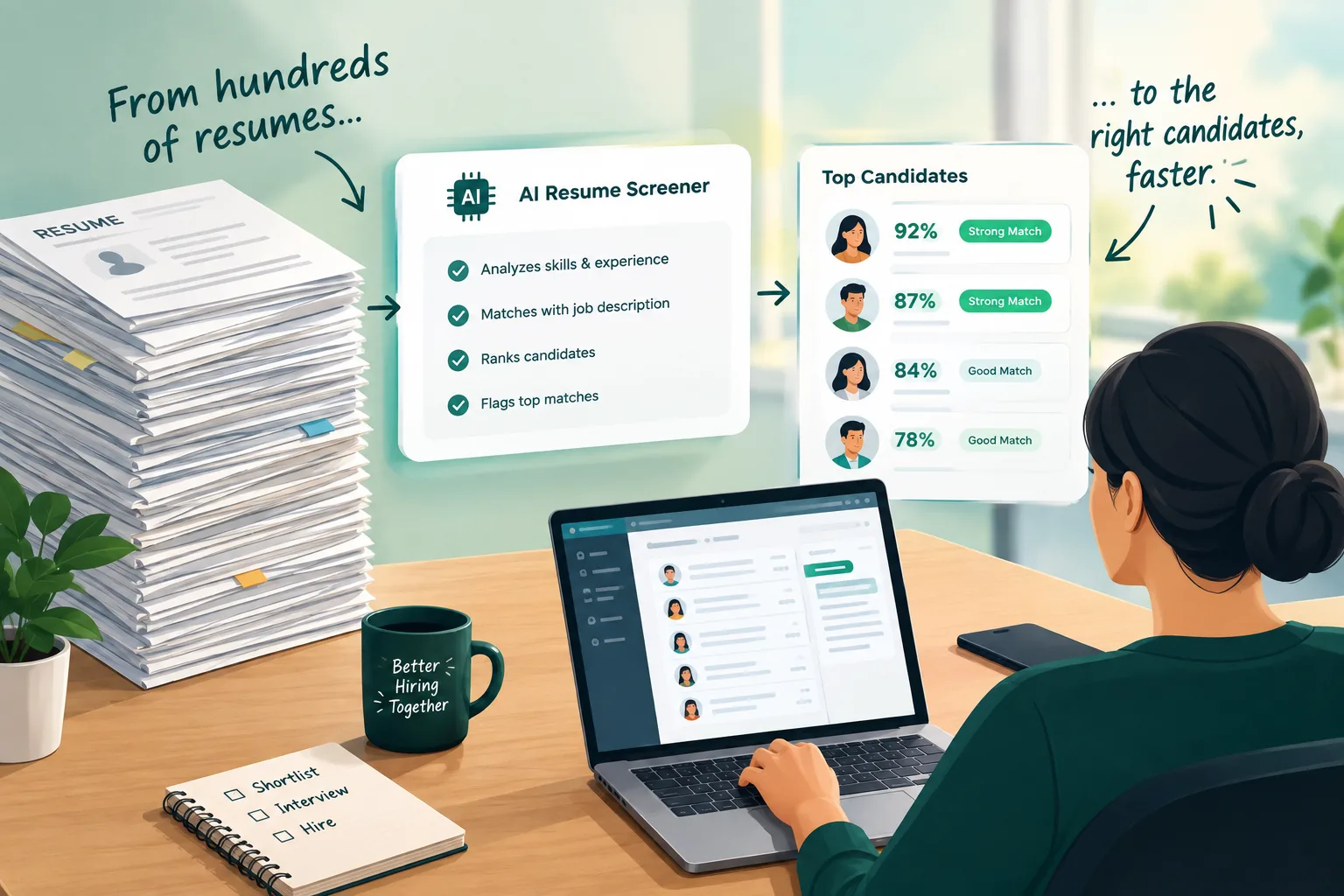
Recruiters have always had one task they could probably do without: going through hundreds of resumes for the same role.
When a job opening attracts 500, 1,000, or even 5,000 applications, manually reviewing every resume becomes difficult. Important candidates can get overlooked, screening takes longer, and recruiters spend more time sorting resumes than actually talking to people.
That’s where AI resume screening comes in.
An AI resume screener can review resumes, identify relevant skills and experience, and help recruiters narrow down a large applicant pool faster. But AI isn't meant to replace recruiters. Its real value is taking some of the repetitive work off their plate so they can focus on the decisions that require human judgment.
So, what does AI resume screening actually look like in 2026, and what should recruiters know before using it?
What Is AI Resume Screening?
AI resume screening is the use of artificial intelligence to analyze resumes against the requirements of a job.
Instead of relying only on exact keyword matches, modern AI resume screeners can look at different parts of a candidate's profile, including:
- Skills and technical abilities
- Relevant work experience
- Previous job responsibilities
- Education and certifications
- Career history
- Industry experience
- Job-specific qualifications
The goal is simple: help recruiters identify candidates who appear to be a strong match without requiring them to manually review every resume from scratch.
For example, imagine you're hiring a software engineer and receive 2,000 applications. An AI resume screener can help organize those applications based on the criteria you've defined, giving recruiters a more manageable shortlist to review.
Why Are Recruiters Using AI Resume Screeners?
The biggest reason is volume.
Recruitment teams often don't have the time or resources to manually evaluate every application in detail. Even when recruiters move quickly, reviewing hundreds of resumes can take hours.
An AI resume screener can help with the first stage of that process.
1. It Helps Handle High Application Volumes
Some roles attract hundreds of applicants within the first few days of being posted.
Instead of opening every resume individually, recruiters can use AI to process applications at scale and identify candidates who meet the initial requirements.
This is particularly useful for:
- High-volume hiring
- Graduate recruitment
- Sales hiring
- Customer support roles
- Technology recruitment
- Large-scale recruitment campaigns
The recruiter still makes the final call, but they don't have to start with a blank page.
2. It Reduces Repetitive Screening Work
Resume screening can be repetitive.
Recruiters may find themselves checking the same things repeatedly:
"Does this person have Python experience?"
"Have they worked in SaaS?"
"Do they have five years of experience?"
"Do they have the required certification?"
An AI resume screener can help surface this information much faster, allowing recruiters to spend more time on interviews, candidate communication, and hiring strategy.
3. It Can Go Beyond Exact Keyword Matching
Traditional resume screening often depends heavily on keywords.
That's useful, but it can also be limiting.
A candidate might have the right experience but describe it differently from the wording used in the job description. For example, one candidate might write "customer acquisition," while another writes "growth strategy" or "new customer development."
Modern AI-powered screening can evaluate context and relevance rather than simply looking for an exact phrase.
That's important because good candidates don't always write their resumes in exactly the same language as a job description.
AI Resume Screening vs. Traditional Resume Screening
The difference isn't necessarily about replacing one process with another. It's about making the initial screening stage more efficient.
Traditional ScreeningAI Resume ScreeningRecruiter reviews resumes manuallyAI analyzes resumes at scaleCan take significant timeProcesses applications quicklyMore repetitive workAutomates repetitive screeningOften relies heavily on keywordsCan evaluate skills and contextDifficult to scaleDesigned for high-volume hiringRecruiter handles most of the initial sortingAI assists with initial candidate prioritizationThe best approach is often a combination of both.
AI can handle the repetitive first pass, while recruiters bring human judgment to the candidates who move forward.
Does AI Resume Screening Replace Recruiters?
No—and it shouldn't.
Hiring is more complicated than matching a resume to a job description.
A resume can't always tell you how well someone communicates, how they approach problems, whether they'll work well with a team, or what motivates them.
Those are areas where human judgment still matters.
Think of an AI resume screener as an assistant rather than a replacement.
It can help answer:
"Which candidates should I look at first?"
The recruiter still needs to answer:
"Should we actually hire this person?"
That distinction is important.
What Should Recruiters Look for in an AI Resume Screener?
Not every AI resume screening tool works in exactly the same way. Before choosing one, recruiters should look at how it handles the actual hiring workflow.
Skill and Experience Matching
The tool should be able to identify relevant skills and experience based on the role—not just match exact keywords.
Custom Screening Criteria
Every role is different. Recruiters should be able to define the qualifications, experience, and skills that matter for a particular position.
Support for Different Resume Formats
Candidates don't all use the same resume template. A useful AI resume screener should be able to work with different formats and layouts.
Explainable Results
Recruiters should have some understanding of why a candidate was considered relevant. Transparency makes it easier to review AI-assisted recommendations instead of blindly accepting them.
Integration With the Hiring Workflow
AI screening becomes much more useful when it fits naturally into the existing recruitment process, rather than creating another disconnected system for recruiters to manage.
What About Bias in AI Resume Screening?
This is one of the most important conversations around AI in recruitment.
AI doesn't automatically make hiring fair.
If an AI system is trained or configured using biased data or poorly designed criteria, it can reproduce or even amplify those problems.
Recruiters should therefore treat AI recommendations as decision support—not as an unquestionable verdict.
A responsible screening process should include:
- Clear and job-relevant screening criteria
- Regular evaluation of screening outcomes
- Human review of AI recommendations
- Attention to potential bias
- Transparency around how candidates are evaluated
The goal should be to use AI to make hiring more consistent and efficient, not to remove accountability from the process.
How AI Resume Screening Fits Into the Hiring Process
AI resume screening is most useful when it's part of a larger recruitment workflow.
A typical process might look like this:
Job description → Applications → AI resume screening → Recruiter review → Interview → Assessment → Final decision
The AI handles one part of the journey.
Recruiters remain involved throughout the process, especially when evaluating candidates, conducting interviews, and making the final hiring decision.
This approach gives recruitment teams the best of both worlds: automation for repetitive work and human judgment where it matters most.
Is AI Resume Screening Worth It in 2026?
For teams dealing with large applicant volumes, it can be.
The biggest benefit isn't simply that AI can process resumes faster. It's that recruiters can spend less time on administrative screening and more time on the parts of recruitment that actually require them.
A good AI resume screener can help recruiters:
- Process applications faster
- Identify potentially relevant candidates
- Reduce repetitive manual work
- Handle larger applicant volumes
- Create a more structured screening process
But the technology works best when recruiters remain in control.
The Future of Resume Screening
Resume screening is likely to become increasingly automated, but that doesn't mean recruitment will become completely automated.
Instead, AI will continue taking over repetitive tasks while recruiters focus more on candidate conversations, relationship building, assessment, and decision-making.
For recruiters, the real question isn't whether AI will become part of hiring. It's already happening.
The more useful question is:
How can we use AI to make hiring faster without making it less human?
That's where AI resume screening has the most potential.
When used thoughtfully, an AI resume screener doesn't have to replace the recruiter. It can simply give them more time to do the work that technology can't and shouldn't do on its own.