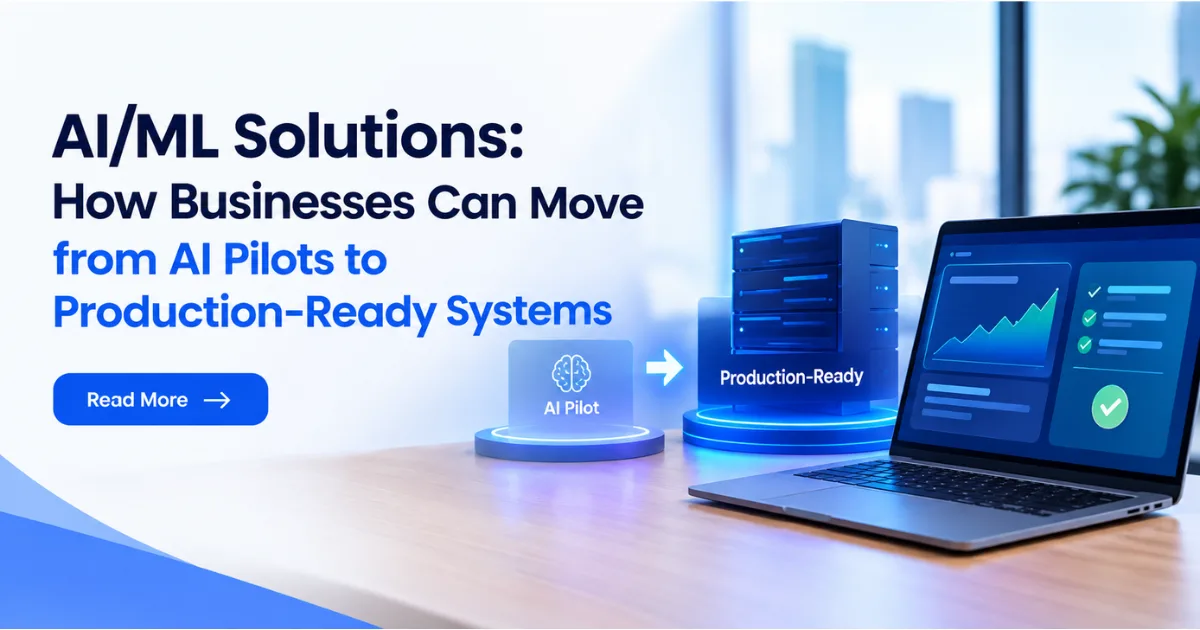
Most AI pilots work. That's the problem.
A demo runs on clean data, a handful of users, and a team that's watching it closely. It impresses the room. Then someone asks, "Can we roll this out to all branches by Q3?" and the project stalls for months, or quietly dies.
Moving from AI experimentation to enterprise deployment is where most of the real work sits. Businesses looking for AI software development in Dubai increasingly need to look past proof-of-concept builds and focus on systems that are scalable, secure, and ready for production from day one.
This guide covers why pilots stall, what a production-ready system actually includes, which use cases deliver the most value, and how to choose the right partner in the UAE and GCC.
What Are AI/ML Solutions?
AI/ML solutions are software systems that learn from data to predict outcomes, understand language, interpret images, generate content, or automate decisions. They fall into five broad groups:
- Machine learning: models that find patterns in structured data, such as forecasting demand or scoring credit risk.
- Natural language processing (NLP): systems that read, classify, and respond to text and speech.
- Computer vision: models that interpret images and video.
- Generative AI: large language models and related systems that produce text, code, summaries, and answers.
- AI automation: workflows where models trigger or complete tasks without manual handoffs.
Most real projects combine two or three of these. A claims-processing system, for example, might use computer vision to read scanned forms, NLP to extract fields, and ML to flag suspicious claims.
Businesses usually get better results when they work with an AI development company in the UAE that starts from the operational problem, not the technology. The useful first question isn't "Where can we use GenAI?" It's "Which process costs us the most time or money, and what data do we already have about it?"
Why Do AI Pilots Fail to Become Production Systems?
Pilots fail to scale mainly because they were built to prove an idea, not to run a business process. The same five problems show up again and again.
Poor data quality
Pilots often run on a curated sample. Production data is messier: missing fields, duplicate records, inconsistent formats, three different spellings of the same customer name. A model that scored well in testing can lose accuracy quickly once it meets real inputs.
Integration challenges
A model sitting in a notebook doesn't help a claims officer or a warehouse manager. It has to connect to the ERP, CRM, core banking system, or whatever the team already works in. Legacy systems, undocumented APIs, and siloed databases slow this down more than most teams expect.
Security and compliance
Pilots are often built on sample data with relaxed access controls. Once real customer or patient data enters the picture, you need access management, audit trails, encryption, and clarity on where data is stored and processed.
Lack of monitoring
Models degrade. Customer behavior shifts, fraud patterns change, new product lines appear. Without monitoring for drift and accuracy, a model can quietly get worse for months before anyone notices.
Unclear ROI
If nobody defined the success metric before the pilot started, nobody can justify the budget to scale it. "It works" isn't a business case. "It cut manual review time from 12 minutes to 4" is.
Here's the catch: all five of these are predictable. A custom AI development company in the UAE that plans for integration, security, monitoring, and measurement from the first sprint can avoid most of them. Treating deployment as something to figure out after the pilot is the most expensive habit in AI projects.
What Does a Production-Ready AI Solution Include?
A production-ready AI solution includes seven components: data engineering, model development, APIs and integration, deployment, monitoring, security, and governance. The model itself is often the smallest part.
- Data engineering: pipelines that collect, clean, validate, and version data automatically, so the model gets consistent inputs every day, not just during the demo.
- Model development: training, testing, and validating models against business metrics (not just technical accuracy), with documentation of what was tried and why.
- APIs and integration: clean interfaces that let the model plug into existing applications, dashboards, and workflows.
- Deployment: containerized, version-controlled releases with rollback options, running on cloud, on-premise, or hybrid infrastructure.
- Monitoring: live tracking of latency, accuracy, data drift, cost, and usage, with alerts when something moves outside normal range.
- Security: role-based access, encryption, secure model endpoints, and protection against issues like prompt injection in LLM applications.
- Governance: clear ownership, approval processes, audit logs, bias checks, and documented policies for how models are updated or retired.
This is where a machine learning company in Dubai earns its keep. Building a model is one skill. Deploying it, keeping it accurate, retraining it when data shifts, and supporting it for years is another. The best partners treat ML as a long-running service, not a handover project.
What Are the Most Common AI/ML Business Use Cases?
The most common enterprise use cases are predictive analytics, fraud detection, recommendation systems, document intelligence, AI copilots, and computer vision. Here's how each one tends to play out.
Predictive analytics
Forecasting demand, predicting equipment failure, estimating customer churn, scoring leads. Machine learning development services in Dubai are widely used here by retail, logistics, real estate, and financial firms, because the data usually already exists and the payoff is easy to measure.
Fraud detection
Models can score transactions in real time and flag unusual patterns that rule-based systems miss. Banks, payment providers, and insurers rely on this heavily, and it's a good example of why monitoring matters: fraudsters adapt, so models have to keep up.
Recommendation systems
E-commerce, hospitality, and media businesses use recommendation engines to suggest products, offers, or content based on behavior. Done well, they lift average order value and repeat visits without adding headcount.
Document intelligence
Contracts, invoices, KYC forms, medical records, customs paperwork. An experienced NLP development company can build systems that extract, classify, and summarize documents, including Arabic and mixed Arabic-English files. Related NLP applications include chatbots that handle first-line customer queries and intelligent search that lets staff ask questions across internal knowledge bases in plain language.
AI copilots
Internal assistants that help employees draft, search, summarize, and answer questions using company data. These work best when they're grounded in your own documents and connected to the tools your team already uses.
Computer vision
Cameras and image models can check products on a line, count inventory, spot safety violations, or read number plates. Computer vision development services are typically used for quality inspection, surveillance, object detection, and visual analytics in manufacturing, construction, retail, and logistics.
What Does the AI/ML Technology Stack Look Like?
A production AI stack has five layers: data, model, application, MLOps/LLMOps, and infrastructure. Weakness in any one of them limits the rest.
LayerWhat it coversData layerData lakes and warehouses, ETL pipelines, feature stores, vector databasesModel layerClassical ML models, deep learning, fine-tuned or foundation LLMsApplication layerAPIs, user interfaces, copilots, chatbots, workflow toolsMLOps / LLMOpsExperiment tracking, CI/CD for models, monitoring, evaluation, prompt and version managementInfrastructureCloud, private cloud, on-premise GPUs, hybrid setupsFor LLM-powered products, a generative AI development company in Dubai typically works across the model and application layers: choosing or fine-tuning the right model, building retrieval-augmented generation (RAG) so answers come from your data, designing copilots, and putting guardrails around outputs.
Just as important is fit with what you already run. A generative AI development company in the UAE should be able to connect GenAI to your existing identity systems, databases, document stores, and business applications, rather than asking you to rebuild around a new platform. A chatbot that can't see your CRM or knowledge base is a toy.
How Do AI/ML Solutions Work for UAE and GCC Businesses?
Regional businesses need AI that handles Arabic and English, respects data residency rules, fits specific industries, and can run in private or cloud environments. Four things matter most.
Arabic-English AI
Customers in the Gulf switch between Arabic and English, sometimes mid-sentence, and Arabic itself varies from Modern Standard to Gulf, Levantine, and Egyptian dialects. For any business serving a multilingual customer base, Arabic NLP customer service is a practical requirement, not a nice-to-have. Models that handle dialects, transliteration, and code-switching resolve more queries without escalating to a human agent.
Data residency
Sectors like banking, healthcare, and government often have strict rules about where data can be stored and processed. The UAE has federal data protection law, and free zones such as DIFC and ADGM have their own regimes. Saudi Arabia and other GCC states have separate requirements. Your provider should help you map these rules to your architecture, and your legal team should confirm the final position.
Industry-specific AI
Generic models rarely fit regional workflows. A logistics firm in Jebel Ali, a hospital group in Abu Dhabi, and a retail chain across the GCC each have different data, regulations, and risks. Experience in your sector shortens the path to something useful.
A computer vision development company with regional experience can support specific needs: safety monitoring on construction and industrial sites, shelf analytics and footfall tracking in retail, imaging support in healthcare, and parcel and container tracking in logistics. Businesses can also adopt computer vision solutions for automated inspection, continuous monitoring, analytics, and day-to-day operational efficiency.
Private and cloud deployment
Some workloads are fine on public cloud. Others, such as sensitive financial or patient data, may need private cloud or on-premise deployment. Many organizations end up with a hybrid: sensitive processing in a controlled environment, general workloads in the cloud. A good provider will help you decide per use case instead of pushing one model for everything.
How Do You Choose an AI/ML Solutions Provider?
Choose a provider that can show end-to-end delivery, not just model-building. Use this checklist when you're comparing options.
- Technical breadth: real experience across ML, NLP, computer vision, and generative AI, so they recommend the right approach instead of the one they happen to sell.
- Enterprise integration: a track record of connecting AI to ERPs, CRMs, and legacy systems through APIs.
- Security and compliance: clear practices for access control, encryption, audit logging, and regional regulations.
- MLOps/LLMOps: a defined process for monitoring, retraining, evaluation, and incident response after launch.
- Deployment flexibility: comfort with cloud, private, and hybrid environments.
- Industry experience: projects in your sector, with people who can talk about your workflows without a long briefing.
- Measurable ROI: willingness to agree on success metrics up front and report against them.
Then test the bigger question: can they support the full lifecycle? That means discovery, data assessment, model development, deployment, monitoring, optimization, and ongoing support. Ask for specifics. Who's on call if the model's accuracy drops? How often is it retrained? What does handover look like?
A provider who only talks about models and accuracy scores is describing the pilot. You're buying the production system.
Treat AI as a Production System, Not a One-Time Experiment
A pilot proves that an idea is possible. A production system proves it's useful, every day, at scale, under real conditions.
The businesses that get lasting value from AI tend to do the same few things well: they build on reliable data, design for integration early, put security and governance in place before launch, and monitor models continuously after it. None of this is glamorous. All of it decides whether the project survives its first year.
If you have an AI pilot that's stuck, or a use case you want to build the right way from the start, talk to our team about moving your AI initiative from pilot to production. We'll review your data, architecture, and goals, and give you a clear, practical roadmap.