A business owner spends two years climbing to position one on Google, only to watch a competitor with a worse ranking get recommended by ChatGPT instead. That scenario is playing out across industries right now.
This is the uncomfortable truth about using AI for SEO: the old playbook of backlinks, keyword density, and page-one rankings no longer guarantees anyone will actually find you. AI systems answer questions directly, and they don't always pull from the top-ranked page.
Understanding how AI for SEO actually works has become essential, not optional, for any business that wants to stay visible as search itself changes shape.
What Does AI for SEO Actually Mean Today?
AI for SEO refers to optimizing your content so AI-driven platforms like ChatGPT, Perplexity, and Google AI Overviews can understand, trust, and cite it directly.
It isn't a replacement for keyword research or technical SEO. It's an added layer that focuses specifically on how generative models parse and recommend information.
The shift matters because AI models don't browse ten results and pick one. They synthesize an answer from whatever sources they trust most, and that trust is earned through structure, not just rankings.
Why Are Old Ranking Tactics Losing Effectiveness for AI for SEO?
Ranking well on Google used to mean visibility. Today, ranking well doesn't automatically mean an AI model will cite you, because these systems weigh clarity and structure differently than search engines do.
A page stuffed with keywords but light on clear, factual structure often gets ignored by AI systems entirely, even if it ranks on page one of Google.
This is where I'll push back on a common assumption in the industry: more content isn't the answer. Most brands respond to this shift by publishing more, when what actually moves the needle is restructuring what already exists so machines can parse it cleanly.
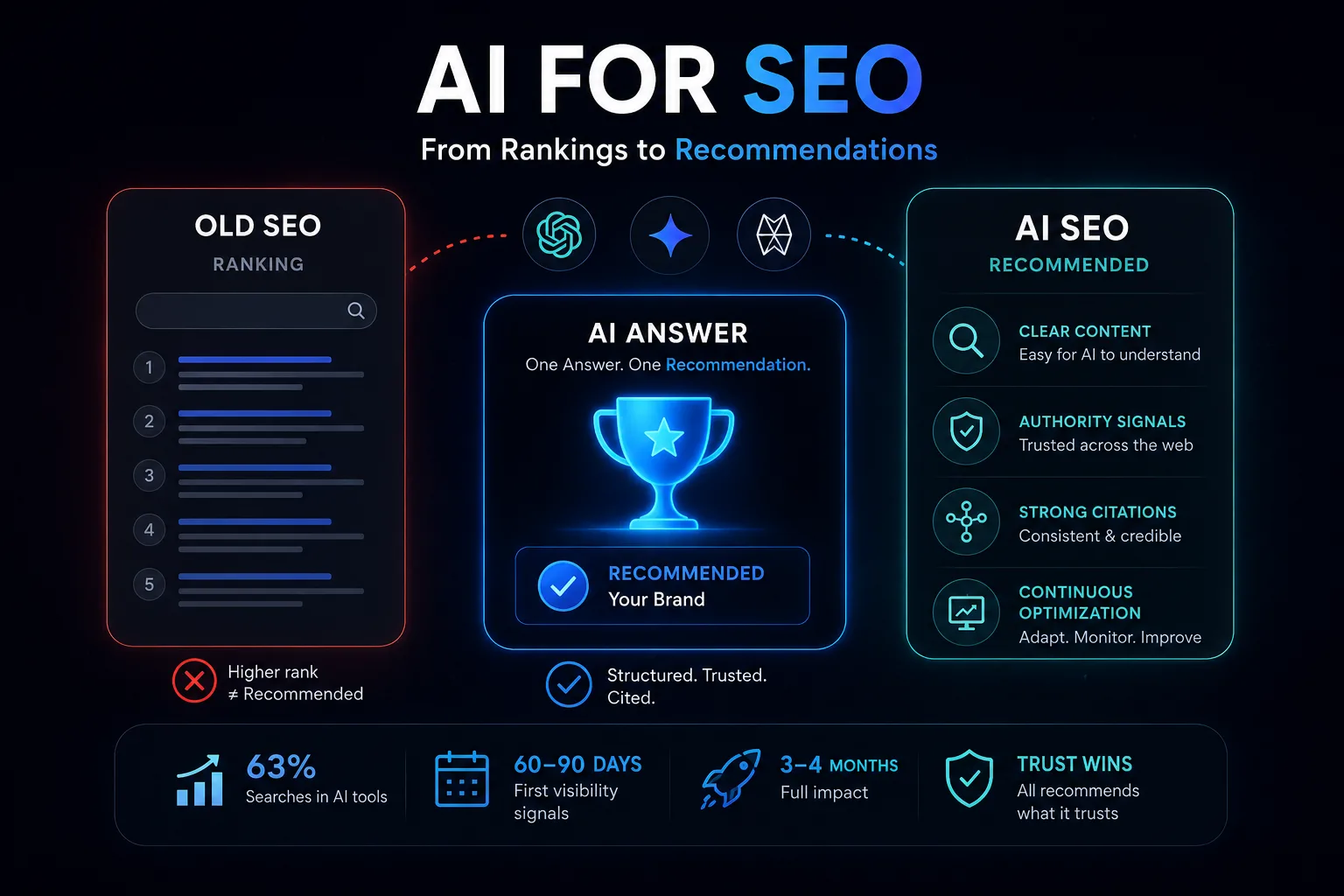
Roughly 63 percent of searches now happen inside AI tools rather than traditional engines, so this isn't a niche concern anymore. It's the mainstream behavior brands need to design for.
How Does AI for SEO Change What Ranking Even Means?
In traditional search, ranking is positional. You're first, fifth, or tenth, and users scroll through options before deciding.
With AI for SEO, there's often only one answer given, sometimes with a couple of alternatives mentioned in passing. Being the definitive citation matters more than occupying a specific numbered slot.
That single-answer format is also why trust signals carry more weight now than raw keyword optimization ever did. AI models are choosing who to vouch for, not just who ranks technically well.
What Should Your AI for SEO Strategy Actually Include?
A working strategy starts with an honest audit of how AI platforms currently describe your business, which is often surprisingly inaccurate or incomplete.
From there, content gets restructured around clear entities, direct answers, and schema markup that machines can parse without ambiguity. This is technical work, not just writing.
Citation building follows, reinforcing your brand's story consistently across the web so multiple sources back up the same facts. AI answers pull confidence from repetition of consistent information, not just a single well-optimized page.
Ongoing monitoring closes the loop, since AI models update constantly and a strategy that worked six months ago may already be outdated.
How Long Before AI for SEO Results Start Showing?
Most businesses start seeing early visibility signals within 60 to 90 days of restructuring their content properly. That's noticeably faster than the 6 to 12 months traditional SEO typically requires before meaningful movement appears.
One insurance brand grew AI mentions by 43 percent within just two and a half months, while a cybersecurity education provider pushed AI Overview mentions up by 579 over six months of sustained work.
Full, consistent visibility across multiple AI platforms typically takes three to four months, since trust compounds gradually rather than appearing overnight.
Is AI for SEO Worth It for Every Type of Business?
Not every business needs to obsess over this equally, but high-consideration categories like finance, healthcare, legal services, and real estate see the sharpest returns, since trust drives every purchase decision in those spaces.
Smaller local businesses benefit too, particularly when customers are already asking AI assistants conversational questions like "who's the best option near me."
The businesses least affected are ones with almost no digital footprint to begin with, though even they will eventually need this as AI-driven discovery becomes the default rather than the exception.
Old ranking tactics aren't useless, but they're no longer sufficient on their own. AI for SEO isn't a future trend to prepare for later. It's already reshaping who gets found today, and the brands treating it seriously now are the ones customers will actually hear about.