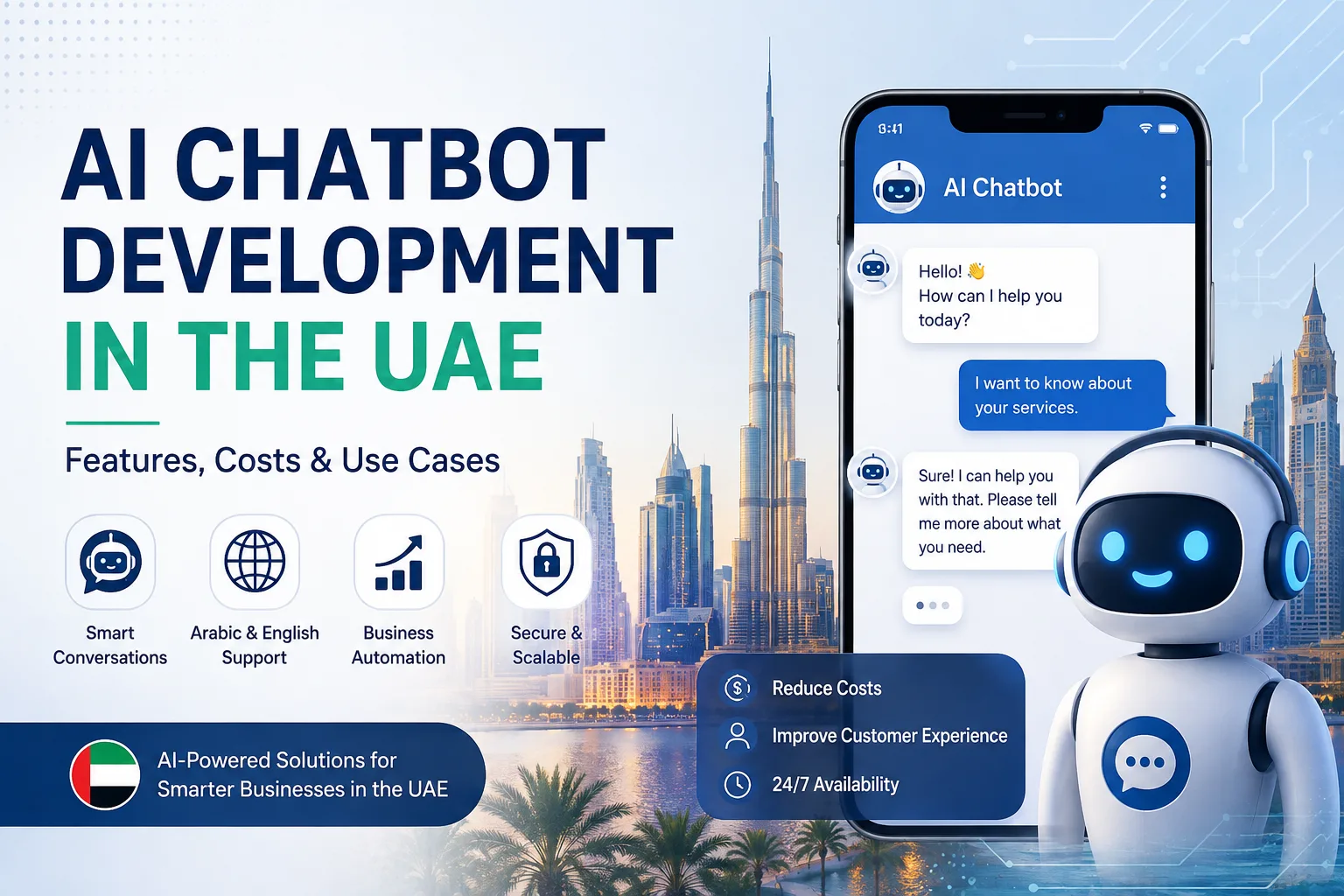
Businesses across the UAE are increasingly using AI chatbots to automate customer support, improve response times, qualify leads, and streamline internal operations. From healthcare and real estate to retail, banking, and professional services, AI-powered chatbots can handle routine conversations while allowing employees to focus on more complex tasks.
However, building an effective AI chatbot involves more than connecting a business website to an AI model. Companies need to consider business goals, data security, integrations, Arabic and English language support, scalability, and the overall user experience.
This guide explains AI chatbot development in the UAE, including key features, development costs, use cases, technology considerations, and how businesses can approach chatbot development.
What Is AI Chatbot Development?
AI chatbot development involves designing and building conversational software that can understand user questions and provide relevant responses using artificial intelligence.
Modern AI chatbots can use technologies such as:
- Large Language Models (LLMs)
- Natural Language Processing (NLP)
- Retrieval-Augmented Generation (RAG)
- Knowledge bases
- APIs and third-party integrations
- Voice and speech technologies
Customer Relationship Management (CRM) systems
Unlike traditional rule-based chatbots that rely on predefined buttons and scripts, AI-powered chatbots can understand natural-language questions and generate responses based on their training or connected business data.
For UAE businesses, this makes it possible to build chatbots that are customized around company information, services, workflows, and customer requirements.
Why Are UAE Businesses Investing in AI Chatbots?
Customer expectations have changed. Users increasingly expect businesses to respond quickly regardless of the time of day.
An AI chatbot can provide automated assistance without requiring a customer service representative to answer every repetitive question.
Some common business benefits include:
- 24/7 customer assistance
- Faster response times
- Automated lead qualification
- Reduced repetitive support workload
- Improved customer engagement
- Multilingual communication
- Automated appointment or enquiry handling
- Integration with existing business systems
- Better access to company information
The business case, however, depends on the chatbot's purpose. A simple FAQ chatbot and an enterprise AI assistant connected to CRM, ERP, or internal knowledge systems are very different projects.
Key Features of an AI Chatbot for UAE Businesses
1. Natural Language Understanding
Users should be able to ask questions naturally rather than follow rigid conversation flows.
For example, instead of selecting:
1. Services → 2. Pricing → 3. Contact
a user could ask:
"How much does your software development service cost?"
The chatbot can interpret the intent and provide the appropriate response.
2. Arabic and English Support
Multilingual support can be particularly valuable for businesses operating in the UAE.
Depending on the target audience, an AI chatbot can be designed to support:
- English
- Arabic
- Mixed-language conversations
- Industry-specific terminology
Arabic support should be tested carefully rather than assumed simply because an underlying AI model supports Arabic.
3. Knowledge Base Integration
Businesses can connect chatbots with approved information sources such as:
- Websites
- Product documentation
- FAQs
- Internal policies
- Service catalogs
- Manuals
- Knowledge bases
- Business documents
This allows the chatbot to provide answers based on company-specific information instead of relying solely on general AI knowledge.
4. RAG-Based Responses
Retrieval-Augmented Generation (RAG) can improve the usefulness of enterprise chatbots.
Instead of asking an AI model to answer from general knowledge, the system retrieves relevant information from a company's knowledge base and uses that information to generate a response.
A simplified workflow looks like:
User Question → Information Retrieval → Relevant Business Data → AI Response
This approach can be useful when businesses need their chatbot to answer questions about frequently changing or proprietary information.
5. CRM Integration
Connecting an AI chatbot with a CRM can help businesses automate lead-related workflows.
For example, a chatbot could:
- Ask the visitor about their requirements.
- Collect contact information.
- Identify the type of enquiry.
- Qualify the lead.
- Send the information to the CRM.
- Notify the relevant sales representative.
This turns a chatbot from a simple customer-support tool into a potential lead-generation channel.
6. Appointment and Booking Automation
Businesses can integrate chatbots with scheduling systems to help users:
- Request appointments
- Check availability
- Reschedule appointments
- Receive confirmations
- Get reminders
This can be useful for clinics, consultants, salons, real estate companies, and other appointment-driven businesses.
7. Human Handoff
AI should not necessarily handle every conversation.
A well-designed chatbot should recognize situations where a human employee needs to take over.
For example:
AI Chatbot → Identifies complex request → Collects relevant information → Transfers conversation to human agent
This creates a balance between automation and human support.
8. Analytics and Conversation Monitoring
Businesses can use analytics to understand:
- Most frequently asked questions
- Conversation volume
- Lead-generation performance
- Unanswered questions
- Customer intent
- Escalation rates
- Common support problems
These insights can help teams continuously improve their chatbot.
AI Chatbot Use Cases in the UAE
AI chatbots can be adapted to different industries and business processes.
Healthcare
Healthcare organizations can use chatbots for non-diagnostic administrative tasks such as:
- Appointment enquiries
- Department information
- Clinic timings
- Patient FAQs
- Service information
- Appointment reminders
- Basic navigation of healthcare services
Healthcare implementations require particular attention to privacy, security, access controls, and applicable UAE healthcare requirements.
Real Estate
Real estate companies can use AI chatbots to:
- Answer property enquiries
- Recommend properties based on requirements
- Collect buyer or tenant preferences
- Qualify leads
- Schedule property viewings
- Provide project information
For example, a visitor could ask:
"Show me two-bedroom apartments available in Dubai within my budget."
The chatbot could retrieve matching information from the company's property database if the appropriate integration is available.
Banking and Financial Services
Potential applications include:
- General product information
- FAQ automation
- Service navigation
- Customer enquiry routing
- Application status information
Financial services require stronger controls around authentication, sensitive information, data handling, and human escalation.
Retail and E-commerce
Retail businesses can use AI chatbots for:
- Product discovery
- Order tracking
- Returns and exchanges
- Product FAQs
- Customer support
- Personalized recommendations
Travel and Hospitality
Hotels and travel businesses can use chatbots for:
- Room enquiries
- Booking assistance
- Check-in information
- Hotel facilities
- Local information
- Guest support
Government and Public Services
AI assistants can help users navigate large volumes of public information, FAQs, procedures, and service information.
For such applications, maintaining accurate and current information is especially important.
Internal Business Operations
AI chatbots don't have to be customer-facing.
Organizations can build internal AI assistants that help employees find information about:
- HR policies
- IT procedures
- Company documentation
- Training materials
- Internal processes
- Product documentation
How Much Does AI Chatbot Development Cost in the UAE?
The cost of developing an AI chatbot in the UAE can vary significantly depending on its complexity.
A basic chatbot with limited FAQs and a simple website integration requires considerably less development than an enterprise AI assistant connected to multiple systems.
Indicative AI Chatbot Development Cost
Chatbot TypeTypical ComplexityIndicative Cost*Basic AI FAQ chatbotWebsite + knowledge baseAED 15,000–30,000Business AI chatbotRAG + integrations + analyticsAED 30,000–70,000Advanced AI assistantCRM/API integrations + workflowsAED 70,000–150,000+Enterprise AI chatbotMultiple systems + advanced securityAED 150,000+*These are indicative development ranges, not fixed UAE market prices or quotations. Actual costs depend on requirements, integrations, AI model usage, data preparation, security requirements, UI/UX, testing, and ongoing maintenance.
What Influences AI Chatbot Development Cost?
Several factors affect the final budget.
1. Chatbot complexity
A scripted FAQ assistant is much simpler than an AI agent capable of performing business actions.
2. AI model
Costs can vary depending on whether the project uses a third-party LLM API, an open-source model, or a customized model architecture.
3. Knowledge base
The amount and quality of business information that needs to be processed can affect development time.
4. Integrations
CRM, ERP, booking systems, payment platforms, databases, and other APIs can increase development complexity.
5. Languages
Supporting both Arabic and English may require additional testing, UX considerations, and language-specific optimization.
6. Security requirements
Applications handling sensitive business or customer information may require additional security controls, authentication, logging, access management, and testing.
7. AI agent capabilities
A chatbot that only answers questions is generally simpler than an AI agent that can take actions such as creating tickets, checking records, booking appointments, or updating CRM information.
AI Chatbot vs Traditional Chatbot
The two approaches serve different purposes.
FeatureTraditional ChatbotAI ChatbotPredefined responsesYesNot necessarilyNatural-language understandingLimitedAdvancedContext awarenessLimitedStrongerKnowledge-base integrationPossibleCommonGenerative responsesNoYesComplex questionsLimitedBetter suitedPersonalizationBasicAdvancedBusiness integrationsYesYesDevelopment complexityLowerHigherA traditional chatbot can still be the right choice when the business has a small number of predictable workflows.
AI is more valuable when customers ask open-ended questions or when the chatbot needs to work with large amounts of business information.
AI Chatbot Development Process
A reliable chatbot should be developed around business requirements rather than starting with the AI model.
Step 1: Define the Business Objective
First determine what the chatbot needs to accomplish.
Examples:
- Generate leads
- Reduce support tickets
- Answer customer questions
- Automate appointments
- Support employees
- Provide product recommendations
Step 2: Identify the Target Users
Define who will interact with the chatbot.
This could include:
- Customers
- Patients
- Employees
- Website visitors
- Sales prospects
- Partners
Step 3: Prepare the Knowledge Base
Collect and organize the information the chatbot is expected to use.
Poor-quality or outdated information can lead to poor chatbot responses, regardless of how advanced the AI model is.
Step 4: Select the AI Architecture
Depending on requirements, the solution may use:
- LLM APIs
- RAG
- Vector databases
- NLP services
- AI agents
- Custom business logic
Step 5: Build Integrations
The chatbot can be connected to relevant systems such as:
- CRM
- ERP
- E-commerce platforms
- Booking systems
- Databases
- Helpdesk software
- Internal APIs
Step 6: Test Responses
Testing should cover normal questions, ambiguous requests, unsupported questions, multilingual conversations, incorrect inputs, and escalation scenarios.
Step 7: Deploy and Monitor
After deployment, businesses should monitor chatbot conversations and continuously improve the knowledge base, prompts, workflows, and integrations.
Technology Stack for AI Chatbot Development
The technology stack depends on the project requirements.
A typical architecture may include:
Frontend: React, Next.js, Flutter, or native mobile technologies
Backend: Node.js, Python, or other suitable backend frameworks
AI Layer: LLM APIs or open-source models
RAG: Embedding models + vector database + retrieval pipeline
Database: PostgreSQL, MongoDB, or another appropriate database
Integrations: REST APIs, webhooks, CRM/ERP APIs
Cloud: AWS, Microsoft Azure, Google Cloud, or other suitable infrastructure
The best stack should be selected based on the chatbot's security, scalability, performance, integration, and budget requirements—not simply because a particular technology is popular.
Security and Compliance Considerations in the UAE
Businesses should treat AI chatbot security as part of the architecture from the beginning.
Depending on the application, considerations may include:
- Data encryption
- Authentication and authorization
- Role-based access
- Secure API communication
- Data retention policies
- Audit logging
- Access controls
- Secure cloud infrastructure
- Protection against prompt injection
- Monitoring for inappropriate AI responses
For regulated sectors such as healthcare and financial services, organizations should also assess the specific regulatory and data-protection requirements applicable to their business and use case.
How to Choose an AI Chatbot Development Company in the UAE
Before selecting a development partner, businesses should evaluate more than a company's ability to build a chatbot demo.
Consider:
Relevant AI Experience
Look for experience with LLM applications, RAG, AI agents, NLP, and enterprise integrations.
Industry Knowledge
A development team familiar with your industry can better understand workflows, security requirements, and user expectations.
Integration Capabilities
Ask whether the company can integrate the chatbot with your existing CRM, ERP, databases, APIs, or business platforms.
Security Approach
Ask how user data, business information, authentication, access control, and AI-generated responses will be protected.
Post-Launch Support
AI applications require ongoing monitoring and optimization. Clarify what maintenance and support will be available after launch.
Transparent Pricing
Request a breakdown covering development, integrations, AI infrastructure, testing, deployment, and ongoing operational costs.
Why Work With an AI Development Company?
Building an AI chatbot using an off-the-shelf tool can be suitable for simple use cases. However, businesses with more complex workflows may need a custom solution.
A development partner can help with:
- AI architecture
- Custom chatbot development
- RAG implementation
- AI agent development
- API integrations
- CRM/ERP integration
- Web and mobile deployment
- Security implementation
- Testing
- Maintenance and optimization
RowthTech's AI GCC services focus on developing customized AI solutions for businesses operating in the GCC, including AI applications, AI agents, RAG-based solutions, LLM integrations, and AI-powered web and mobile applications.
Frequently Asked Questions
How much does it cost to build an AI chatbot in the UAE?
A basic AI chatbot may start around AED 15,000–30,000, while more advanced business and enterprise solutions can cost AED 70,000 to AED 150,000+. The final price depends on integrations, AI architecture, languages, security, and functionality.
How long does it take to develop an AI chatbot?
A basic chatbot can potentially be developed within a few weeks, while an enterprise-grade chatbot with RAG, integrations, authentication, and advanced workflows can take several months.
Can an AI chatbot support Arabic?
Yes. AI chatbot applications can be designed to support Arabic and English. However, Arabic responses should be tested for language quality, terminology, regional usage, and the specific business context.
Can an AI chatbot connect to a CRM?
Yes. A custom AI chatbot can connect to CRM systems through APIs or other integration methods to support lead capture, customer lookup, ticket creation, and other approved workflows.
Is RAG necessary for an AI chatbot?
Not always. RAG is particularly useful when a chatbot needs to answer questions using frequently updated, proprietary, or domain-specific information.
Can an AI chatbot be integrated into a mobile app?
Yes. AI chatbot functionality can be integrated into iOS, Android, Flutter, React Native, and other mobile applications through APIs or a backend AI layer.
Final Thoughts
AI chatbots are moving beyond simple customer-support widgets. For UAE businesses, they can become practical digital assistants capable of answering questions, supporting customers, qualifying leads, retrieving business information, and connecting users with internal systems.
The right approach depends on the business objective. A company should first identify the problem it wants to solve, then select the appropriate AI model, knowledge architecture, integrations, security controls, and user experience.
For organizations considering a custom AI chatbot or AI-powered business solution in the UAE and wider GCC, starting with a clearly defined use case and measurable business outcome is often the best first step.
👉 Looking to build an AI chatbot for your UAE or GCC business? Explore RowthTech AI GCC Solutions