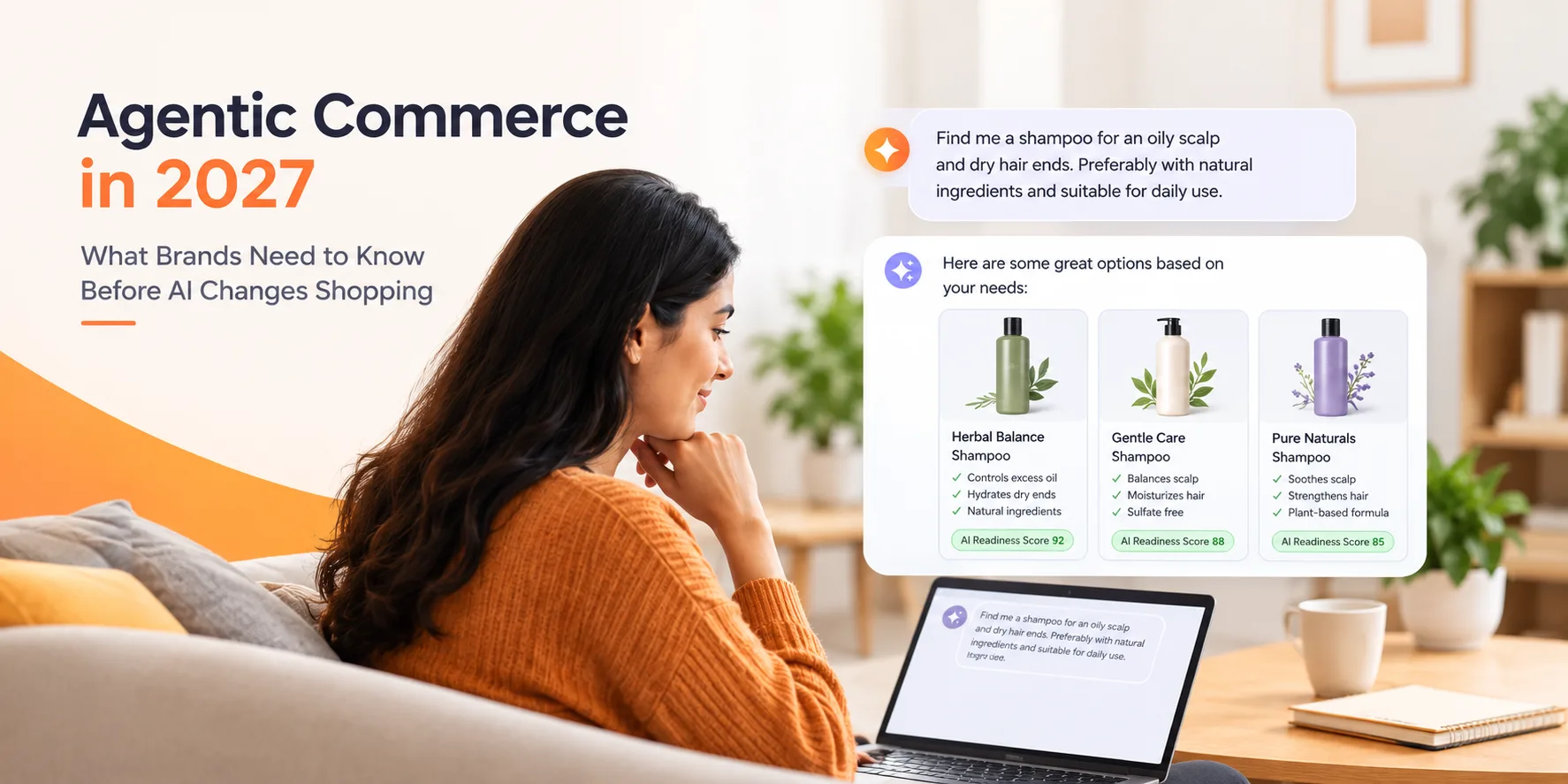
Ecommerce product discovery is changing. Shoppers are no longer relying only on search bars, category pages, and filters. AI shopping assistants increasingly helps them compare products, answer questions, and find what best fits their needs. This makes complete product data more important than ever!
That creates a new challenge for ecommerce brands: AI can only recommend what it can understand from your product data.
If your product page leaves important details unclear, incomplete, or inconsistent, an AI system may struggle to determine where your product fits. The problem is not necessarily that the product is poor. The problem is that the product data does not explain its value clearly enough.
Product Data Is Becoming the Language of AI Shopping
Traditional ecommerce content was largely written for human shoppers. A product title, description, images, specifications, and reviews helped people decide whether to buy.
AI shopping systems have a different job. They need to interpret product information and connect it with a shopper's specific intent.
Consider a shopper looking for a shampoo for an oily scalp that is also sulfate-free and suitable for frequent use.
A product page might simply say:
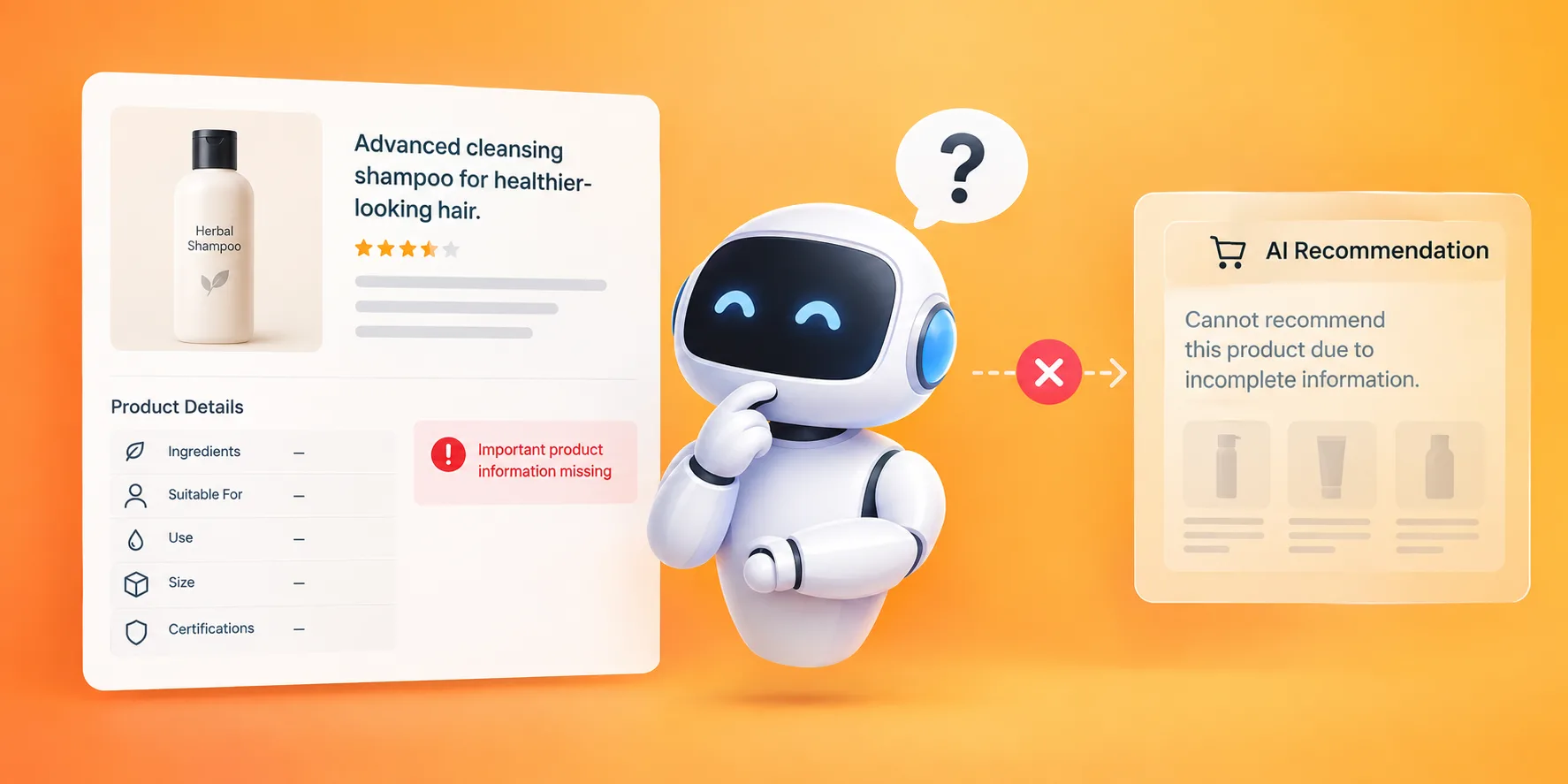
“Advanced cleansing shampoo for healthier-looking hair.”
That sounds reasonable to a person, but it does not answer several important questions.
Is it actually sulfate-free? Is it designed for oily scalps? Can it be used daily? What hair types is it intended for?
When those attributes are missing, ambiguous, or buried in unrelated content, the AI has less information to work with.
Missing Attributes Can Become Missing Recommendations
AI recommendations depend heavily on product attributes.
Depending on the category, these might include ingredients, dimensions, compatibility, material, use case, skin or hair type, dietary properties, technical specifications, certifications, or intended audience.
When these attributes are incomplete, AI may not confidently connect a product to a shopper's request.
For example, a furniture product might have a detailed description but fail to clearly state whether it is suitable for small apartments. A laptop may list its processor but not clearly explain battery life. A skincare product may describe its benefits without explicitly identifying the skin types it is formulated for.
The information may exist somewhere on the website, but if it is difficult to interpret or inconsistent across product fields, it becomes harder for AI systems to use.
Product Content Needs More Than Keywords
Adding more keywords is not the solution.
AI shopping systems need clear, structured, and consistent product information that explains what a product is, who it is for, what it does, and how it differs from alternatives.
That means ecommerce teams should look beyond traditional keyword optimization.
A stronger product page might clearly define:
- Core product attributes
- Use cases and applications
- Compatibility
- Materials or ingredients
- Size and dimensions
- Key benefits
- Limitations or exclusions
- Target audience
- Certifications and specifications
- Frequently asked pre-purchase questions
The goal is not to write more content for the sake of volume. It is to remove uncertainty.
Consistency Matters Across the Catalog
Another challenge is inconsistency.
One SKU may describe ingredients in a structured format, while another puts them inside a paragraph. One product may specify dimensions in centimeters, while another uses inches. Some products may identify compatibility clearly, while others leave it vague.
For humans, this creates friction. For AI systems processing hundreds or thousands of products, inconsistent data can make comparison and interpretation more difficult.
A strong ecommerce catalog should communicate product information consistently across SKUs, categories, and channels.
This Is Where ACO Comes In
This is the shift from traditional ecommerce optimization toward Agentic Commerce Optimization (ACO).
ACO focuses on whether product content is sufficiently complete, understandable, and structured for AI-driven shopping experiences.
Instead of asking only, “Can shoppers find this product on Google?”, brands increasingly need to ask:
“Can an AI shopping agent understand this product well enough to recommend it for the right intent?”
That requires auditing product information for gaps, ambiguity, missing attributes, inconsistent terminology, and weak explanations.
It also means thinking about the questions shoppers are likely to ask AI before they purchase.
Make Your Product Easier for AI to Explain
Your product data should make the recommendation easier, not harder.
When product information clearly explains what a product is, what it does, who it is for, and when it should be chosen, AI systems have more context to work with. Clear attributes, consistent product information, and complete descriptions help reduce the gaps that can prevent AI from confidently understanding a product.
This is where Enaiblex approaches ecommerce content through Agentic Commerce Optimization (ACO). By helping brands identify product data gaps and improve how product information is structured and explained, Enaiblex helps make catalogs more understandable for AI-driven shopping experiences.
The future of ecommerce discovery will not be determined only by how much product content a brand publishes. It will increasingly depend on how well that content can be understood and used by AI.
Because if your product data fails to explain your product, AI has less to recommend.