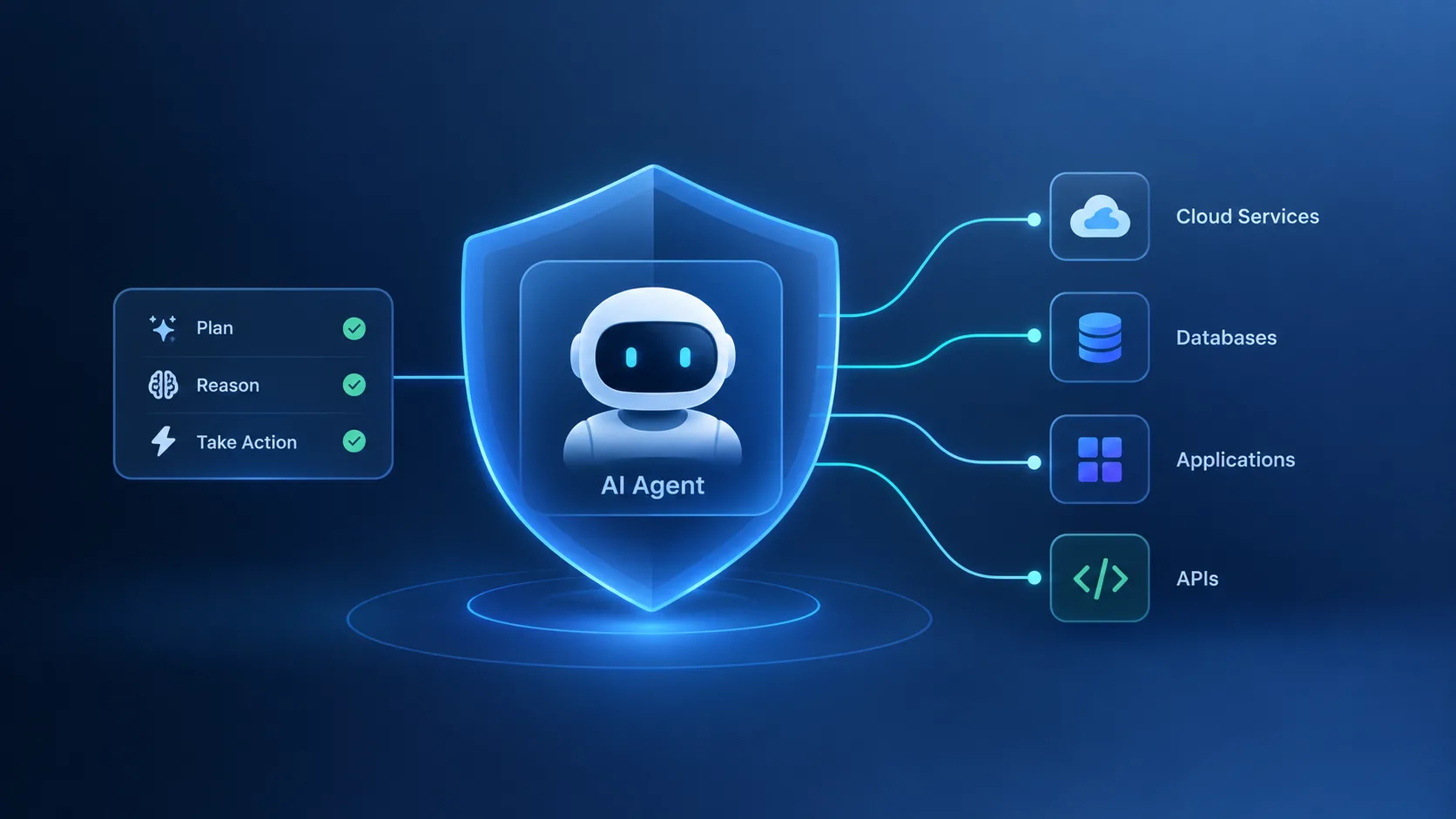
An AI agent that passes its demo is not an AI agent that is ready for production. In a demo, the inputs are friendly, the tools are sandboxed, and nobody is trying to break anything. In production, the agent reads emails written by strangers, calls tools with real credentials, and acts on data nobody has reviewed.
That gap is why AI agent security has become a go-live gate rather than an afterthought. Traditional application security assumes predictable inputs and bounded outputs. Agents break both assumptions: they perceive, plan, call tools, hold memory, and take actions on their own. Every one of those steps is an attack surface.
This guide covers the ten AI agent security risks enterprises should address before an agent reaches real users and real data. For each, you will see what the risk is, why it matters, and what to verify before launch. Throughout, one theme repeats: most of these risks can only be found by testing agent behavior, which is why AI evaluation belongs at the center of any pre-launch security process.
Why AI Agent Security Is Different From Application Security
A conventional application does what its code says. An agent does what its model decides, informed by whatever text, tool output, and memory it encounters. Three consequences follow.
- Instructions and data share a channel. An agent cannot reliably tell the difference between a user request and a command hidden inside a document it was asked to summarize.
- Authority is delegated. Agents act with credentials that humans granted them, so a manipulated agent becomes a privileged insider.
- Behavior changes over time. Memory, model updates, and new tools mean an agent that was safe last month may not be safe today.
The OWASP Top 10 for Agentic Applications was created for this reason: agent risks need their own taxonomy. If you are mapping your program to it, Trusys maintains a reference at trusys.ai/owasp-top-10.
Risk 1: Prompt Injection (Direct and Indirect)
Prompt injection is the defining AI agent security risk. In the direct form, a user types instructions designed to override the agent’s rules. In the indirect form, which is more dangerous, the malicious instruction is hidden in content the agent processes: a web page, a PDF, an inbound email, a support ticket.
The indirect form requires no access to your systems. The attacker only needs the agent to read something they control.
Verify before go-live:
- Test the agent against both direct and indirect payloads across every input channel it touches.
- Treat all retrieved and tool-returned content as untrusted.
- Confirm that high-impact actions are not triggered solely by externally sourced text.
Risk 2: Excessive Permissions and Over-Privileged Access
Agents are often given broad access because it is faster than scoping it properly: a service account with read-write access to the whole CRM, or an API key that can touch every environment.
When an over-privileged agent is manipulated, the blast radius is whatever the agent could reach, not whatever the task needed.
Verify before go-live:
- Apply least privilege per agent and per task.
- Separate read and write scopes, and require approval for destructive actions.
- Review every tool the agent can call and remove the ones it does not need.
Risk 3: Tool Misuse and Unauthorized Actions
Agents execute actions through tools: sending email, updating records, running code, moving money. The risk is not only that a tool is abused by an attacker, but that the agent uses a legitimate tool in a way nobody intended, such as chaining three harmless calls into a harmful outcome.
These failures are hard to spot in code review because each individual call looks valid.
Verify before go-live:
- Test multi-step workflows, not just single tool calls.
- Define allowed parameter ranges and rate limits for each tool.
- Log every tool invocation with the context that triggered it.
Risk 4: Data Leakage and Confused-Deputy Exfiltration
In a confused-deputy attack, an agent with legitimate access to sensitive data is tricked into sending it somewhere it should not go, using its own tools. The agent is not hacked in the traditional sense. It is persuaded.
Because the data leaves through approved channels, traditional network and endpoint controls often see nothing unusual.
Verify before go-live:
- Map every egress path the agent has: email, webhooks, file exports, external APIs.
- Enforce data-classification rules on agent outputs.
- Red-team specifically for exfiltration scenarios before go-live.
Where Trusys fits: Platforms like Trusys TruScout test agents the way attackers actually attack them, through poisoned emails, hostile websites, malicious documents, and compromised tool responses, with campaigns mapped to the OWASP Agentic AI Top 10 and MITRE ATLAS.
Risk 5: Memory and RAG Poisoning
Agents that retain memory or retrieve from knowledge bases can be fed fabricated content that they later treat as verified fact. A single poisoned document in a retrieval index can influence many future answers and actions.
The damage is delayed and persistent, which makes it difficult to trace back to a source.
Verify before go-live:
- Control who and what can write to memory stores and knowledge bases.
- Validate and version retrieval sources.
- Include poisoned-document scenarios in your pre-launch AI evaluation suite.
Risk 6: Behavioral Drift Across Sessions and Updates
An agent’s behavior is not fixed at deployment. Accumulated memory, prompt edits, model version changes, and new tool integrations can shift how it decides. A control that held in testing may quietly stop holding.
Point-in-time sign-off cannot catch this. It requires a baseline and continuous comparison against it.
Verify before go-live:
- Record behavioral baselines before launch.
- Re-run evaluations on every model, prompt, or tool change.
- Plan production monitoring that detects deviation from the baseline.
Risk 7: Multi-Agent Trust and Cascading Failures
In multi-agent systems, agents often trust each other implicitly. A compromised or confused low-privilege agent can pass a malicious instruction to a higher-privilege one, and one error can cascade through the whole chain.
Security reviews that examine agents one at a time miss these inter-agent paths entirely.
Verify before go-live:
- Draw the full agent-to-agent communication map.
- Authenticate and authorize messages between agents, not just between users and agents.
- Evaluate the system end to end, including delegation and hand-offs.
Risk 8: Shadow Agents and Weak Agent Identity
Employees connect assistants to internal systems, enable AI features inside SaaS tools, and spin up agent frameworks without involving security. Meanwhile, sanctioned agents often share credentials or run under generic service accounts.
You cannot secure, audit, or revoke what you cannot identify.
Verify before go-live:
- Build and maintain an inventory of every agent, its owner, tools, data access, and credentials.
- Issue unique, revocable identities per agent.
- Make sure the inventory is part of the go-live checklist, not a later project.
Risk 9: Supply Chain and Third-Party Component Risk
Agents depend on models, plugins, open-source packages, and tool servers, including those exposed through the Model Context Protocol. A malicious or compromised component, such as a tool whose description carries hidden instructions, inherits the agent’s authority.
The agent’s security is only as strong as the least-reviewed thing it connects to.
Verify before go-live:
- Vet and pin every third-party tool, plugin, and MCP server.
- Scan agent code and dependencies before release.
- Test how the agent behaves when a tool returns hostile or malformed output.
Risk 10: No Audit Trail, Oversight, or Regulatory Evidence
When an agent does something unexpected, teams need to answer four questions fast: what triggered it, what data did it touch, which tools did it call, and what did it produce. Without full lineage, incident response becomes guesswork.
It is also a compliance problem. Regulators and auditors increasingly expect evidence that AI systems were tested and are overseen, not just assurances.
Verify before go-live:
- Capture traces with full action lineage from day one.
- Define escalation paths and human-in-the-loop approvals for high-impact actions.
- Keep versioned evaluation results as audit evidence.
How AI Evaluation Turns These Risks Into a Go-Live Gate
Reading the list above, a pattern emerges. Almost every risk is a behavioral risk. A code scanner will not tell you whether an agent can be talked into exfiltrating data. A prompt benchmark will not tell you whether a three-step tool chain ends badly. Only structured AI evaluation, run against realistic and adversarial scenarios, answers those questions.
Effective AI evaluation for agent security covers more than prompt-and-response accuracy. It should assess:
- Tool use and parameter handling across multi-step workflows
- Multi-turn reasoning and resistance to injected instructions
- Memory persistence and exposure to poisoned content
- Sub-agent delegation and inter-agent collaboration
- Behavior on edge cases, hostile inputs, and failures
Trusys TruEval is built for this kind of behavioral AI evaluation. It evaluates how agents actually behave across tool use, multi-turn reasoning, memory, and delegation, supports text, voice, image, and agentic applications, and produces regulator-ready reports with 75+ scoring metrics. Teams can use it to set a pass/fail bar before launch and re-run the same suite whenever the agent changes.
Evaluation finds problems before launch. Runtime controls contain what testing cannot anticipate. In the Trusys platform, TruGuard enforces policy inline at the agent’s input, output, and action layers, TruPulse traces every action in production with full lineage, and Argus orchestrates continuous evaluation, monitoring, and red-teaming so governance does not depend on a one-time review.
One boundary worth stating plainly: Trusys governs AI systems your organization owns and operates. It is not a tool for assessing AI that third-party vendors embed inside their own products.
A Go-Live Readiness Checklist for AI Agent Security
Use this as a launch gate. If any item cannot be answered with evidence, the agent is not ready.
- Inventory: Is the agent registered, with a named owner, tool list, data scope, and unique identity?
- Permissions: Is every credential scoped to the minimum needed, with approvals for destructive actions?
- Injection testing: Have direct and indirect injection payloads been tested across all input channels?
- Exfiltration testing: Have egress paths been mapped and red-teamed?
- Memory and retrieval: Are write access and sources controlled, with poisoning scenarios evaluated?
- Behavioral baseline: Is there a recorded AI evaluation baseline to compare future changes against?
- Multi-agent paths: Are agent-to-agent messages authenticated and tested end to end?
- Third-party components: Are tools, plugins, and MCP servers vetted and version-pinned?
- Runtime controls: Are guardrails and monitoring live before the first user, not after the first incident?
- Evidence and response: Are traces, evaluation results, and an incident runbook ready for auditors and responders?
Conclusion: Make AI Agent Security a Launch Criterion
Agents are autonomous, so security cannot be a checkbox completed once. The ten risks above share a root cause: organizations test whether an agent works and skip testing whether it can be made to misbehave. Closing that gap means treating AI agent security as a launch criterion, backed by AI evaluation that measures real behavior and by continuous controls after go-live.
If you are preparing an agent for production, Trusys can help you evaluate, red-team, and govern it before it ships. Book a Trusys demo to see how.
Frequently Asked Questions
What is AI agent security?
AI agent security is the practice of protecting autonomous AI systems, meaning systems that plan, use tools, hold memory, and take actions, from manipulation, misuse, and failure. It covers the agent’s inputs, permissions, tools, memory, outputs, and runtime behavior, not just the underlying model.
Why is AI agent security different from LLM security?
LLM security focuses on what a model says. AI agent security also covers what an agent does. Because agents execute actions with real credentials, a successful attack can change records, move data, or trigger transactions rather than just produce bad text.
What is the biggest AI agent security risk?
Prompt injection, particularly indirect injection through content the agent reads, is widely treated as the defining risk because it can drive several other risks, including tool misuse and data exfiltration. In practice, over-permissioned agents determine how much damage any attack can cause.
How does AI evaluation improve AI agent security?
AI evaluation tests agent behavior against realistic and adversarial scenarios before launch, such as injection attempts, tool-chain abuse, and poisoned memory. It produces a repeatable baseline so teams can re-test after every model, prompt, or tool change.
Is a one-time penetration test enough before go-live?
No. Agent behavior changes with memory, updates, and new tools, so point-in-time testing goes stale. Pair pre-launch testing with continuous evaluation and runtime monitoring.
What should an enterprise do first?
Start with an inventory of every agent, its owner, tools, data access, and credentials. Then scope permissions, run adversarial evaluation, and set up runtime guardrails and tracing before launch.
How does Trusys support AI agent security?
Trusys provides TruEval for AI evaluation, TruScout for adversarial red-teaming, TruGuard for inline guardrails, and TruPulse for runtime observability, orchestrated by Argus. It is designed for AI systems your organization owns and operates.
How long does it take to connect an agent to Trusys?
Per the Trusys site, most agents are connected in under 10 minutes: SaaS agents via API, custom agents via SDK, and coding agents via MCP.