Introduction
Artificial intelligence is becoming a bigger part of the way businesses work. From automating everyday tasks to improving customer experiences and supporting better decisions, AI is helping organizations find new ways to work smarter. But successfully adopting AI involves much more than simply choosing a tool and putting it into operation.
Businesses need to understand where AI can actually add value, what resources they will need, and how they can manage the risks that come with the technology. This is where an AI Adoption Framework in detail can make a real difference.
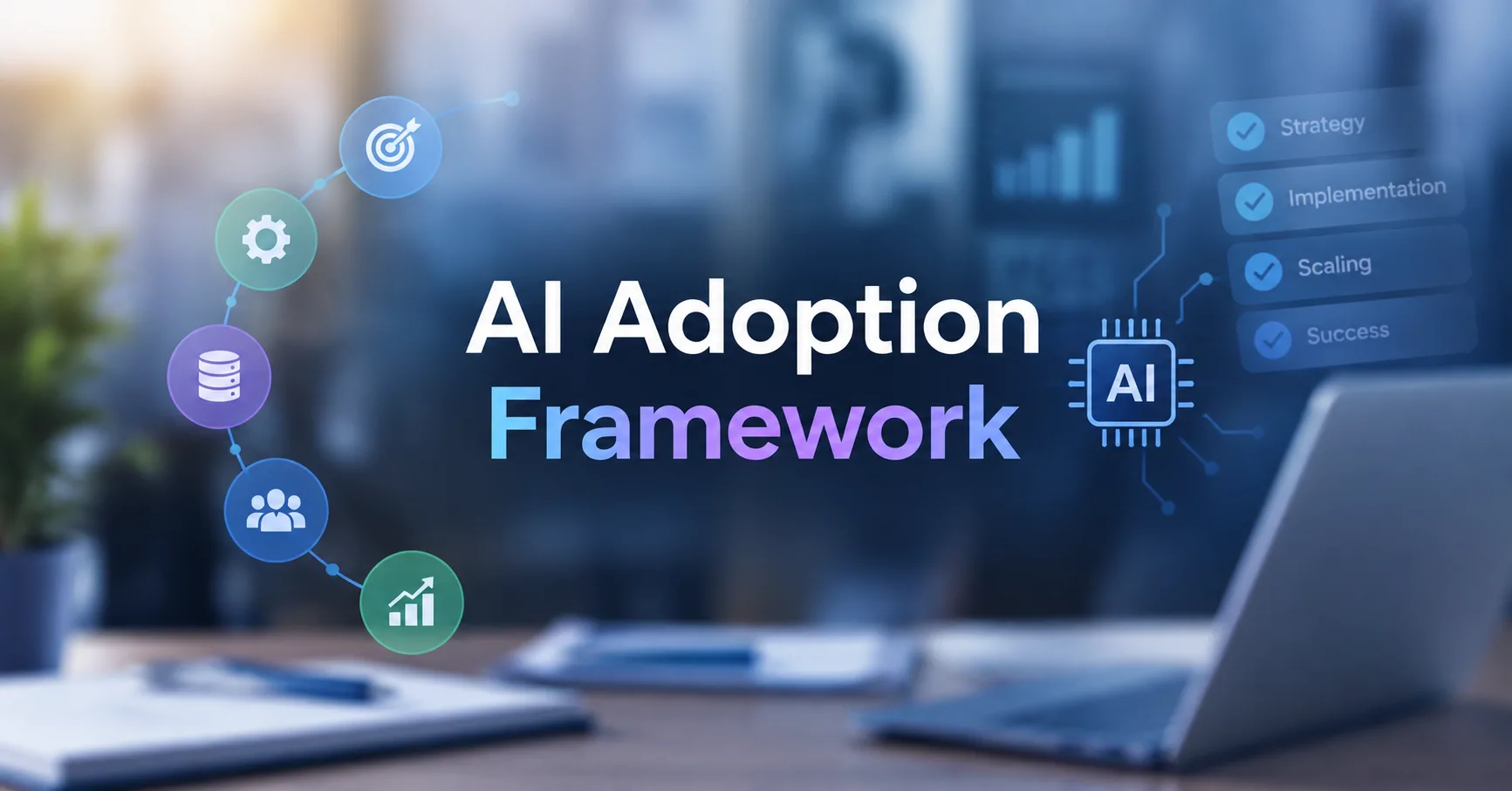
An AI adoption framework gives organizations a practical roadmap for introducing AI in a structured and sustainable way. It can help businesses identify the right opportunities, test potential solutions, deploy them effectively, measure their results, and scale the initiatives that prove successful.
It also helps bring different teams onto the same page. Business leaders, IT teams, data professionals, security specialists, and employees can work toward shared goals instead of adopting AI tools independently. With a clear plan in place, organizations can make the transition to AI smoother and build a stronger foundation for future growth.
What Is an AI Adoption Framework?
An AI adoption framework is essentially a roadmap that helps an organization plan and manage its journey toward using artificial intelligence.
It brings together important areas such as business strategy, data, technology, employee skills, security, governance, implementation, and performance measurement. Instead of looking at AI as a one-time technology project, a framework treats adoption as an ongoing process.
This approach gives businesses room to start small, learn from their experiences, improve their processes, and gradually expand AI into other areas of the organization.
Why Do Businesses Need an AI Adoption Framework?
AI can offer significant benefits, but jumping into implementation without a plan can lead to wasted resources, security concerns, and projects that fail to deliver meaningful results. A well-defined framework helps businesses avoid these problems and approach AI adoption with greater confidence.
Aligning AI With Business Goals
Before investing in AI, businesses should first ask a simple question: What problem are we trying to solve?
AI initiatives should connect to clear business objectives, whether that means improving customer service, reducing costs, increasing employee productivity, or making faster and more informed decisions.
Improving Resource Planning
AI adoption involves more than buying software. Organizations may need reliable data, suitable infrastructure, technical expertise, employee training, and ongoing support.
A framework helps businesses understand these requirements early, making it easier to plan budgets, assign responsibilities, and prepare teams for implementation.
Managing Risks
AI can bring challenges involving data privacy, cybersecurity, inaccurate results, bias, compliance, and accountability. Having a structured approach allows organizations to identify these risks before they become bigger problems.
Creating a Scalable Approach
Rather than running several disconnected AI experiments, companies can use a common framework to evaluate different projects. Successful initiatives can then be improved and expanded across other departments or business processes.
Key Stages of an AI Adoption Framework
1. Assess Current Readiness
Before introducing AI, take a close look at where the organization stands today. This means reviewing existing technology, data quality, infrastructure, employee capabilities, and business processes.
A readiness assessment can reveal gaps that need attention before the company moves ahead with larger AI projects.
2. Identify High-Value AI Opportunities
Not every task needs artificial intelligence. The goal is to find areas where AI can solve a genuine business problem or deliver measurable improvements.
Potential use cases could include customer support automation, predictive analytics, document processing, personalized recommendations, fraud detection, and workflow automation.
Starting with practical, high-value opportunities can make it easier to demonstrate the benefits of AI.
3. Build a Strong Data Foundation
Good AI depends heavily on good data. If an organization's data is incomplete, outdated, inconsistent, or poorly managed, AI initiatives may struggle to deliver reliable results.
Businesses should focus on making their data accurate, accessible, secure, and properly organized. Clear data governance policies can also help determine who can access information and how sensitive data should be handled.
4. Run Pilot Projects
Starting small is often a smart way to introduce AI. Instead of rolling out a solution across the entire organization immediately, businesses can begin with a focused pilot project.
The pilot should have clear goals and measurable success criteria. Once the results are available, the organization can decide whether the solution needs improvement, is ready to scale, or should be discontinued.
5. Prepare Employees and Teams
Technology alone cannot make AI adoption successful. Employees need to understand how AI tools work and how those tools will affect their day-to-day responsibilities.
Training can help employees build basic AI literacy and become more comfortable using new systems. It is also important to explain where human judgment is still needed, particularly when AI is supporting important business decisions.
6. Establish AI Governance
As AI becomes part of business operations, organizations need clear rules around how it should be used.
AI governance may cover areas such as data privacy, cybersecurity, model monitoring, human oversight, transparency, and regulatory compliance. Businesses should also clearly define ownership so everyone knows who is responsible for approving projects, monitoring performance, and dealing with issues.
7. Measure and Scale
Launching an AI solution is only the beginning. Businesses need to track whether it is actually delivering the expected results.
Useful metrics can include cost savings, productivity gains, customer satisfaction, accuracy, employee adoption, and return on investment. If an AI solution consistently delivers value, it can then be expanded to other teams, departments, or processes.
Common Challenges in AI Adoption
AI adoption rarely happens without challenges. One of the most common issues is poor-quality or inaccessible data, which can affect the performance of AI systems. A lack of skilled employees can also make implementation more difficult.
Another challenge is resistance to change. Employees may worry about how AI will affect their jobs or whether they will be expected to learn complicated new tools. Open communication, proper training, and involving employees in the process can help reduce these concerns.
Businesses can also run into trouble when they adopt AI simply because the technology is popular. Instead, organizations should begin with a real business problem and determine whether AI is the right solution.
Best Practices for Successful AI Adoption
A successful AI strategy starts with clear goals and realistic use cases. Businesses should identify what they want to achieve, define how success will be measured, and involve the right stakeholders from the beginning.
Data quality should remain a priority, while security and governance should be considered before AI solutions are scaled. Employee training is equally important because even the most advanced technology will have limited value if people do not know how to use it effectively.
Most importantly, businesses should view AI adoption as a continuous journey. Technology, customer expectations, and business needs keep changing, so organizations should regularly review their AI initiatives and make improvements based on what they learn.
Conclusion
An AI Adoption Framework gives businesses a practical way to move from experimenting with artificial intelligence to using it for real business value. By assessing their readiness, identifying useful opportunities, improving their data foundation, testing solutions through pilot projects, preparing employees, establishing governance, and measuring results, organizations can approach AI adoption with greater clarity and confidence.
The objective isn't to introduce AI into every part of the business overnight. It's about finding the right problems to solve, starting with manageable projects, learning from the results, and expanding the solutions that genuinely work.
With the right strategy and a willingness to keep learning, AI can become much more than another piece of technology. It can become a valuable part of how an organization operates, grows, and prepares for the future.