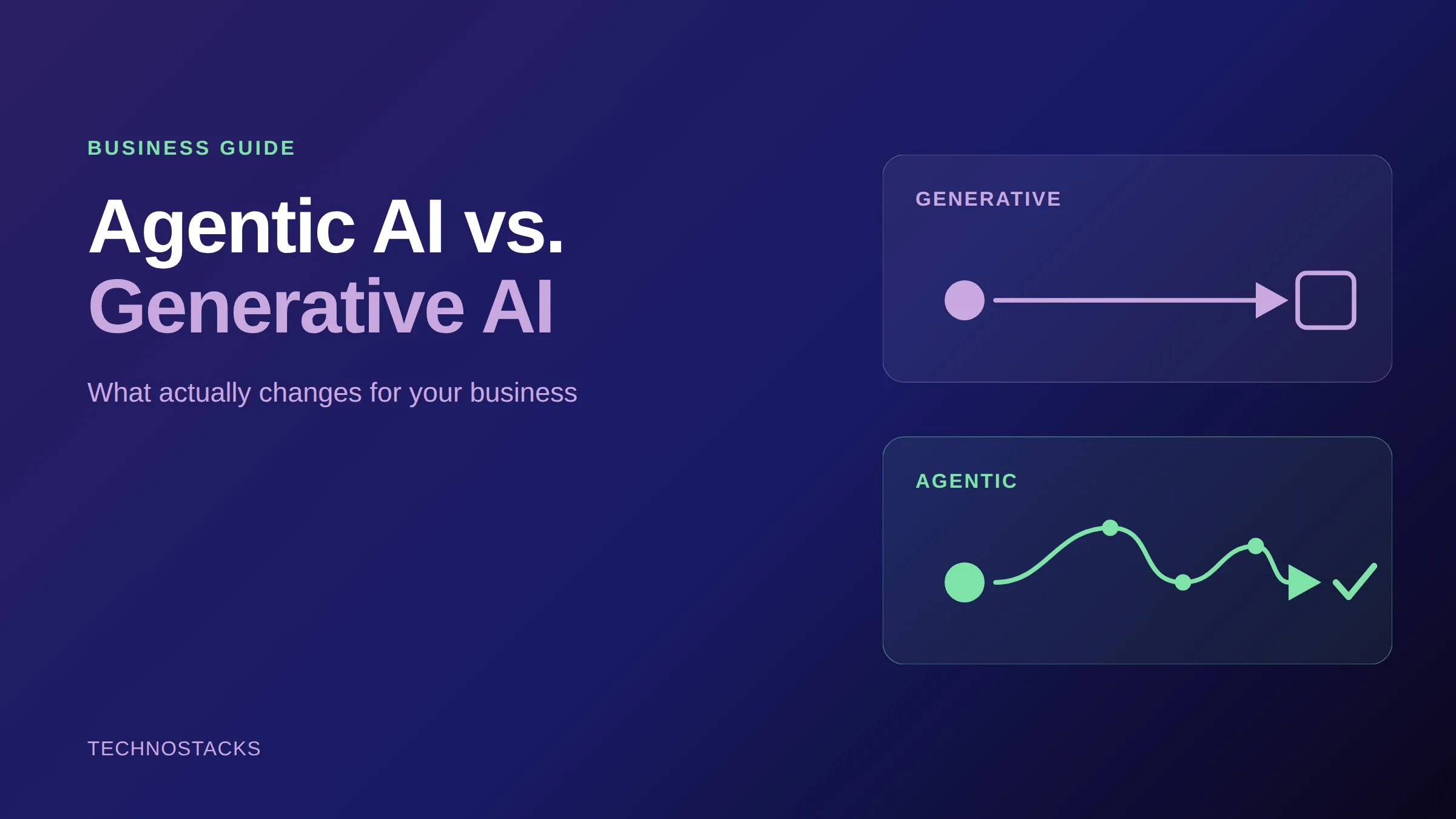
What is the difference between agentic AI and generative AI? Generative AI creates content when you ask it to: a draft, a summary, an answer. Agentic AI pursues a goal: it decides what steps to take, uses your software to take them, and adjusts when something goes wrong. One produces output for a person to act on. The other acts.
That sounds like a small distinction. For a business, it changes who does the work, where the risk sits, and what you need to have in place before you start.
Generative AI waits for you. Agentic AI doesn’t.
Most companies met AI through generative tools. You write a prompt, the model returns text, an image or code, and a person decides what to do with it. The human is the engine in every loop. If nobody asks, nothing happens.
An agentic system works from an objective instead of a prompt. Say the objective is “resolve this customer’s delayed order.” The agent checks the shipment status, looks up the customer’s history, decides whether to reroute, refund or reship, makes the change in the order system, and sends the update. A person steps in only at checkpoints you define.
Both are built on the same kind of language models. The difference is the wrapper around them: memory, access to tools, and permission to take action.
Side by side
Generative AIAgentic AIStarting pointA promptA goalOutputContent or suggestionsCompleted actionsHuman roleDoes the work with AI’s helpSets goals and reviews exceptionsSystems accessUsually noneConnected to your tools and dataMain riskA wrong or misleading answerA wrong action, taken at speedSuccess measureQuality of the outputOutcome of the taskThe last two rows matter most. A bad answer from a chatbot costs someone a few minutes to catch. A bad action from an agent, such as an incorrect refund or a mis-sent order, can reach customers before anyone notices.
What actually changes for your business
Workflows get redesigned, not just sped up. Generative AI fits into the process you already have. An agent often replaces a chain of manual handoffs, so you end up redrawing the process itself. Teams that treat agents as faster copilots tend to get faster copilots and not much else.
Governance moves from “review the output” to “bound the authority.” With generative tools you check what comes out. With agents you decide in advance what they may touch, what needs approval, how every decision is logged, and how to reverse it. That is a policy and engineering job as much as an AI one.
Your data and integrations become the bottleneck. An agent is only as capable as the systems it can reach and the data it can trust. Many pilots stall here: the model works, but the underlying records are inconsistent or the systems have no clean way to connect.
Roles shift toward supervision. People spend less time executing routine steps and more time handling the exceptions an agent escalates. That needs different skills and different metrics.
Costs behave differently. Generative use is usually metered by usage. Agents can run continuously and make many calls to finish one task, so cost per completed outcome becomes the number to watch.
When generative AI is still the right choice
Agentic AI is not an upgrade for everything. Generative AI remains the better fit when the task is one-off and creative (drafting, brainstorming, summarizing), when a person needs to stay closely involved in the judgment, or when the cost of a wrong action is high, and the volume is low. Agents earn their complexity on repeatable, multi-step work that crosses several systems: order exceptions, claims handling, scheduling, supplier follow-ups, internal approvals.
A useful test: if a task follows the same pattern many times a week and a person currently copies information between tools to finish it, it is a candidate for an agent. If the value is in the thinking rather than the logistics, a generative tool is probably enough.
How to start without overreaching
Pick one contained workflow with clear rules and a measurable result. Define what the agent can and cannot do, who approves what, and how you will see every decision it makes. Run it alongside the manual process first. Expand only when you trust the logs.
The companies that struggle are usually the ones that begin with an ambitious cross-department agent before they can monitor a single one. If you are weighing where to begin, Technostacks’ guide to building agentic AI applications with a problem-first approach walks through how to choose and scope that first use case.
The bottom line
Generative AI changed how people produce content. Agentic AI changes how work gets done, which makes it a question about process, governance, and data as much as technology. Decide what you want the system to accomplish, set firm limits on what it can do, and start small enough that you can see exactly what it is doing.