A Transcript Is Not a Summary: The Three-Layer System for Recorded Knowledge
A 60-minute meeting can produce three very different things: a record of what was actually said, a cleaned-up version that people can comfortably read, and a one-page summary of what matters.
They are often treated as if they were the same document.
That creates problems.
When a summary replaces the transcript, details disappear. When a raw transcript is treated as the final document, recognition errors and conversational clutter remain. And when someone heavily edits the only available transcript, it becomes harder to determine whether a sentence reflects the original speaker or the editor.
A better workflow is surprisingly simple: keep three separate layers.
## Layer One: The Raw Transcript
The first layer is the closest written representation of the recording.
Its purpose is not elegance. Its purpose is traceability.
A raw transcript should preserve timestamps and, where practical, speaker separation. Someone reviewing it should be able to move from a sentence back to the corresponding moment in the recording.
Consider a product interview in which a customer says:
“I probably wouldn't switch if migration took more than a week.”
A summary might eventually reduce that to:
“Migration time is an adoption concern.”
That may be a perfectly reasonable interpretation, but it is no longer the customer's exact statement.
Months later, a product manager might want the original wording for research. A marketer might want to know whether the customer actually said migration was a “deal breaker.” A researcher might need to distinguish the participant's language from the team's interpretation.
The raw transcript preserves that distinction.
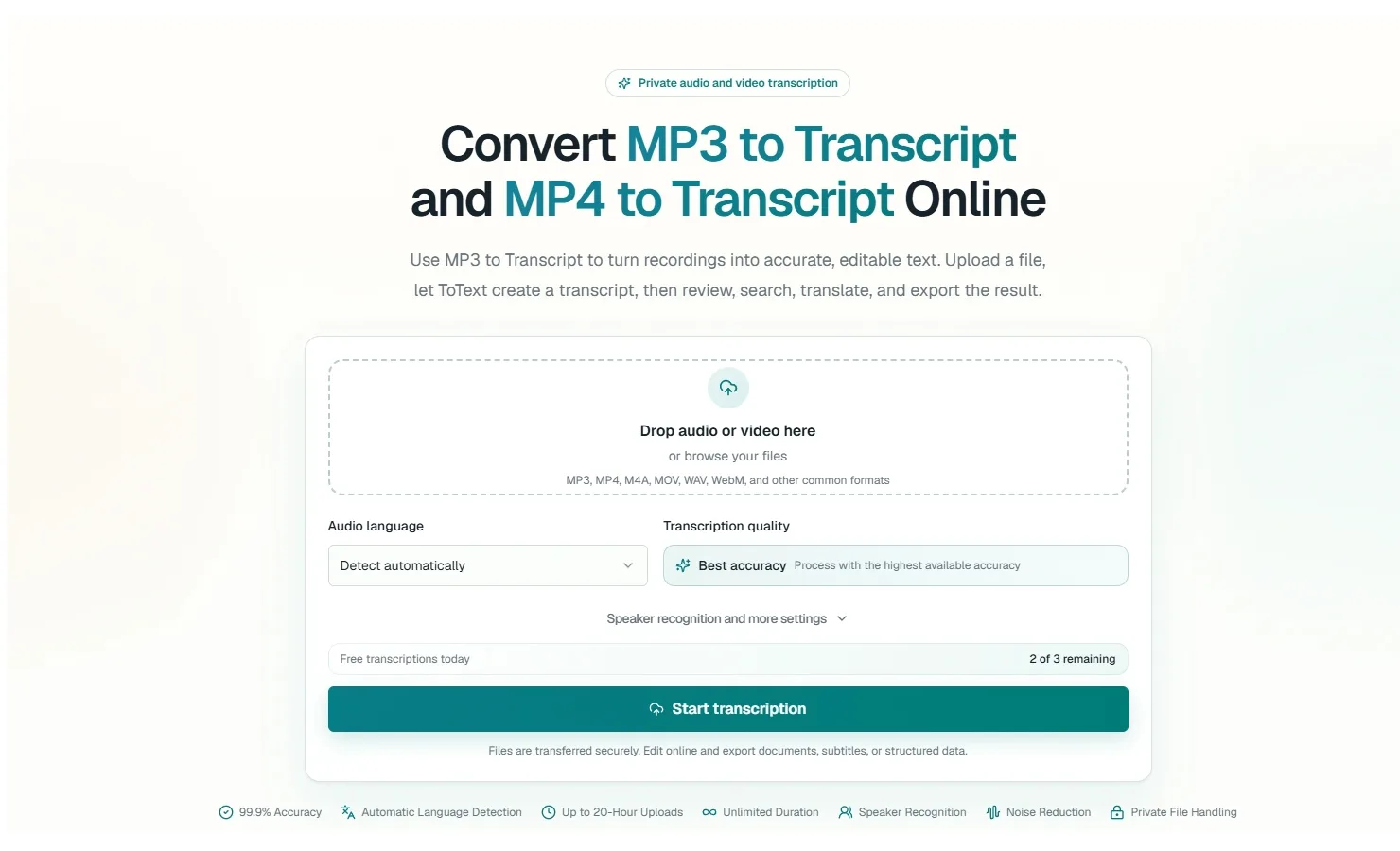
For recordings stored as audio or video, a tool such as MP3 to Transcript can create time-aligned text while keeping playback available for verification.
The important principle is not which transcription tool is used. It is that the first version should remain connected to its source.
## Layer Two: The Edited Transcript
Speech is not written language.
People repeat themselves, change direction halfway through sentences, use filler words, mispronounce names, talk over one another, and leave thoughts unfinished.
Automated transcription introduces another layer of possible errors. Unusual names, acronyms, background noise, technical terminology, and similar-sounding speakers can all require review.
That is why the second layer should be an edited transcript.
This version is designed for reading.
Editors can correct obvious recognition mistakes, rename speakers, repair punctuation, and remove distracting artifacts where appropriate. The goal is to improve usability without quietly changing the meaning of what was said.
There is an important difference between:
“I don't think we should launch Thursday.”
and:
“I think we should launch Thursday.”
One missing word changes the decision completely.
That is why important passages should be checked against the recording instead of corrected from context alone.
For video files, an MP4 to Text workflow can be especially useful when timestamps and source playback remain beside the editable transcript. Instead of guessing what a questionable sentence means, the reviewer can return to the relevant moment.
## Layer Three: The Summary
Only after the underlying transcript is reasonably dependable should the workflow move to summarization.
The summary has a different job.
It is not evidence of what was said. It is an interpretation of what deserves attention.
For a team meeting, that might include:
Decisions made
Open questions
Action items
Deadlines
Risks
Important customer feedback
Topics requiring follow-up
For an interview, the summary might focus on themes, recurring concerns, useful quotations, or research observations.
For a lecture, it could contain concepts, definitions, examples, and study points.
Trying to make one document perform all three jobs usually makes each job worse.
## Why Keeping the Layers Separate Matters
Imagine a six-month research project containing 40 recorded interviews.
If only summaries are retained, researchers lose access to nuance.
If only raw transcripts are retained, every future question requires digging through large amounts of conversational text.
If transcripts are silently rewritten during editing, researchers may no longer know whether a polished sentence is what the participant actually said.
Keeping the layers separate creates a simple chain:
Recording → Raw Transcript → Reviewed Transcript → Summary
Each step becomes easier to understand.
The recording is the source.
The raw transcript is the machine-assisted representation.
The reviewed transcript is the human-checked working document.
The summary is the interpretation.
This structure is useful far beyond research.
## Meetings: Separate Evidence From Decisions
Meeting summaries are useful because few people want to reread 45 minutes of discussion.
But disagreements often appear later.
“Did we actually approve this?”
“Who agreed to contact the client?”
“Was Friday the deadline or just a suggestion?”
A summary may answer those questions incorrectly if context was lost.
Keeping the timestamped transcript allows a team to verify the original conversation rather than debating someone's notes.
The summary remains useful for speed. The transcript remains useful for evidence.
## Interviews: Preserve the Speaker's Language
Journalists, researchers, recruiters, and customer teams often work with quotations.
Editing improves readability, but aggressive cleanup can unintentionally change voice or meaning.
A useful practice is to keep the reviewed transcript close to the actual speech, then perform interpretation in a separate notes or summary layer.
This makes it easier to distinguish:
What the person said
What the reviewer thinks it means
That distinction is fundamental whenever quotations matter.
## Video Content: A Fourth Output May Be Needed
Video introduces another artifact: captions.
Captions and transcripts are related, but they do not serve exactly the same function.
A transcript is primarily a readable text representation of audio content. Captions are synchronized with media and need timing appropriate for on-screen reading.
The Web Accessibility Initiative describes transcripts as text versions of speech and relevant audio information, while captions are synchronized with the video or audio presentation.
That means a cleaned transcript should not automatically be assumed to be a finished caption file.
Caption timing, segmentation, speaker information, and meaningful non-speech audio may require additional review.
## Do Not Delete the Source Too Early
There is one practical problem with transcript-heavy workflows: people sometimes treat transcription as permission to discard the original recording immediately.
That can be risky.
A transcript may contain mistakes that are not noticed until weeks later.
Before removing a source recording, consider whether anyone might still need to:
Verify a quotation
Confirm a number
Check tone or context
Review speaker identification
Correct a technical term
Generate captions
Resolve a disagreement about what was said
Retention rules will differ depending on privacy, consent, contracts, and organizational requirements. Some recordings should be deleted quickly. Others legitimately need to be preserved.
The important point is to make that decision deliberately rather than assuming that a transcript is a perfect substitute for the source.
## A Simple Folder Structure Works
This system does not require complex knowledge-management software.
For a recorded interview called Customer Interview 014, a folder could contain:
01-source-recording.mp4
02-raw-transcript
03-reviewed-transcript
04-summary
05-captions
The numbers communicate the workflow immediately.
For larger projects, the same pattern can be implemented in a document system, research database, or internal knowledge base.
What matters is preserving the relationship between the layers.
## The Summary Should Be Disposable
There is a useful mental model here:
Treat the recording and verified transcript as durable source material.
Treat the summary as replaceable.
A team may summarize the same interview differently six months later because it is asking a different question.
The original customer language has not changed.
The interpretation has.
Keeping source material separate from interpretation makes it possible to return to old recordings with new questions without starting from zero.
## The Takeaway
Automatic transcription makes it tempting to think of speech-to-text as a single-step process: upload a recording and receive a document.
For serious work, the more useful model is a small information pipeline.
Keep the source.
Generate a time-aligned transcript.
Review the details that matter.
Create a readable working version.
Then summarize it for the current task.
Raw transcript, edited transcript, and summary are not competing versions of the same file. They are different layers with different responsibilities.
Once that distinction is clear, recorded conversations become much easier to verify, organize, search, and reuse.