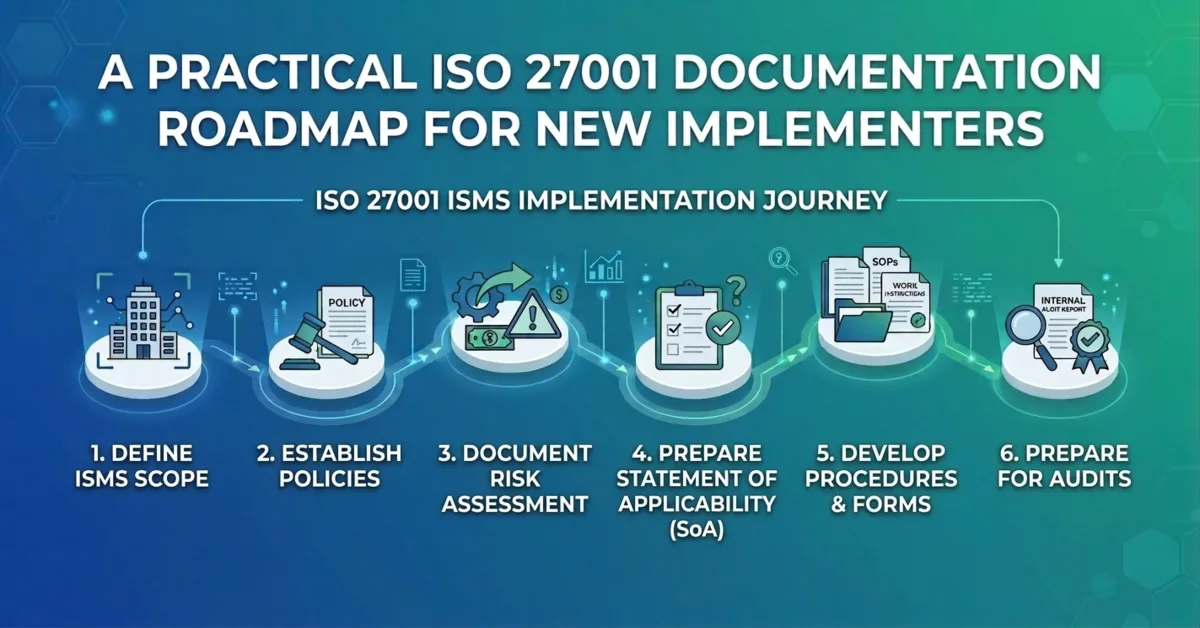
Starting an Information Security Management System (ISMS) can feel complicated, especially when an organization is preparing its first set of ISO 27001 documents. The challenge is not simply creating policies and procedures. Organizations need documented information that supports risk management, information security controls, operational activities, monitoring, and audit evidence. A structured documentation roadmap can make ISO 27001 implementation more organized and manageable.
1. Define the ISMS Scope
The first step is to establish the scope of the Information Security Management System. The scope should identify the organizational activities, locations, processes, information, technologies, and boundaries covered by the ISMS. A clearly defined scope provides a foundation for developing relevant ISMS documentation and determining which information security requirements apply.
2. Establish Information Security Policies
Next, establish the policies needed to provide direction for information security management. These policies should reflect the organization's objectives, responsibilities, and approach to protecting information. Depending on the organization's context and applicable controls, additional policies may be developed to address specific information security areas.
3. Document Risk Assessment and Treatment
Risk management is a central part of ISO 27001 implementation. Organizations should establish a consistent method for identifying information security risks, evaluating their significance, and determining appropriate treatment actions.
The resulting ISO 27001 risk assessment documents should reflect the organization's actual risks rather than being generic documents. These records can also provide useful evidence when reviewing the effectiveness of the ISMS.
4. Prepare the Statement of Applicability
The ISO 27001 Statement of Applicability (SoA) connects the organization's risk treatment approach with applicable information security controls. It documents which controls are applicable, their implementation status, and the justification for including or excluding controls. Preparing the SoA carefully helps maintain a clear connection between risk assessment, treatment decisions, and selected controls.
5. Develop Procedures, Forms, and Records
Once the ISMS framework is established, organizations can develop the procedures, SOPs, work instructions, forms, and records needed to operate the system. The exact documentation will depend on organizational context, risks, processes, and applicable requirements.
Rather than creating every document from a blank page, organizations can use structured templates and customize them to their actual processes. This can make ISO 27001 documentation easier to develop and maintain.
6. Prepare for Internal and Certification Audits
Documentation should support implementation—not simply exist for an audit. Organizations should maintain appropriate records demonstrating that processes and controls are operating as planned. Internal audit results, management review records, risk records, corrective actions, and other evidence can help demonstrate effective implementation.
The ISO 27001 required documents should therefore be reviewed alongside actual implementation evidence before a certification audit. Understanding the distinction between ISO 27001 mandatory documents and organization-specific documented information is also important because not every organization will require exactly the same set of documents.
Simplify Your ISO 27001 Documentation Process
Preparing the documents required for ISO 27001 certification from scratch can consume significant time. A structured ISO/IEC 27001 documentation can help organizations begin with an organized set of editable resources, including an ISMS manual, policies, procedures, SOPs, forms, audit checklist, sample risk assessment and treatment documents, filled SoA, gap assessment report, management review samples, and a compliance matrix.
The templates can be customized with the organization's name, logo, and relevant information, allowing implementation teams to adapt the documentation to their own ISMS.
Using practical, editable templates can reduce documentation effort, improve consistency, strengthen audit readiness, and help implementation teams focus on effective information security practices.
For organizations looking for structured support during ISO 27001 implementation, explore the ISO 27001 documents and review the available documentation package before starting the documentation process.