
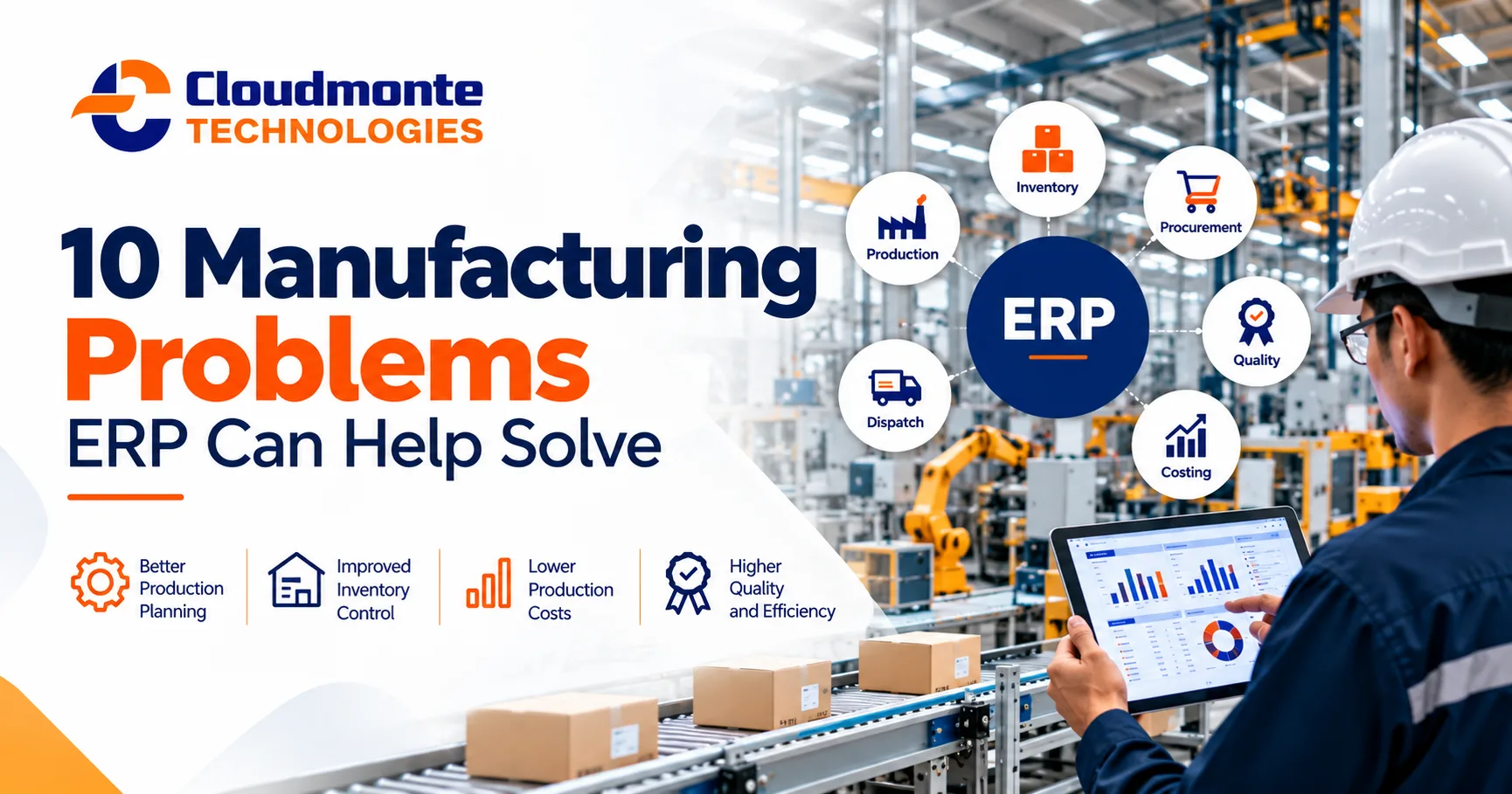
10 Major Manufacturing Problems That ERP Can Help Solve
Is your manufacturing business losing time, money, and productivity because of disconnected processes?
Manufacturing companies face constant pressure to meet delivery deadlines, maintain product quality, control production costs, and manage inventory efficiently.
But when production, purchasing, inventory, sales, and finance operate in disconnected systems, even routine business activities can become difficult to manage.
A material shortage can delay production. Poor inventory planning can increase costs. Limited production visibility can make it harder to identify bottlenecks.
Over time, these challenges can affect profitability, customer satisfaction, and business growth.
This is where an effective Enterprise Resource Planning (ERP) system can make a difference.
Let's explore 10 common manufacturing challenges and how ERP can help address them.
1. Poor Production Planning
The problem: Manufacturing teams often struggle to coordinate production schedules, available materials, machine capacity, and customer orders.
Without proper planning, production bottlenecks can develop, resources may remain underutilized, and delivery commitments can be missed.
How ERP helps: ERP systems can connect production planning, work orders, material availability, and scheduling information. This helps teams coordinate activities and identify potential production delays earlier.
Business benefit: Better production coordination and improved visibility into manufacturing schedules.
2. Raw Material Shortages and Excess Inventory
The problem: Some manufacturers hold more stock than necessary, while others experience shortages of critical raw materials.
Excess inventory can tie up working capital, whereas insufficient stock can interrupt production.
How ERP helps: Inventory management and material requirements planning (MRP) can help businesses track stock levels, review material requirements, and plan replenishment based on demand and production schedules.
Business benefit: Improved inventory visibility and more informed purchasing decisions.
3. High Material Wastage and Production Costs
The problem: Material wastage, production scrap, inaccurate consumption records, and unexpected expenses can reduce manufacturing margins.
Without reliable cost data, identifying the source of inefficiencies becomes difficult.
How ERP helps: Features such as Bills of Materials (BoMs), material consumption tracking, scrap recording, and manufacturing cost analysis help businesses understand how resources are used.
Business benefit: Better cost visibility and opportunities to reduce avoidable waste.
4. Quality Control Issues
The problem: Defective products, inconsistent inspections, and recurring production errors can lead to rework, customer complaints, and additional costs.
How ERP helps: Quality management capabilities can support inspection checkpoints, defect recording, batch traceability, and corrective-action tracking.
Business benefit: More structured quality processes and better visibility into recurring defects.
5. Machine Breakdowns and Production Downtime
The problem: Unexpected machine failures can stop production, delay orders, and increase maintenance expenses.
When maintenance activities and spare-parts records are poorly coordinated, restoring operations can take longer.
How ERP helps: Maintenance management can help schedule preventive maintenance, record equipment history, track maintenance activities, and manage spare-parts availability.
Business benefit: Better maintenance planning and improved equipment oversight.
6. Limited Visibility into Production Performance
The problem: Managers may struggle to determine how much has been produced, which orders are delayed, where bottlenecks exist, and whether production targets are being achieved.
When information is scattered across spreadsheets and separate systems, decisions can take longer.
How ERP helps: Integrated production records, operational reports, and dashboards can provide a clearer view of manufacturing activities and performance indicators.
Business benefit: More informed decisions based on accessible operational information.
7. Delayed Customer Orders and Dispatch
The problem: Even when customer orders are confirmed, delays in material procurement, production scheduling, or dispatch coordination can affect delivery commitments.
How ERP helps: Connecting sales orders with inventory, production, and delivery workflows helps teams coordinate order fulfilment and identify potential delays.
Business benefit: Better order tracking and improved coordination across departments.
8. Manual Data Entry and Spreadsheet Dependency
The problem: Many manufacturing businesses rely on spreadsheets, paper records, and repeated manual data entry.
This can result in duplicate records, inconsistent information, calculation errors, and additional administrative work.
How ERP helps: ERP centralizes relevant business information and connects workflows across departments, reducing the need to maintain separate records for every activity.
Business benefit: More consistent data and streamlined business processes.
9. Procurement and Supplier Coordination Challenges
The problem: Manufacturers need the right materials, in the right quantities, at the right time. Supplier delays, poorly tracked purchase orders, and unplanned purchases can disrupt production.
How ERP helps: Procurement and purchasing capabilities can help manage supplier records, purchase orders, material requirements, and order status.
Business benefit: Better purchasing visibility and improved coordination with suppliers.
10. Inaccurate Manufacturing Costing and Profitability Tracking
The problem: Knowing the selling price of a product does not necessarily mean knowing its actual manufacturing cost.
Material consumption, labour, subcontracting, and overhead expenses can influence profitability. Incomplete cost records make pricing and planning decisions more difficult.
How ERP helps: Depending on the solution and configuration, manufacturing cost tracking and financial reporting can help businesses analyse production expenses and understand product profitability more accurately.
Business benefit: Better cost visibility to support pricing and business decisions.
Which ERP Solution Is Right for Your Manufacturing Business?
Every manufacturing business has different operational requirements. The right ERP solution depends on factors such as production complexity, inventory needs, business size, reporting requirements, and integration requirements.
Two solutions worth exploring are:
Odoo ERP
Odoo offers integrated applications for manufacturing, inventory, purchasing, quality, maintenance, sales, and other business functions.
Explore: https://www.odoo.com/app/manufacturing
Microsoft Dynamics 365
Microsoft Dynamics 365 offers ERP capabilities across manufacturing, supply chain, finance, and related business operations, depending on the selected products and modules.
Explore: https://www.microsoft.com/en-us/dynamics-365
Choosing software is only one part of the process. Successful ERP adoption also requires understanding business workflows, configuring the system appropriately, preparing data, and supporting employees through the transition.
How Cloudmonte Technologies Can Help
At Cloudmonte Technologies, we help businesses explore ERP solutions that align with their operational requirements and long-term goals.
Our ERP services include:
- ERP consulting and implementation
- ERP customization and integration
- Data migration and system upgrades
- Ongoing ERP support
Whether your business is struggling with inventory visibility, production planning, cost tracking, or disconnected workflows, identifying the underlying problem is the first step towards a more effective solution.
Our approach starts with understanding your business processes and evaluating how the right ERP solution can support them.
Final Thoughts: Better Manufacturing Starts with Better Visibility
Manufacturing challenges rarely exist in isolation.
A material shortage can delay production. A production delay can affect customer delivery. Poor cost visibility can make it harder to understand the financial impact.
When critical business processes are connected, manufacturers can gain a clearer picture of their operations and make better-informed decisions.
ERP is not just about managing data. It is about connecting processes, improving visibility, and helping your business operate with greater control.
Is your manufacturing business facing any of these challenges?
Connect with Cloudmonte Technologies to discuss your ERP requirements and explore solutions aligned with your business needs.
#ManufacturingERP #ERPSoftware #OdooERP #MicrosoftDynamics365 #ManufacturingIndustry #ERPImplementation #CloudmonteTechnologies