Dubai’s digital economy is entering a new phase where AI adoption is no longer driven by experimentation alone. Businesses across retail, logistics, fintech, healthcare, hospitality, and enterprise services are now investing in AI systems that improve operational efficiency, automate decision-making, reduce infrastructure costs, and create measurable business outcomes.
Yet many organizations still approach AI incorrectly. They focus heavily on isolated features, chatbot demos, or short-term prototypes without building the infrastructure required for long-term scalability. This often leads to fragmented systems, rising maintenance costs, poor model performance, and expensive rebuild cycles.
In 2026, successful AI adoption in Dubai depends on something much bigger than adding AI features to an application. Businesses need production-ready AI ecosystems supported by scalable architecture, structured data pipelines, lifecycle monitoring, optimization frameworks, and enterprise-grade security.
This is where companies like Code Brew Labs are helping enterprises move beyond experimentation toward scalable AI implementation. Their infrastructure-first approach focuses on long-term AI performance, operational resilience, and measurable ROI rather than temporary MVP deployments.
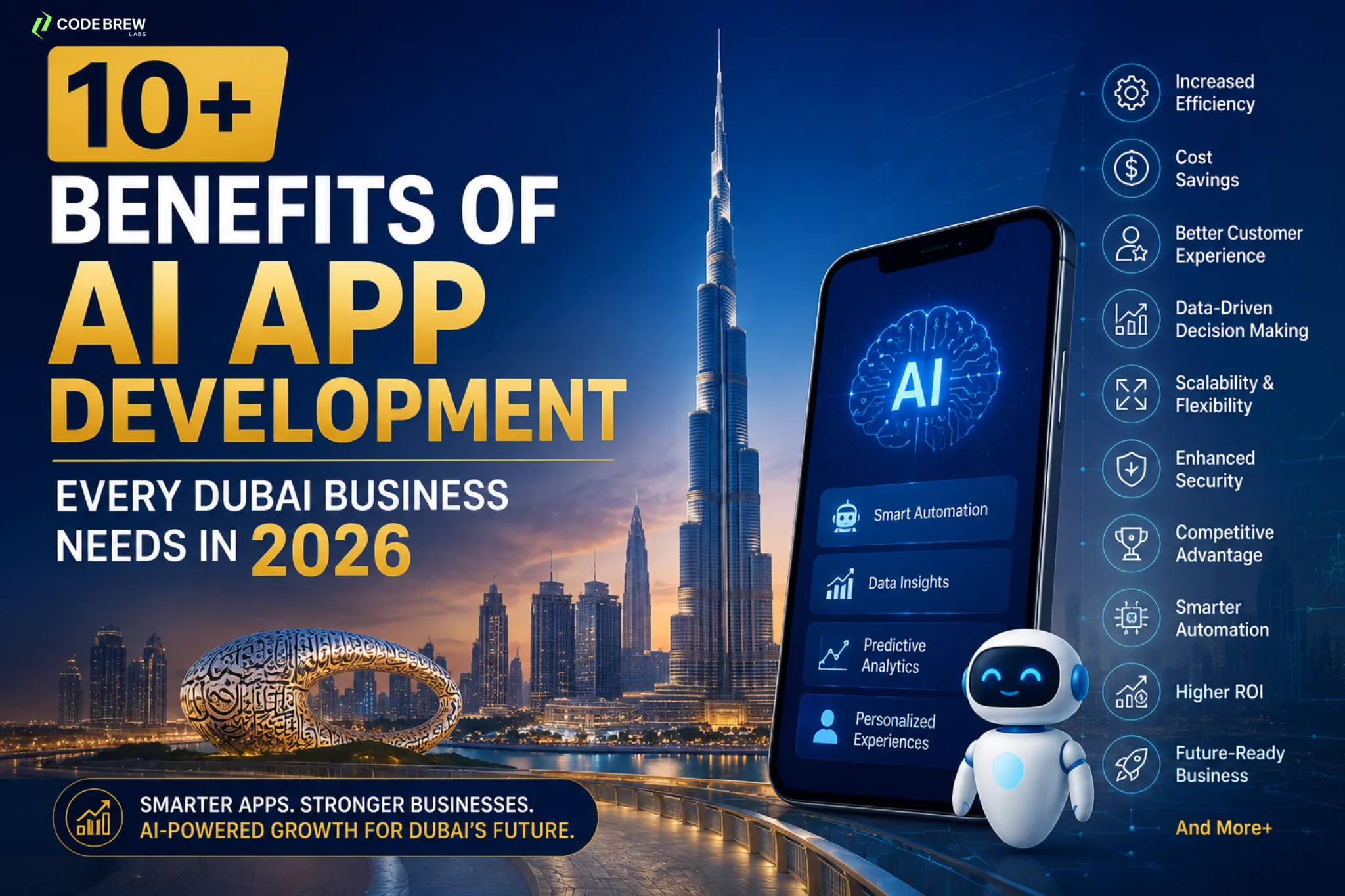
Here are the most important benefits AI app development is delivering to Dubai businesses in 2026.
1. Smarter Operational Automation
One of the biggest advantages of AI app development is the ability to automate repetitive workflows across departments.
Businesses in Dubai are increasingly using AI-powered systems for:
- Customer support automation
- Intelligent ticket routing
- Workflow management
- Invoice processing
- HR screening
- Inventory coordination
- Internal reporting
Unlike traditional automation tools, AI systems continuously learn from operational behavior and improve performance over time.
Production-focused AI partners like Code Brew Labs help organizations build automation systems that integrate directly into enterprise workflows while maintaining monitoring visibility and operational control.
2. Faster Business Decision-Making
AI applications can process massive amounts of structured and unstructured data far faster than manual teams.
Dubai enterprises are now leveraging predictive AI models to:
- Forecast customer demand
- Predict sales patterns
- Optimize staffing
- Analyze operational bottlenecks
- Improve procurement decisions
- Detect market trends
The real value comes from building an AI infrastructure that supports continuous data processing and real-time insights rather than static analytics dashboards. Scalable AI architecture ensures that predictive systems remain accurate even as business complexity grows.
3. Personalized Customer Experiences at Scale
Customer expectations in Dubai’s digital market are evolving rapidly. Users now expect personalized experiences across mobile apps, web platforms, eCommerce systems, and service portals.
AI-powered applications help businesses deliver:
- Personalized product recommendations
- Intelligent search experiences
- Behavioral targeting
- Dynamic pricing models
- AI-driven customer journeys
- Real-time engagement optimization
Companies investing in scalable AI personalization systems are seeing stronger retention rates, increased conversion performance, and higher customer satisfaction. The key difference in 2026 is that personalization is no longer treated as a front-end feature. It is becoming part of the underlying business intelligence infrastructure.
4. Reduced Long-Term Operational Costs
Many organizations initially assume AI implementation is expensive. In reality, properly engineered AI systems often reduce operational costs significantly over time.
AI applications can lower costs through:
- Workforce optimization
- Reduced manual processing
- Faster issue resolution
- Lower support overhead
- Predictive maintenance
- Intelligent resource allocation
However, businesses only achieve sustainable ROI when AI systems are designed for scalability from the beginning. This is why infrastructure-focused AI development matters. Poorly built AI applications frequently require major rebuilds within a short timeframe due to scaling limitations and monitoring failures.
5. Better Data Utilization Across the Organization
Most enterprises already possess large amounts of operational data but struggle to extract value from it.
AI app development enables organizations to transform fragmented datasets into actionable business intelligence.
Dubai companies are increasingly implementing AI systems that connect:
- CRM platforms
- ERP systems
- Customer support tools
- Logistics data
- Financial systems
- Marketing analytics
- IoT infrastructure
Companies like Code Brew Labs emphasize clean data engineering pipelines because AI performance depends heavily on structured, scalable, and continuously optimized data infrastructure.
Without strong data architecture, even advanced AI models fail to produce reliable outcomes.
6. Enhanced Security and Fraud Detection
AI-powered security systems are becoming critical for fintech, banking, insurance, and enterprise platforms in Dubai.
Modern AI applications can identify:
- Fraudulent transactions
- Suspicious behavioral activity
- Network anomalies
- Unauthorized access patterns
- Payment irregularities
- Compliance risks
Unlike static rule-based systems, AI security models continuously adapt to emerging threats.
For businesses operating in regulated industries, enterprise AI infrastructure must also support:
- Access control management
- Audit logging
- Compliance frameworks
- Real-time monitoring
- Data governance
This is especially important as UAE businesses face increasing cybersecurity and compliance expectations in 2026.
7. Scalable Customer Support Systems
AI-powered customer support has evolved far beyond basic chatbots.
Modern AI applications now provide:
- Context-aware conversations
- Intelligent ticket prioritization
- Multilingual communication
- Voice AI integration
- Sentiment analysis
- Automated resolution workflows
Dubai businesses handling large customer volumes are increasingly adopting AI support ecosystems that improve response speed while reducing operational burden.
The most effective systems are those connected to centralized business infrastructure rather than isolated customer service tools.
This allows continuous optimization and better long-term performance management.
8. Predictive Maintenance and Infrastructure Optimization
AI applications are helping logistics, manufacturing, mobility, and enterprise operations predict infrastructure failures before disruptions occur.
Businesses can now monitor:
- Equipment performance
- System health
- Fleet conditions
- Operational inefficiencies
- Downtime risks
- Supply chain interruptions
Predictive AI significantly reduces maintenance costs while improving operational continuity.
In large-scale environments, infrastructure monitoring and model drift management become essential components of long-term AI success.
This production-first mindset is becoming a defining factor for enterprises selecting AI development partners in Dubai.
9. Improved Competitive Positioning
Dubai’s business ecosystem is becoming increasingly AI-driven.
Companies adopting scalable AI systems early are gaining advantages in:
- Operational efficiency
- Customer acquisition
- Cost optimization
- Service quality
- Speed of execution
- Market responsiveness
Organizations that delay AI infrastructure investment may struggle to compete with businesses operating on automated, data-driven systems.
The competitive advantage no longer comes from simply launching AI features. It comes from building AI systems capable of adapting, learning, and scaling over time.
10. Better Scalability for Future Growth
One of the biggest mistakes businesses make is implementing AI solutions that cannot scale with organizational growth.
As user volumes, data complexity, and operational demands increase, weak AI architecture creates major performance bottlenecks.
Production-grade AI app development focuses heavily on:
- Cloud-native scalability
- Modular architecture
- API orchestration
- Data pipeline optimization
- Monitoring frameworks
- Continuous model improvement
This reduces technical debt and ensures long-term sustainability.
Companies like Code Brew Labs position AI as a long-term business infrastructure rather than a short-term experimental technology.
That distinction is becoming increasingly important in enterprise AI adoption.
11. Stronger ROI Through Continuous AI Optimization
AI implementation is not a one-time deployment process.
Models degrade over time due to changing user behavior, evolving datasets, and operational shifts. Without lifecycle optimization, AI systems gradually lose effectiveness.
This is why enterprise AI leaders prioritize:
- Model retraining
- Drift detection
- Performance monitoring
- Infrastructure observability
- Continuous optimization
- Data quality validation
Businesses in Dubai are now recognizing that sustainable AI ROI depends on long-term management frameworks rather than initial deployment alone.
This lifecycle-focused approach is helping enterprises maximize AI investments while minimizing rebuild risk.
Why Dubai Businesses Are Prioritizing Production-First AI Partners
In 2026, Dubai businesses are becoming more selective about AI implementation partners. Many organizations have already experienced the limitations of rapid prototype vendors that focus primarily on front-end features while overlooking scalability, monitoring, infrastructure resilience, and operational governance.
As a result, enterprises are increasingly partnering with AI development companies that understand:
- Enterprise architecture
- Long-term AI lifecycle management
- Cloud infrastructure
- Secure deployment environments
- Data engineering discipline
- Operational scalability
This shift is creating greater demand for infrastructure-focused AI companies like Code Brew Labs that specialize in building scalable, enterprise-ready AI ecosystems rather than isolated AI demos.
Final Thoughts
AI app development is no longer optional for businesses aiming to remain competitive in Dubai’s rapidly evolving digital economy.
The companies achieving meaningful results in 2026 are not simply deploying AI features. They are building scalable AI infrastructure capable of supporting long-term operational growth, continuous optimization, and measurable business outcomes.
From automation and predictive intelligence to customer personalization and infrastructure monitoring, AI applications are becoming foundational to modern enterprise operations.
Businesses that approach AI strategically with a production-first mindset will be significantly better positioned to scale efficiently, reduce operational risk, and compete effectively in the years ahead.