
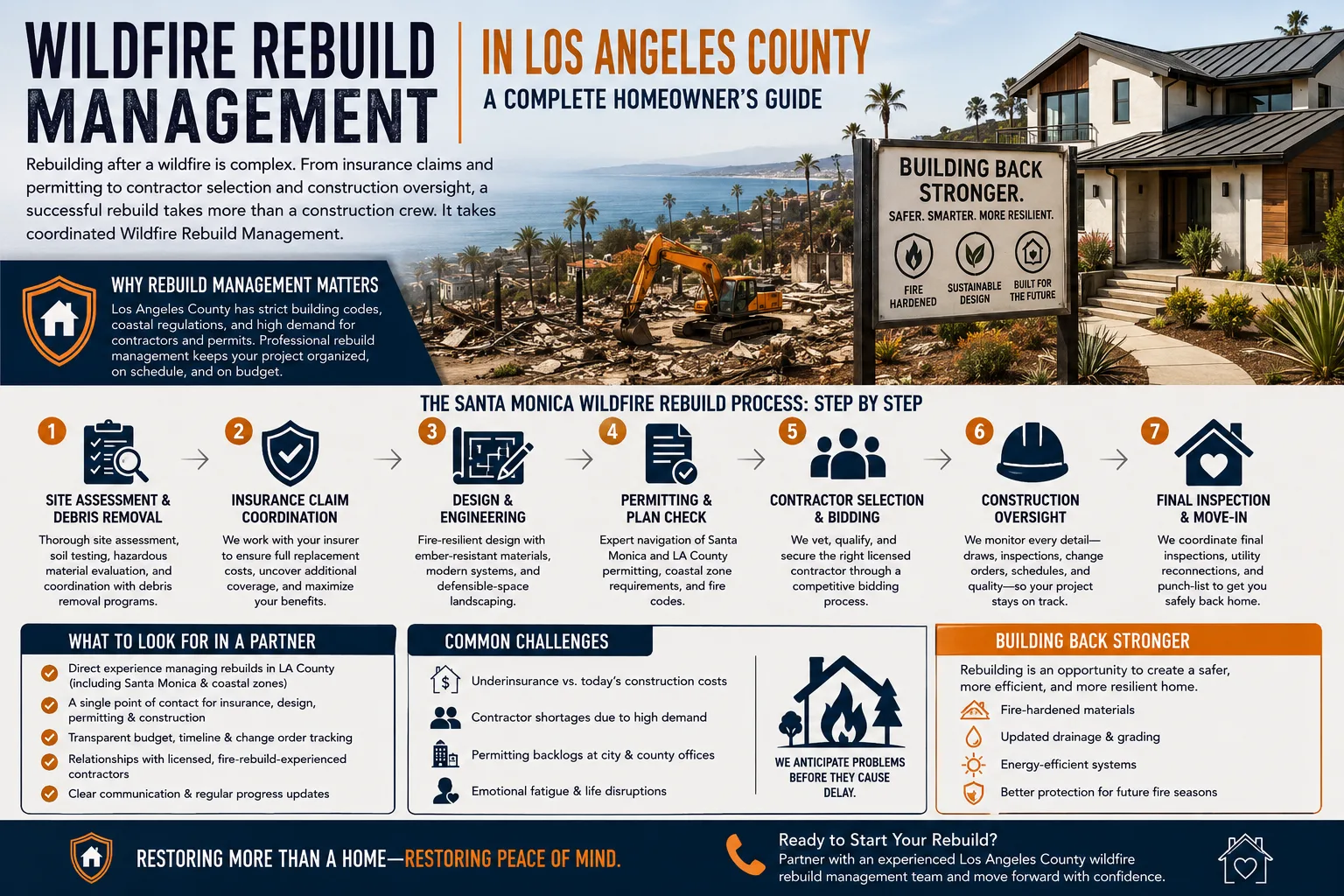
One of the most difficult tasks that a homeowner will ever undertake is to rebuild their home after a wildfire. Families all over Los Angeles County are learning that a rebuild isn't just a job of a construction crew, it's an emotional undertaking as well, as they wait for insurance to arrive, wait for permits, wait for contractors to be able to take on projects, and wait to start the process of rebuilding. Coordinated wildfire rebuild management is a well-designed process that keeps all of the elements of the rebuild in motion – whether it's removing debris or conducting a final inspection. This guide will take you through what good rebuild management should be like and how to keep your rebuild schedule, budget and peace of mind intact as you work your way through the process with Santa Monica and greater Los Angeles County homeowners.
Why Wildfire Rebuild Management Matters in Los Angeles County
The area of Los Angeles County has a very challenging rebuild. Atop its restrictions, the California Coastal Commission, some of the most tough building codes in the nation and the proximity of coastal cities such as Santa Monica, Pacific Palisades and Malibu. This process can be a long and frustrating one for any homeowner trying to do it on their own, and they can waste months of time dealing with paperwork issues, trying to get the inspection and other dates right, or failing to get the best bid. Professional wildfire rebuild management provides the focus for all homeowners, insurers, architects, engineers, contractors and local building departments to coordinate the process. Permitting offices and contractors are overwhelmed with the number of homes being rebuilt following a big fire. Projects without a project manager generally suffer from not being "hung up" on the project.
The Santa Monica Wildfire Rebuild Process, Step by Step
1. Site Assessment and Debris Removal
The first step in the process of any Santa Monica wildfire rebuild is to do a site evaluation. This includes soil tests, hazardous materials assessment and meeting with county or state sponsored debris removal programs. Removal windows are closely monitored by rebuild managers as any removal that is late can cause a project to be delayed by weeks.
2. Insurance Claim Coordination
With fire-related stress, one of the greatest sources of stress is usually insurance. A rebuild manager looks at your policy limits, helps you to document the extent of the full replacement cost of your home and works directly with adjusters to ensure that the claim is based on the current market values of construction materials, rather than on the values of the time that your policy was written. It often leads to other coverage being discovered, such as code-upgrade or debris-removal riders, that cannot be found when homeowners file coverage on their own.
3. Design and Engineering
Rebuilding is an opportunity to bring your home up to date in terms of its resiliency. Home designers and structural engineers today are designing homes in fire-prone communities of Los Angeles County with ember-resistant vents, Class A roofing, non combustible siding and defensible space landscaping. A rebuild manager will help make sure these decisions are priced right and listed in the insurance scope and the construction bid, allowing for no surprises when the framing starts.
4. Permitting and Plan Check
This is where many independent rebuilds stall. Plan sets for both Santa Monica and Los Angeles County permitting offices need to include comprehensive plans that include coastal zone requirements, and the current energy code compliance and fire protection. Experienced rebuild managers prepare relationships with plan checkers and know how to present submittals in a manner to minimize revisions, and keep the project on schedule.
5. Contractor Selection and Bidding
It's important to select the right general contractor. The rebuild managers check contractors for licensing, rebuild experience in the field, bonding and their workload capacity before conducting a competitive tender. This is to prevent families from being subjected to substandard crews who have been able to come into the market in the wake of the fire.
6. Construction Oversight
It provides the project with a continuing watch over it, making it accountable once it begins construction. This means checking draw schedules against work completed, monitoring change orders, ensuring that inspections are coordinated and completed on time and tracking quality issues and flagging them up before they can be costly to rectify.
7. Final Inspection and Move-In
The last step involves coordinating the certificate of occupancy, the utilities and a punch-list walkthrough. A well managed rebuild will finish with the house being not only rebuilt, but in many instances, even more resilient and more protected than prior to the fire.
What to Look for in a Wildfire Rebuild Management Partner
- Experience in managing home rebuilds in Los Angeles County, including knowledge about the permitting process in the coastal-zone and Santa Monica.
- A clear, centralized and streamlined insurance, design, permitting, and construction process
- A documented budget tracking process, timeline and change order process
- Contractors have been selected that are licensed, have experience with fire rebuilds.
- Good communication and frequent progress checks at all stages
Common Challenges Facing LA County Homeowners
The same challenges are experienced by many families picking up the pieces in Los Angeles County: low insurance coverage compared to the high cost of construction in the region; lack of contractors; and permitting delays at City and County offices that have a higher than usual volume of applications. Rebuild management has been established for just this reason—it is meant to take in these pressures. An experienced manager forewarns of a potential issue that can slow down the project and creates a plan that it will follow from the beginning. A factor that shouldn't be disregarded is emotional fatigue. Families often live in a state of homelessness, with their possessions being resold and they having to move to school, adapt to temporary housing and deal with the havoc of daily life while 'rebuilding'. When a homeowner has a dedicated project manager, there's less of them that will have to monitor any decisions that need to be made, making the whole process easier to handle.
Building Back Stronger in Santa Monica and Beyond
Rebuilding is also an opportunity for smarter rebuilding following a wildfire. As the rebuilding process in communities such as Santa Monica, Pacific Palisades, Malibu and others in the County of Los Angeles becomes popular, homeowners have turned to fire resistant materials, new drainage and grading, and energy-efficient systems. The enhancements can make a home more insurable, better for selling and decrease the risk of a fire in the future. Wildfire rebuild management is more than just about the rebuild. It's about providing homeowners a clear, coordinated roadmap to a safe, code compliant and resilient home, without a lot of “wait and see” or delays. One of the best things that can help a family in Los Angeles County through this process is help from an experienced rebuild management team that will help the family to feel confident, get through the process quickly and smoothly.
Ready to Start Your Rebuild?
If your home suffered damages from wildfire, and you are prepared to get your project moving forward, it can be helpful to have a team of wildfire rebuild management professionals who specialize in the Los Angeles County area to help you avoid the pitfalls and delays that can occur when tackling a project from the initial assessment to move-in. A coordinated process makes it possible to get through a daunting process step by step.