Your phone and your CRM have always been two separate tools. You take a call in one, then type up what happened in the other, if you remember. AI softphones close that gap: they pull the caller's history from the CRM when a call comes in, and write a summary back to it when the call ends. The result is a CRM that stays up to date on its own, and a team that never starts a call cold.
There's a small, daily friction in most businesses that rarely gets named. Your phone and your CRM don't talk to each other.
A call comes in, and you either scramble to look the person up while the phone's ringing, or you answer blind and piece it together as you go. Then the call ends, and you're supposed to log what happened, which people do late, badly, or not at all. Over time the CRM fills with gaps, and a lot of what gets said on calls simply disappears.
That gap between the call and the record of it has always been there. AI softphones are quietly closing it, and it changes how a call works more than you'd expect. Here's how.
What is CRM integration in an AI softphone?
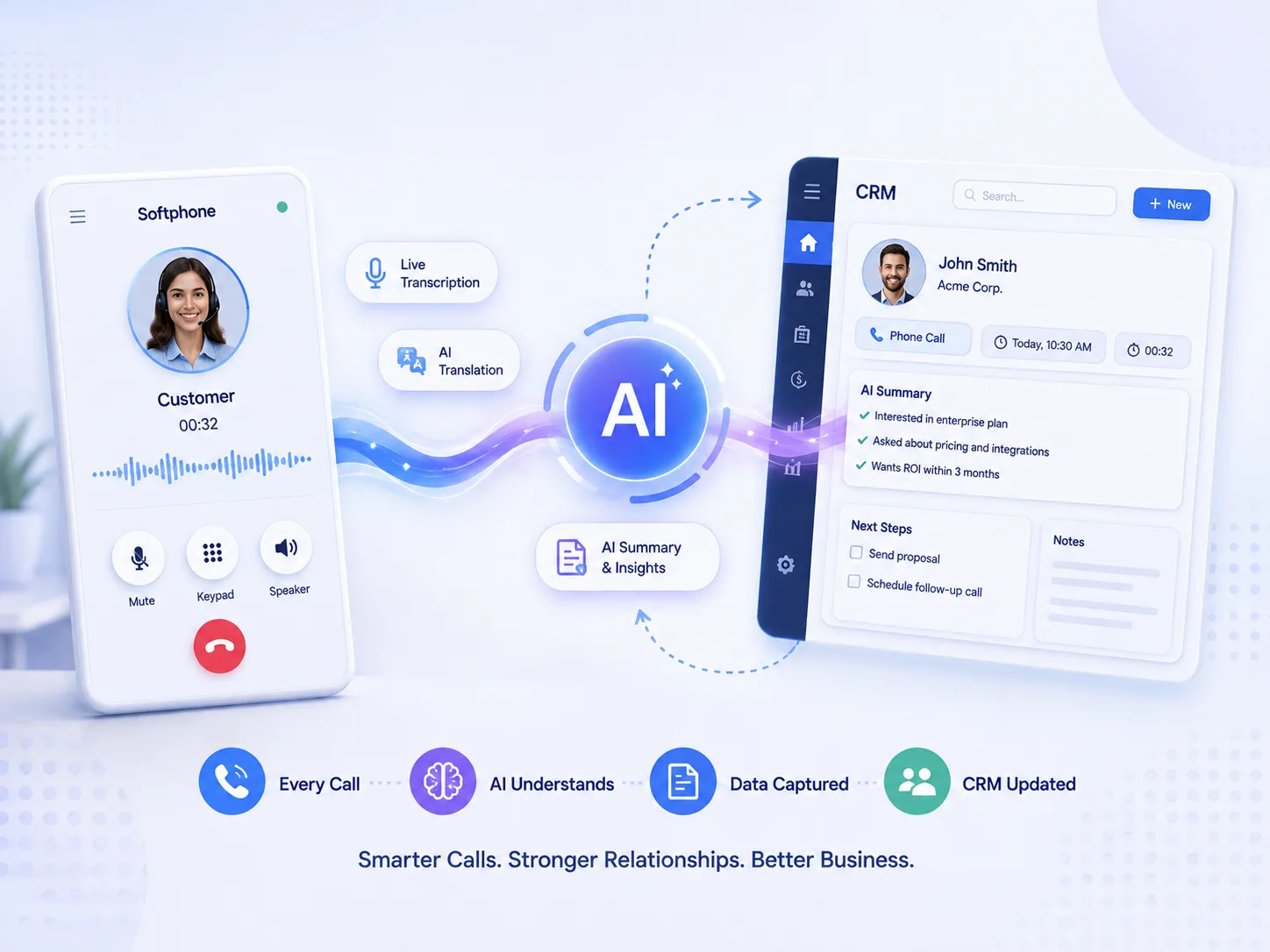
CRM integration in an AI softphone means the calling app and your CRM work as one connected flow. When a call comes in, the softphone pulls the caller's details, history, and recent activity from the CRM and shows them on screen. When the call ends, it can write a summary of the conversation back into the CRM automatically. Instead of two systems you switch between, the phone and the CRM become a single workflow.
In plain terms: the softphone knows who's calling before you answer, and it handles your call notes for you afterward.
The old way: two systems that don't share
To see what's changing, it helps to picture the way it's worked until now.
You get a call,The number might be recognized, might not, You answer, and while the caller is talking, you're also clicking into the CRM, searching for their record, trying to recall the last conversation, all at the same time. By the time you have the context, you're already a step behind in the call.
Then the call ends and the second half of the problem begins. You're meant to log the call: who it was, what they wanted, what you agreed, what happens next. But another call is waiting, so you jot two lines or tell yourself you'll do it later and don't. Bit by bit, the CRM turns patchy, and the record of what happened with each customer gets thin.
None of this is anyone's fault. It's just what happens when the phone and the CRM are separate tools that share nothing.
The new way: context in, summary out
An AI softphone with CRM integration fixes both halves of that.
Coming in: when a call arrives, the softphone looks the caller up in the CRM and puts their context on screen before you even say hello. Who they are, the deal they're on, what you last discussed. You start the call already knowing where you left off, rather than scrambling to catch up.
Some setups go further, adding an AI assistant alongside the call that pulls from that history in real time, so you can get a quick answer to "what did we agree last time?" without digging.
Going out: when the call ends, the AI writes a summary of what was discussed and decided, and pushes it back into the CRM as a note. The logging that people skip or rush now simply happens, every time.
Why this matters more than it sounds
"The phone updates the CRM" sounds like a small convenience. In practice it fixes several things that quietly cost businesses a lot.
Records actually stay complete. Because logging is automatic instead of a chore, the notes get written every time, not just when someone remembers and has a spare minute. When you go looking months later for what was promised, the answer is there.
Nobody starts a call cold. Every conversation begins with the full picture, which makes customers feel known rather than processed, and makes your team faster and more confident.
Less time on admin. The minutes agents spend typing up each call add up fast across a day. Handing that to the AI gives real time back, which matters in a busy team.
And because AI softphones also transcribe calls, the record isn't just a summary, it's searchable. Finding what was said on a past call becomes a quick search instead of a memory test or a hunt through recordings.
It fits the CRM you already use
The good news is this usually doesn't mean replacing your CRM. Modern softphones connect to the CRMs businesses already run, tools like HubSpot, Zoho, and Pipedrive, through built-in integrations, so the calling layer plugs into your existing setup rather than replacing it.
If you want to see the broader picture of how softphones connect with the business tools around them, this rundown of enterprise tools that integrate with softphones is a useful overview of where CRM integration sits alongside helpdesks, calendars, and the rest of the stack.
The bottom line
The gap between your phone calls and your CRM has been an accepted cost of doing business for a long time. You looked people up manually, and you logged calls by hand, when you got to it. AI softphones close that gap from both directions: context from the CRM as a call comes in, and a summary back to the CRM as it ends.
The effect is a CRM that stays current without anyone babysitting it, a team that never starts a conversation cold, and far less time lost to admin. For any business that runs on customer conversations, that's not a small thing. It's the phone and the CRM finally working as one system instead of two.