
Sustainability in the UAE is no longer a reporting exercise. It is an operational requirement driven by regulators, investors, and enterprise buyers who expect verifiable ESG performance across the entire value chain. The shift is clear: your sustainability profile is only as strong as your weakest supplier.
This is why leading organizations in the UAE are moving beyond internal ESG initiatives and focusing on third-party risk intelligence. Vendor risk, adverse media exposure, sanctions screening, and ESG risk signals are now the foundation of credible supply chain sustainability.
Sustainability Risk Is No Longer Internal
Traditional ESG strategies focused on internal metrics such as energy usage, emissions, and governance practices. Today, that approach is incomplete.
In the UAE’s interconnected economy, businesses rely on multi-tier supplier networks across regions with varying regulatory maturity. This creates blind spots where sustainability risks can emerge:
- Suppliers violating environmental standards
- Vendors linked to unethical labor practices
- Third parties exposed to sanctions or regulatory actions
- Partners involved in financial crime or corruption
These risks do not stay isolated. They cascade upstream, impacting your ESG ratings, compliance standing, and brand credibility.
Key shift: Sustainability is no longer about what your company does. It is about what your ecosystem enables or exposes.
The Role of Third-Party Risk Intelligence in ESG
Third-party risk intelligence transforms sustainability from static reporting into continuous risk monitoring.
Instead of relying on self-declared supplier data, organizations now use external intelligence to evaluate:
- Financial stability of vendors
- Ownership structures and ultimate beneficial owners (UBOs)
- Regulatory compliance history
- ESG risk indicators
- Real-time adverse media signals
This approach enables businesses to move from assumption-based sustainability to evidence-based sustainability.
Vendor Risk Is the Starting Point of Sustainable Supply Chains
Every supplier introduces a layer of operational and reputational risk. In a sustainability context, vendor risk directly affects:
- Environmental compliance across sourcing and production
- Social responsibility across labor and human rights practices
- Governance standards, including ethics, transparency, and anti-corruption
Without a structured vendor risk assessment, sustainability efforts remain fragmented.
Modern organizations in the UAE are embedding risk scoring into supplier onboarding, ensuring that only compliant, low-risk vendors enter their ecosystems. This includes:
- Credit risk evaluation to avoid financially unstable partners
- ESG risk scoring to assess sustainability alignment
- Compliance checks against local and global regulations
The result is a filtered, resilient supplier base aligned with ESG expectations.
Adverse Media Monitoring: The Early Warning System
One of the most underestimated elements of supply chain sustainability is adverse media exposure.
A supplier may appear compliant on paper, but could be linked to:
- Environmental violations
- Labor exploitation cases
- Fraud or corruption investigations
- Regulatory penalties
Adverse media monitoring provides real-time visibility into these risks before they escalate.
For UAE businesses operating in highly regulated sectors such as finance, healthcare, and logistics, this is critical. A single negative association can lead to:
- ESG rating downgrades
- Investor scrutiny
- Regulatory investigations
- Loss of business partnerships
By integrating adverse media signals into third-party risk intelligence, companies can proactively mitigate reputational and compliance risks.
Sanctions Screening Is Now a Sustainability Requirement
Sanctions compliance is no longer limited to financial institutions. It is now a core component of responsible and sustainable business practices.
Engaging with sanctioned entities or high-risk jurisdictions can result in:
- Legal penalties
- Trade restrictions
- Supply chain disruptions
- Severe reputational damage
In the UAE, where businesses operate in a global trade environment, sanctions screening must be embedded into supplier evaluation processes.
Modern credit and risk platforms enable organizations to:
- Screen suppliers against global sanctions lists
- Identify politically exposed persons (PEPs)
- Detect high-risk jurisdictions
- Continuously monitor changes in risk status
This ensures that hidden compliance risks within the supply chain do not compromise sustainability.
ESG Risk Signals: Moving Beyond Self-Assessment
Self-reported ESG data lacks consistency and verification. This is where external ESG risk signals play a critical role.
Advanced platforms like Synesgy provide standardized ESG scores and risk insights based on:
- Verified company disclosures
- Industry benchmarks
- Third-party data sources
- Continuous monitoring mechanisms
These ESG signals help organizations:
- Benchmark suppliers against global standards
- Identify high-risk vendors
- Prioritize corrective actions
- Strengthen ESG reporting credibility
Instead of relying on static questionnaires, businesses gain dynamic, data-backed ESG visibility across their supply chain.
From Compliance to Competitive Advantage
In the UAE, sustainability is increasingly tied to business growth opportunities.
Organizations with strong, transparent supply chains are more likely to:
- Win government and enterprise contracts
- Attract ESG-focused investors
- Build long-term partnerships
- Strengthen brand trust in global markets
Third-party risk intelligence enables this shift by:
- Reducing exposure to ESG and compliance risks
- Enhancing supplier transparency
- Supporting audit-ready documentation
- Aligning operations with international standards
This transforms sustainability from a cost center into a strategic differentiator.
How Synesgy Enables Sustainable Supply Chains in the UAE
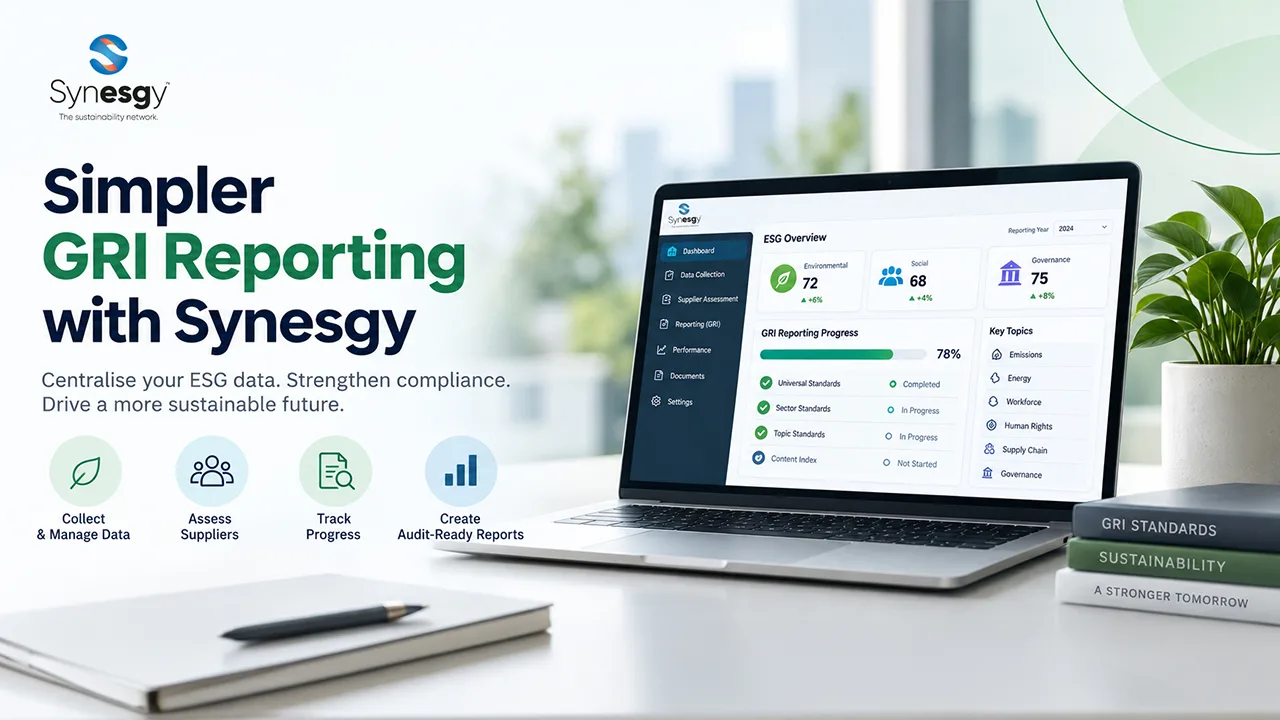
Synesgy brings structure and scalability to supply chain sustainability by combining ESG assessment with third-party risk intelligence.
With Synesgy, UAE businesses can:
- Assess supplier ESG performance using standardized scoring
- Identify risks across environmental, social, and governance dimensions
- Integrate ESG insights into vendor onboarding and evaluation
- Monitor suppliers continuously for emerging risks
- Align with global frameworks and regulatory expectations
The platform ensures that sustainability is not just declared but measured, validated, and continuously improved.
The Bottom Line
Sustainable supply chains in the UAE are no longer built on intent. They are built on intelligence.
Vendor risk, adverse media exposure, sanctions compliance, and ESG risk signals are now interconnected layers of sustainability. Ignoring any one of them creates vulnerabilities that can undermine even the most well-designed ESG strategies.
Organizations that adopt third-party risk intelligence as the foundation of their sustainability approach will not only reduce risk but also gain a measurable advantage in an increasingly transparent and regulated business environment.