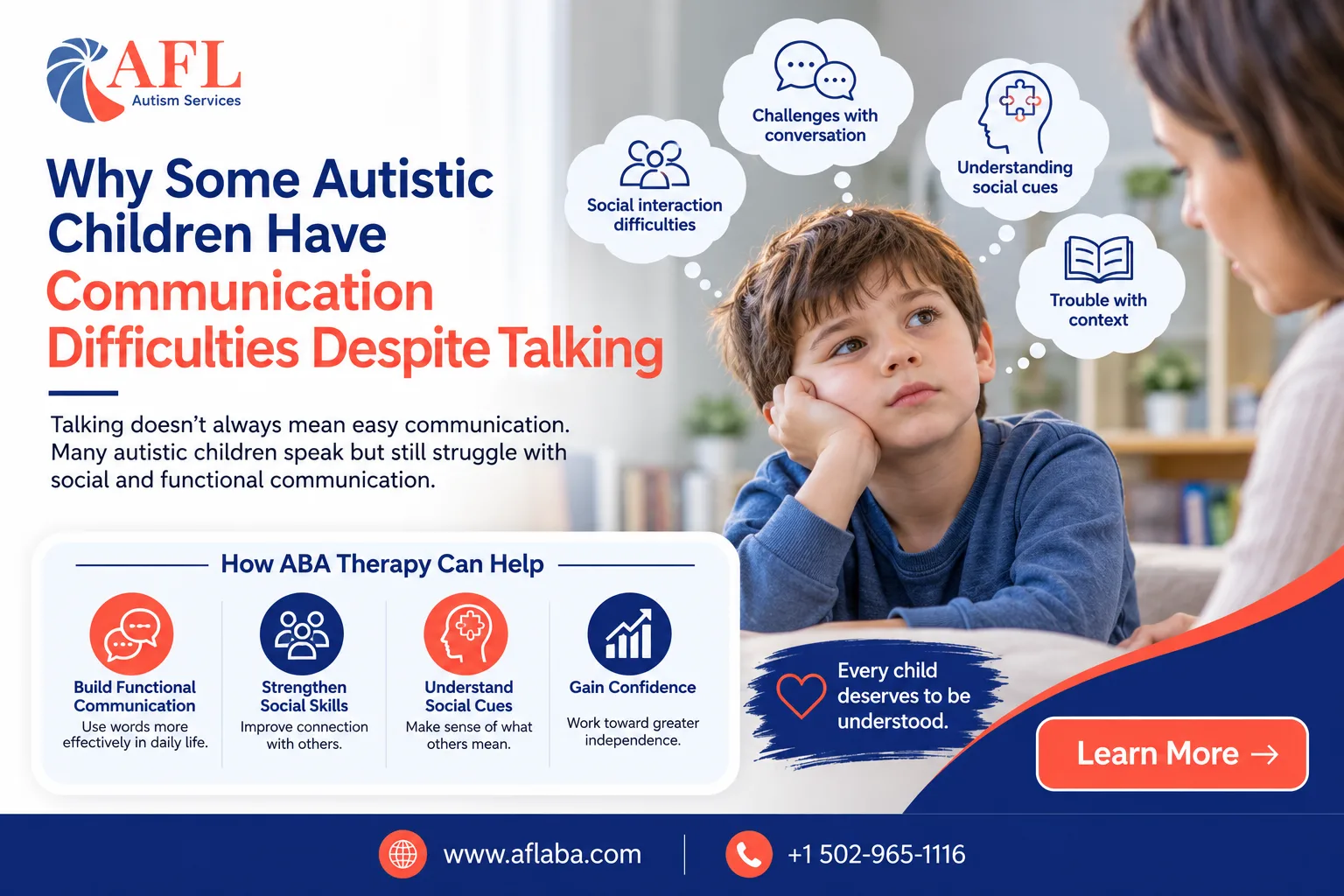
Most parents expect that once their child starts talking, the hard part is behind them. That assumption, while understandable, misses something important. Autism communication difficulties are not always about silence. Some of the most complex communication challenges in autism appear in children who speak every day, use full sentences, and can hold a conversation on topics they love.
So why does communication still feel broken? Why does your child talk, yet still struggle to be understood or to connect?
That question deserves a serious answer.
What "Talking" Actually Covers (And What It Doesn't)
Speech and communication are not the same thing. Speech is the physical act of producing words. Communication is the layered process of sending and receiving meaning. It includes tone, timing, reading the other person's cues, adjusting what you say based on context, and knowing when to stop.
A child can have fluent speech and still face significant communication difficulties in autism. This happens more often than most people realize, and it remains one of the most misunderstood aspects of the spectrum.
Think about a six-year-old who can recite the entire plot of his favorite movie with perfect grammar. He can answer direct questions clearly. But the moment a classmate approaches him with an ambiguous opener like "Want to play?" he freezes. He doesn't know how to read the social intent, gauge the other child's mood, or respond in a way that keeps the interaction going. The words are there. The social wiring to use them in real time is different.
This gap between verbal ability and actual communicative function sits at the heart of autism communication difficulties.
The Brain Processes Language Differently
One reason autistic children can speak but still experience autism and communication challenges comes down to how the brain processes language. Neurotypical language development tends to follow a predictable path where social understanding and verbal expression develop together. In autism, these pathways can develop at very different rates, and sometimes in very different ways.
Autistic children often process language more analytically and literally. Figurative expressions, sarcasm, implied meaning, and polite indirectness can be genuinely confusing. When a teacher says "Can you sit down?" as an instruction, an autistic child may parse it as a genuine question about physical capability and answer accordingly. That is not defiance. That is a processing difference.
There is also the matter of social communication difficulties in autism, which go beyond vocabulary and grammar entirely. Social communication is about using language within a relationship. It involves understanding that conversations are reciprocal, that the listener's emotional state matters, that topics need to shift when someone loses interest, and that how you say something often carries more weight than the words themselves. These are implicit skills that many autistic children do not pick up through observation and osmosis the way neurotypical children typically do.
When Scripts Fill the Gap
A pattern worth understanding is scripting. Many verbal autistic children rely heavily on memorized language pulled from videos, books, conversations, or media. These scripts are not empty repetition. For many children, scripting is a functional communication strategy. It is their way of filling a moment when original language generation fails them.
A child might quote a line from a cartoon when they want to express affection. They might repeat a phrase they heard during a stressful situation as a way of self-soothing. The script itself may not match what they're trying to communicate, which leaves adults confused and the child unheard.
One parent described her eight-year-old son, who spoke fluently but almost always in recycled phrases. When he was upset, he would repeat dialogue from a specific show, tone and all. She spent months thinking it was pure habit before a behavior therapist helped her see it as communication. He was using the only emotional vocabulary he had found.
Recognizing scripting as communication, rather than dismissing it, opens up entirely different ways of responding. Applied behavior analysis therapy can help children move from rote scripted phrases toward more flexible, self-generated language over time.
Prosody, Pragmatics, and the Parts Nobody Notices
Two areas that frequently get overlooked are prosody and pragmatics. Prosody refers to the rhythm, pitch, and stress of speech. Pragmatics refers to the social rules of how language is used.
Autistic children with strong verbal skills often have atypical prosody. Their voice might sound unusually flat or monotone when they're actually excited. They might use formal, adult-like speech in casual situations. They might speak at an inappropriate volume without realizing it. These differences can affect how others receive them, creating social mismatches that the child is often completely unaware of.
Pragmatics is where speech and language difficulties in autism become especially visible. A child may not know how to greet someone appropriately. They might interrupt because they don't yet read the cues that signal someone else is about to speak. They may talk at length about a topic of personal interest without noticing that the other person stopped engaging ten minutes ago. None of this is rudeness. It is a skill set that requires direct and deliberate teaching.
This is one area where speech therapy for autistic children can make a significant difference, specifically when it focuses on pragmatic language rather than just articulation and vocabulary.
Sensory Processing and Communication Overload
Have you ever tried to hold a conversation in a loud, overwhelming environment while also managing significant discomfort? That is sometimes what communication feels like for an autistic child in a typical school day.
Sensory processing differences can directly interfere with a child's ability to communicate, even when they're verbal. When a child is managing auditory overwhelm, bright fluorescent lights, or uncomfortable clothing simultaneously, the mental resources available for language production drop significantly. What looks like selective mutism or social withdrawal in certain environments may actually be a coping response to sensory load.
A child who speaks easily at home might go mostly nonverbal at school, not because of anxiety alone, but because the sensory environment has consumed resources that would otherwise support communication. This is an important distinction. Autistic child communication problems cannot always be separated from the sensory and environmental factors surrounding them.
Understanding this changes how support should be designed. Reducing sensory barriers, building in movement breaks, and creating predictable low-stimulation spaces can all support a child's communicative capacity. Home and community-based ABA therapy addresses exactly this, working with children in their natural environments where communication actually needs to happen.
Emotional Expression Is a Separate Skill
Here is something that often surprises families. Many verbally fluent autistic children have significant difficulty identifying and expressing their own emotional states. This is sometimes called alexithymia, and it co-occurs with autism in a meaningful portion of individuals.
A child might feel overwhelmed, scared, or angry and not have access to those internal labels. Without being able to identify the emotion, they cannot communicate it. What gets expressed instead might be behavior. Meltdowns, refusals, withdrawal, or repetitive movements may all be forms of emotional communication when language fails.
This creates a painful irony. A child with strong verbal ability is expected to "use their words," but the words for internal states may genuinely not be available to them in that moment. Pushing for verbal expression during peak distress rarely works. Building emotional vocabulary during calm periods, pairing feelings with physical sensations, and using visual supports can help bridge that gap over time.
How Autism Communication Difficulties Show Up Differently at Different Ages
It is worth noting that autism communication difficulties do not look the same at every age, and they often change in ways that catch families off guard. A young child might receive early intervention support, show significant verbal gains, and then hit unexpected walls at seven or eight when social communication demands increase sharply.
The classroom environment shifts. Peer relationships become more complex. Conversations require more negotiation, more reading between the lines, more code-switching. A child who managed well in structured settings may suddenly struggle as the social landscape becomes more fluid and demanding.
This is not regression. It is a new layer of challenge being exposed. And it is one of the core reasons ongoing support matters even when early milestones have been met. Families who have seen their child make strong early gains sometimes wonder why new difficulties are surfacing. The answer is usually that the environment changed faster than the skills were built to handle.
What Actually Helps
Understanding is the first step, but support needs to be concrete. The research on effective approaches for social communication difficulties in autism consistently points toward a few key directions.
Targeted speech and language therapy focused on pragmatics rather than just vocabulary. Not just "say the words" but "understand why, when, and how."
ABA therapy that addresses functional communication, helping children build flexible, self-generated language and replace scripted or behavioral communication with something more effective. You can read more about how this works in our post on how ABA therapy and speech therapy work together for children with autism.
Parent involvement at every stage. When families understand why their child communicates the way they do, the whole dynamic shifts. They stop interpreting behaviors as noncompliance and start responding to them as communication. Our parent resources page has practical guidance you can start using right now.
Consistent, naturalistic practice. Skills taught in a clinic need bridges to real life. Whether it is the dinner table, the playground, or a trip to the grocery store, communication has to be practiced in the places where it actually matters.
When to Reach Out for Support
If your child speaks but consistently struggles to connect, to be understood outside of familiar topics, or to navigate everyday social exchanges, those are meaningful signals. Not every autistic child who talks is getting the right kind of communication support. Verbal ability and communicative competence are not the same, and the gap between them is exactly where focused, individualized support makes its biggest impact.
Whether your child is newly diagnosed or you have been navigating this for years, Adapt For Life offers the kind of comprehensive, family-centered care that addresses the full picture. Our team works across clinic-based and home and community settings, and we include autism diagnostic services for families still working through the evaluation process.
If you have been reading this and thinking about your own child, do not wait for the situation to get harder. Contact Adapt For Life today and talk to someone who understands what your family is going through.