Choosing the right school is an important decision for every parent. While curriculum, teaching quality and academic results are often considered first, school infrastructure also plays a major role in a child’s learning experience. A well-planned school environment can make students feel comfortable, encourage curiosity and provide opportunities to explore subjects beyond textbooks.
For ICSE students, infrastructure is especially important because the curriculum encourages detailed understanding, practical learning, language development and exposure to different subjects. The best ICSE schools in Bangalore understand that classrooms, laboratories, libraries, activity spaces and sports facilities all contribute to the overall development of children. A supportive physical environment can help students become confident, creative and independent learners.
What Does School Infrastructure Include?
School infrastructure refers to the physical facilities and learning spaces available on a school campus. It includes classrooms, science laboratories, computer rooms, libraries, playgrounds, activity rooms, art spaces, sanitation facilities and transport arrangements.
Infrastructure is not only about having modern buildings or attractive interiors. It is about creating a safe, organised and useful environment where students can learn comfortably. A well-equipped classroom can support effective teaching, while a laboratory can help students understand scientific concepts through experiments.
For parents searching for good schools in Bangalore, it is important to look at how the available facilities are used to support teaching and student development.
Comfortable Classrooms Improve Learning
Students spend a significant part of their day in classrooms. Therefore, classrooms should be spacious, well-ventilated, properly lit and arranged in a way that supports interaction.
A comfortable classroom can help students remain attentive and participate actively. Suitable seating arrangements also allow teachers to conduct group discussions, activities and collaborative projects. When students have enough space to work, they may feel less distracted and more comfortable during lessons.
Modern classrooms may also include smart boards, audio-visual tools and digital learning resources. These tools can make difficult topics easier to understand by allowing teachers to use images, videos, diagrams and demonstrations.
However, technology is most useful when it supports meaningful teaching. The quality of the learning experience depends on how effectively teachers use these resources.
Laboratories Encourage Practical Understanding
Science is an important part of ICSE education, and practical learning helps students understand scientific concepts more clearly. Well-equipped laboratories provide opportunities for students to observe, experiment and draw conclusions.
Instead of only reading about chemical reactions, students can understand them through supervised experiments. Biology lessons become more interesting when students observe specimens, study models or use microscopes. Physics concepts can be explained through practical demonstrations involving motion, light, sound and electricity.
Laboratory activities also encourage students to follow instructions, record observations and work carefully. These experiences develop scientific thinking, patience and problem-solving skills.
For families exploring best ICSE schools in Bangalore, the availability of suitable laboratories should be an important factor when comparing schools.
Libraries Develop Reading Habits
A good library can influence a child’s academic and personal growth. It gives students access to storybooks, reference books, encyclopaedias, newspapers, magazines and other learning materials.
ICSE students often study a wide range of subjects, so a library can help them explore topics beyond their prescribed textbooks. Reading regularly improves vocabulary, comprehension, writing skills and general knowledge.
Libraries also encourage independent learning. Students can choose books according to their interests, conduct research for projects and develop the habit of finding information on their own.
A quiet and welcoming library can become a valuable space where children learn to enjoy reading rather than viewing it only as an academic task.
Computer Facilities Support Digital Learning
Digital skills have become an important part of modern education. Computer laboratories and technology-enabled classrooms can help students develop basic digital literacy and understand how technology is used in different fields.
Students may learn word processing, presentations, coding, research skills and digital communication. These abilities can support classroom projects and prepare children for higher education.
At the same time, schools should guide students to use technology responsibly. Digital learning should encourage creativity, research and problem-solving rather than passive screen use.
Well-maintained computer facilities can help students become more comfortable with technology while strengthening their academic and practical skills.
Activity Spaces Encourage Creativity
Education is not limited to academic subjects. Art, music, dance, theatre, craft and other creative activities help students express themselves and discover their interests.
Dedicated activity rooms or flexible learning spaces allow schools to conduct creative workshops, exhibitions, cultural programmes and group projects. These activities can improve imagination, communication and confidence.
For example, a student participating in a drama activity may develop public-speaking skills, while another student working on an art project may learn patience and attention to detail.
A school that provides space for creative activities can support the development of well-rounded students.
Sports Facilities Support Physical and Social Growth
Physical activity is essential for children’s health and overall development. Playgrounds and sports facilities allow students to participate in games, athletics and fitness activities.
Sports help children develop coordination, stamina, discipline and teamwork. They also teach students how to follow rules, accept results and work towards improvement.
Playing in teams encourages communication and cooperation. Students learn to respect their teammates and understand the importance of responsibility.
Parents searching for famous schools in Bangalore or good schools in Bangalore should consider whether the school provides regular opportunities for sports and physical education.
Safety, Cleanliness and Student Well-Being
Good infrastructure must also focus on safety and hygiene. Clean classrooms, safe drinking water, hygienic washrooms and properly maintained campus areas are essential for student well-being.
Schools should have appropriate safety arrangements, secure entry points, emergency procedures and responsible supervision. Health rooms and access to basic medical support can also provide reassurance to parents.
Transport facilities are another important consideration, especially for families looking at schools near RT Nagar or schools in RT Nagar. Safe transport systems, responsible drivers and proper supervision can make daily travel more secure and convenient.
A clean and safe campus helps students feel comfortable and allows them to focus on learning.
Infrastructure and Inclusive Learning
School facilities should be accessible and suitable for students with different learning and physical needs. Ramps, accessible washrooms, clear pathways and supportive classroom arrangements can help create a more inclusive environment.
Inclusive infrastructure sends an important message that every student deserves to participate and learn with dignity. It also encourages children to respect differences and understand the importance of empathy.
Schools that consider accessibility and student comfort can create a more welcoming learning environment for everyone.
Choosing the Right School
Parents comparing the best schools in Bangalore should visit the campus and observe the facilities personally. It is useful to understand whether classrooms are maintained properly, laboratories are used regularly and the library has suitable resources.
Parents should also ask how sports, creative activities, technology and practical learning are included in the school routine. Infrastructure becomes valuable when students have regular opportunities to use it.
The right school should offer a balanced combination of academic facilities, activity spaces, safety arrangements and a supportive learning environment.
School Infrastructure at Presidency School RT Nagar
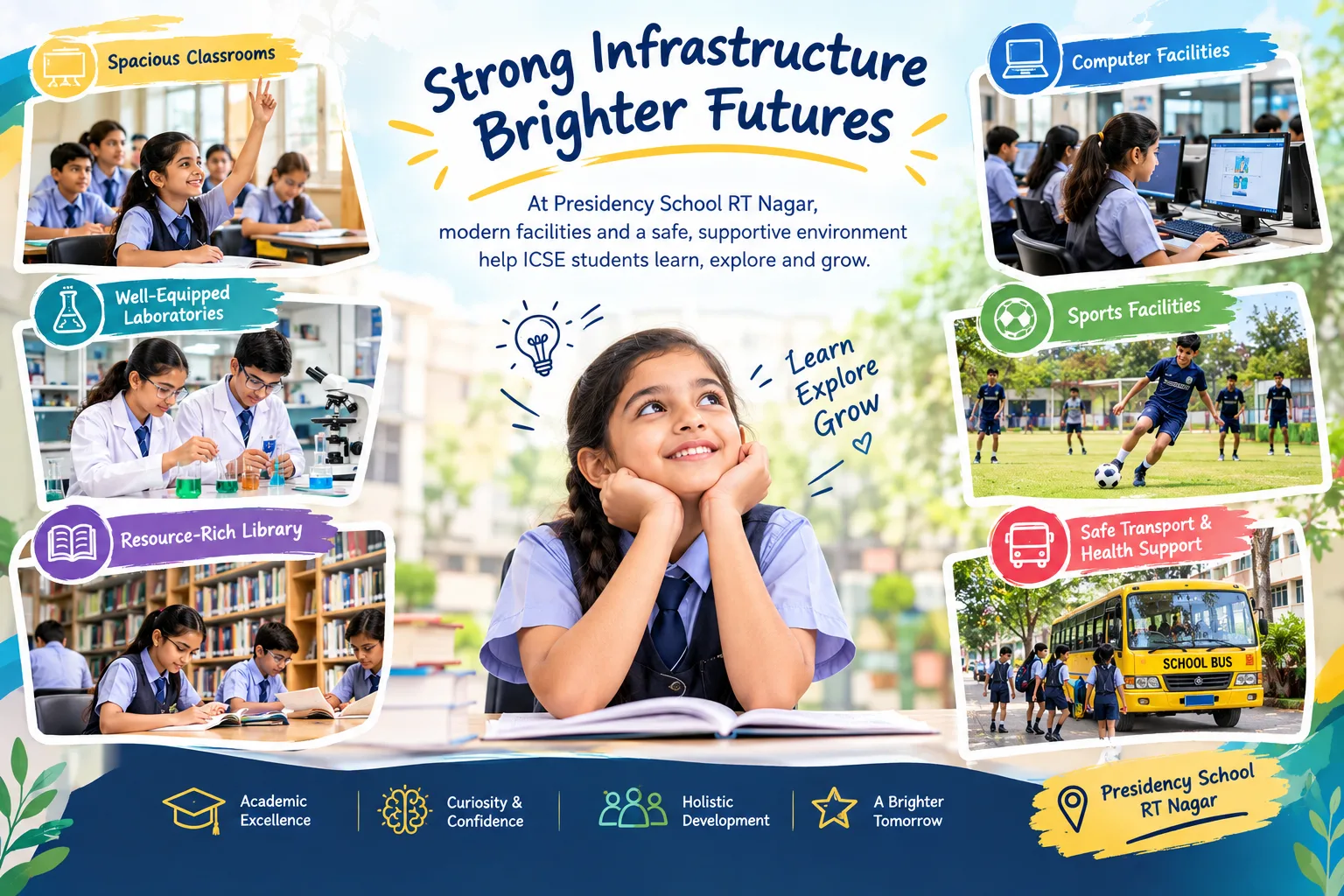
Presidency School RT Nagar provides a supportive ICSE learning environment with spacious classrooms, well-equipped Physics, Chemistry, Biology, Mathematics and Computer laboratories, along with a resource-rich library. These facilities encourage practical learning, research, curiosity and deeper conceptual understanding. Sports facilities, safe transport, sanitation and health support further contribute to students’ academic, physical and overall development.
Conclusion
School infrastructure plays an important role in shaping the learning experience of ICSE students. Comfortable classrooms, laboratories, libraries, computer facilities, creative spaces and sports grounds can support academic understanding and personal development.
For parents exploring best ICSE schools in Bangalore, schools near RT Nagar or schools in RT Nagar, infrastructure should be considered along with curriculum, teachers and student support. A well-equipped and carefully maintained school can encourage curiosity, confidence, discipline and lifelong learning, helping students grow both inside and outside the classroom.