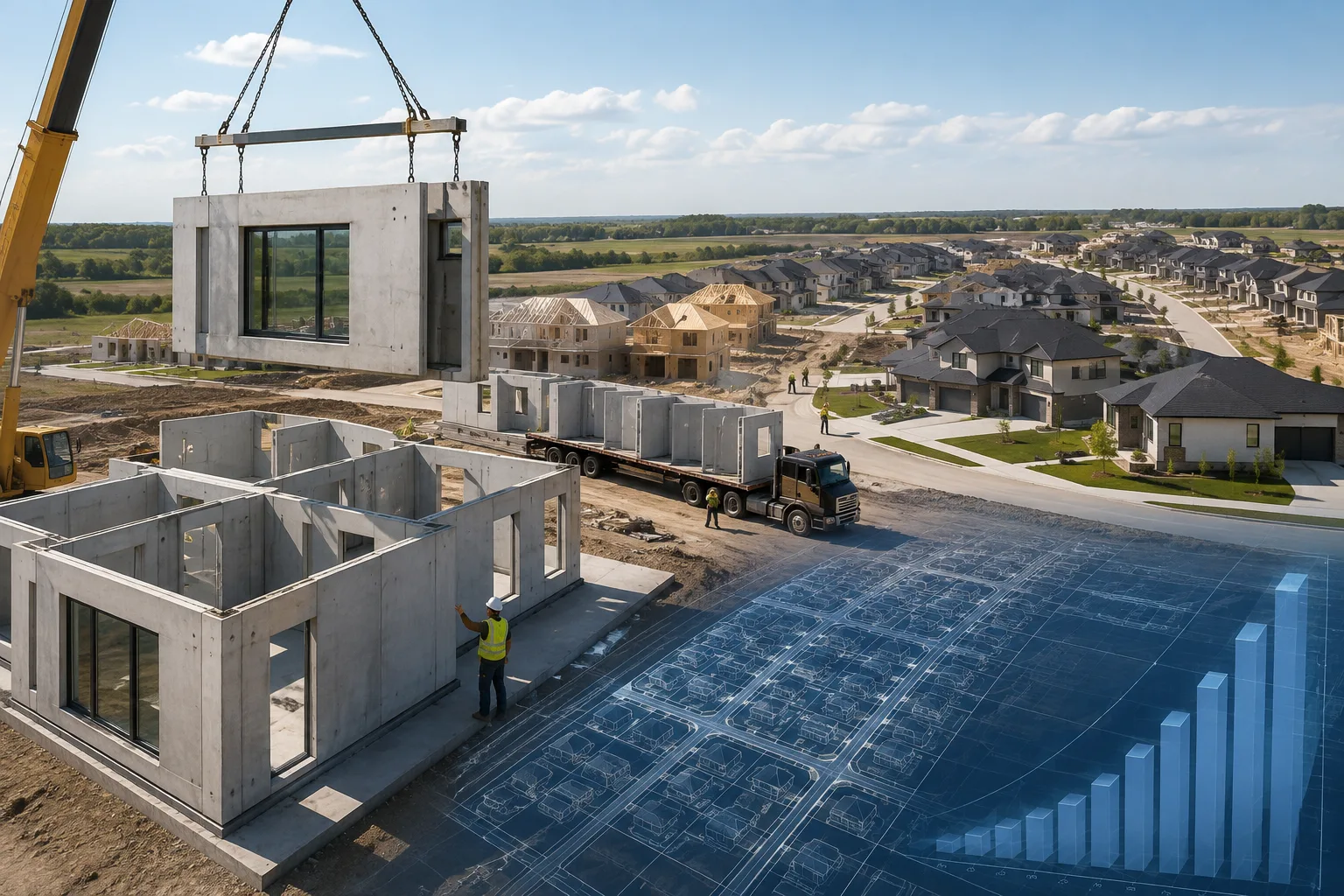
Drive past a new residential development today and you will notice something odd. There is barely any formwork. Almost no scaffolding. A crane sets a wall, a crew braces it, and by afternoon a house has an envelope that would have taken weeks to build a decade ago.
That is precast construction, and it has quietly become the standard way large subdivisions get built.
The basic idea is simple
Instead of pouring concrete on site, the walls, floor slabs, columns, beams, stairs, and even the perimeter fence are cast in a factory. They cure indoors under controlled conditions. Trucks deliver them. A crane sets them in place. Crews connect them.
The house is not built on site. It is assembled there.
Why subdivisions suit this better than towers
Factories reward repetition, and a subdivision is repetition at its purest: three or four house designs, repeated hundreds of times, on flat and open land.
One mold gets used dozens of times. One crew repeats a cycle it already knows. Roads are built early as part of land development, so delivery trucks have access before the first panel arrives. There are no neighbors crowding the crane and no height limits on lifting.
A condominium tower changes floor by floor. A subdivision does not, and that is exactly the point.
Where it goes wrong
Worth knowing before assuming precast is always the better choice. It fails in predictable ways:
- Too few houses. Below roughly 100 units, the cost of building molds never gets recovered.
- Too many designs. Heavy architectural variety cancels out the repetition advantage.
- Difficult land. Steep or irregular terrain makes crane positioning and hauling the bottleneck.
- Too far from a plant. Past roughly 100 kilometers, transport can eat the entire saving.
- Deciding too late. Precast has to be designed in from the start. Switching mid-project loses most of the benefit.
A contractor who admits these limits is usually a better sign than one who does not.
The plant is the real bottleneck
Everything depends on production capacity, and on whether that capacity is already spoken for.
That capacity sits with a handful of players. One construction company Philippines developers hire for large horizontal projects runs a plant producing around 131,000 cubic meters of precast concrete a year. Numbers at that level are what make a 300-house subdivision realistic on a compressed timeline. A contractor without plant access is simply buying panels from someone else, and inheriting their queue.
Distance matters just as much. Precast pieces are heavy and bulky, so hauling them long distances gets expensive fast. Contractors working far from their main facility usually set up mobile batching capacity nearer the site.
What actually changes on the ground
The schedule stops being a straight line. While the factory casts panels, the site handles earthworks, roads, drainage, and foundations. Two things happen at once instead of one after the other.
Weather also stops dictating progress. Concrete cures indoors, so rain that would kill a pour barely affects an erection day. In a country that takes around twenty tropical cyclones a year, that changes an entire program.
And quality becomes measurable. Mix is checked per batch. Dimensions are verified before anything leaves the yard. Steel reinforcement gets consistent concrete cover, which is the single biggest factor in how long a concrete structure lasts.
The part nobody photographs
Precast panels are only as strong as the joints holding them together. Grouted couplers, cast-in plates, and wet joints tie everything into one continuous structure that can handle earthquakes and typhoon-force wind.
This is where quality is either earned or lost. Perfect panels connected by sloppy grouting deliver none of the durability the method promises. Any contractor proposing precast should have test data and inspection records for its connection system.
Why buyers feel the difference
Because houses go up cluster by cluster, developers can turn over completed blocks while later phases are still under construction. Families move in earlier. Developers collect earlier. Financing costs less to carry.
On a several-hundred-unit development, that timing shift often matters more than the construction saving itself.
The takeaway
Precast is not magic and it is not cheaper per piece. It is faster, steadier, and far more predictable, and it demands early decisions and real discipline in return.
The technology is already here at scale. What separates a good precast subdivision from a stalled one is planning, not equipment.