
For decades, the legal industry followed a relatively predictable hierarchy. Large law firms had the biggest teams, the broadest resources, and the strongest ability to handle complex client matters. More lawyers often meant greater capacity.
That assumption is being challenged.
In today’s legal market, many mid-sized law firms are becoming increasingly competitive against much larger firms. Their advantage does not necessarily come from having more attorneys, larger offices, or bigger operating budgets.
It comes from being more flexible.
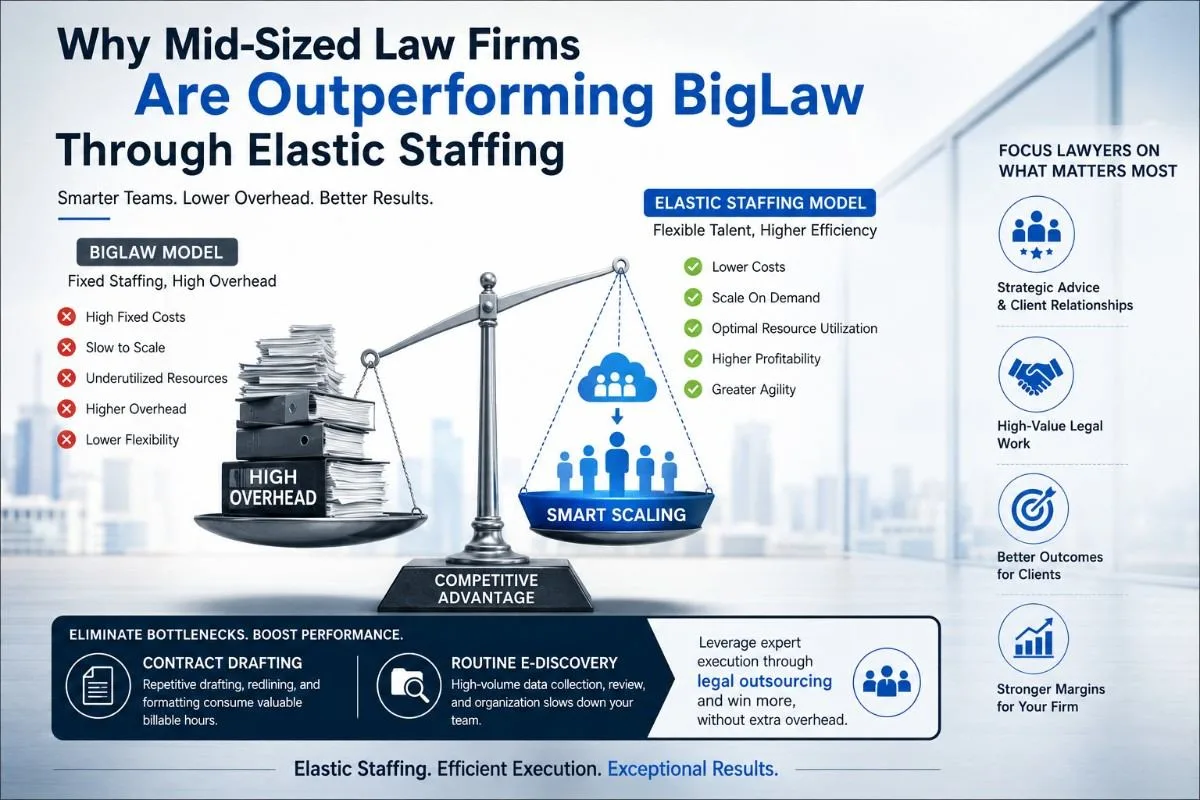
Mid-sized firms are discovering that they do not need to maintain permanent internal teams for every possible workload. Instead, they can build lean core teams and expand operational capacity when demand increases.
This approach, often described as elastic staffing, is changing how law firms manage costs, talent, and client expectations.
The result is a potentially powerful competitive advantage: the ability to scale without carrying the full cost of permanent expansion.
The Traditional BigLaw Advantage Is Becoming Less Certain
Large law firms have historically benefited from scale.
They can employ hundreds or even thousands of professionals across practice areas. When a major litigation matter or transaction arrives, they can allocate substantial internal resources immediately.
However, this model also comes with significant fixed costs.
Large teams require:
- Higher payroll commitments
- Extensive office infrastructure
- Technology investments
- Administrative support
- Recruitment and training
- Management layers
These costs exist regardless of whether every professional is fully utilized.
For mid-sized firms, trying to replicate this model can be financially risky.
Hiring aggressively to prepare for potential future workloads may create unnecessary overhead. Yet failing to scale during busy periods can result in missed opportunities and slower client service.
Elastic staffing offers a middle path.
Instead of permanently building capacity for peak demand, firms can maintain a strong internal core and access additional resources when workloads require them.
The Real Bottleneck: Highly Skilled Lawyers Doing Routine Work
One of the biggest operational challenges facing law firms is not necessarily a shortage of legal talent.
It is the inefficient use of legal talent.
Experienced attorneys often spend substantial time on activities that, while important, do not always require their highest level of strategic expertise.
Two areas are particularly significant:
Contract Drafting and Administration
Contract work can consume a large amount of attorney time.
Initial drafts, revisions, clause comparisons, formatting, document organization, and related administrative activities can create significant workloads.
Of course, complex negotiations and high-risk contractual decisions require experienced legal judgment.
But many supporting tasks surrounding contract workflows are repetitive and process-driven.
When senior lawyers spend excessive billable hours managing routine drafting activities, firms face a difficult question:
Is this the best use of their expertise?
Routine E-Discovery Work
E-discovery presents another major capacity challenge.
Large volumes of electronically stored information may need to be collected, organized, reviewed, categorized, and prepared for legal teams.
The strategic legal decisions surrounding discovery can be highly complex.
However, much of the underlying operational work follows structured workflows.
When internal teams must handle every stage of high-volume discovery internally, workloads can quickly become a bottleneck.
This is where flexible staffing structures can create meaningful advantages.
Elastic Staffing Changes the Economics of Growth
Traditional staffing models require firms to make long-term commitments before demand is guaranteed.
Elastic staffing works differently.
A firm can maintain its core team of partners, associates, and senior legal professionals while expanding operational capacity during periods of increased demand.
For example, additional support may be required during:
- Major litigation
- Large discovery projects
- Mergers and acquisitions
- Contract-heavy engagements
- Regulatory reviews
- Due diligence projects
- Seasonal workload increases
Once the workload decreases, the firm does not necessarily remain responsible for the same level of permanent staffing overhead.
This creates greater financial flexibility.
Mid-sized firms can compete for larger assignments without immediately transforming their entire internal cost structure.
Legal Outsourcing as a Competitive Equalizer
For many firms, legal outsourcing is becoming an important part of this flexible operating model.
The strategic value is not simply lower-cost labor.
The larger advantage is access to scalable execution capacity.
A mid-sized law firm may have highly experienced partners and attorneys but lack the internal resources to efficiently manage a sudden increase in document-heavy or process-intensive work.
Third-party support can help address this gap.
Depending on the engagement and appropriate supervision requirements, external teams may support activities such as:
- Document review
- Legal research
- Contract support
- Litigation support
- E-discovery processes
- Due diligence assistance
- Document management
- Administrative legal workflows
This allows internal attorneys to remain focused on client strategy, complex legal analysis, negotiations, and other high-value responsibilities.
The result is not necessarily a smaller legal operation.
It is a more strategically structured one.
Competing on Speed Without Expanding Overhead
Clients increasingly expect faster responses.
They want contracts reviewed quickly. They expect updates on litigation matters. They want transactions completed efficiently.
For a mid-sized law firm, speed can become a major differentiator.
However, increasing speed through permanent hiring can be expensive.
Elastic staffing provides another option.
By accessing additional execution capacity when required, firms can potentially improve turnaround times without permanently increasing payroll.
This is particularly valuable for firms serving clients with unpredictable workloads.
A client may have relatively modest legal needs for several months and then suddenly require intensive support because of a transaction, dispute, or regulatory issue.
A rigid staffing model can struggle with these fluctuations.
A flexible model is better positioned to adapt.
The Billable Hour Model Is Also Creating Pressure
The traditional billable-hour system creates another challenge.
Clients are becoming increasingly aware of how legal work is performed and how much time is spent on different activities.
They may question why highly experienced lawyers are spending significant billable time on routine operational tasks.
Law firms therefore face pressure to demonstrate greater efficiency.
The answer is not always to eliminate billable work.
Instead, firms can improve how work is allocated.
High-value legal analysis should remain with highly qualified professionals.
Repeatable and process-driven activities can be handled through more efficient workflows and appropriately supervised support resources.
This creates a stronger alignment between expertise and task complexity.
Technology and Third-Party Execution Work Together
Elastic staffing does not operate independently from technology.
Modern law firms are increasingly combining technology with external operational capacity.
Automation can help with:
- Document classification
- Contract comparison
- Information extraction
- Workflow management
- Data organization
However, technology still requires human oversight.
Someone must manage exceptions, review outputs, and ensure quality.
The most effective firms are therefore building hybrid systems that combine:
Legal expertise + Technology + Flexible execution capacity
This model can give mid-sized firms capabilities that were once available primarily to much larger organizations.
The Strategic Advantage of Staying Lean
The biggest advantage for mid-sized firms may be their ability to remain agile.
Large organizations often face complex internal approval structures and significant fixed overhead.
Mid-sized firms can sometimes make operational changes more quickly.
They can experiment with new technologies.
They can redesign workflows.
They can develop specialized partnerships.
They can expand capacity without dramatically increasing permanent headcount.
This agility can allow them to compete effectively for sophisticated legal work while maintaining tighter control over operating costs.
The Future Belongs to Flexible Legal Operations
Mid-sized law firms do not need to become BigLaw to compete with BigLaw.
Instead, they can build a different type of advantage.
The future of legal competition may depend less on the number of professionals permanently employed and more on how effectively a firm can assemble the right resources for each client matter.
Elastic staffing gives firms the ability to scale during periods of high demand while maintaining a leaner cost structure during quieter periods.
When combined with technology, strong internal legal leadership, and carefully managed third-party execution, this approach can transform the traditional limitations of a mid-sized firm into a competitive strength.
The firms that succeed will be those that understand a simple principle:
Clients do not necessarily need the largest legal team. They need the right expertise, delivered efficiently, at the right time.
For mid-sized law firms, that principle may be the key to outperforming much larger competitors in the years ahead.