
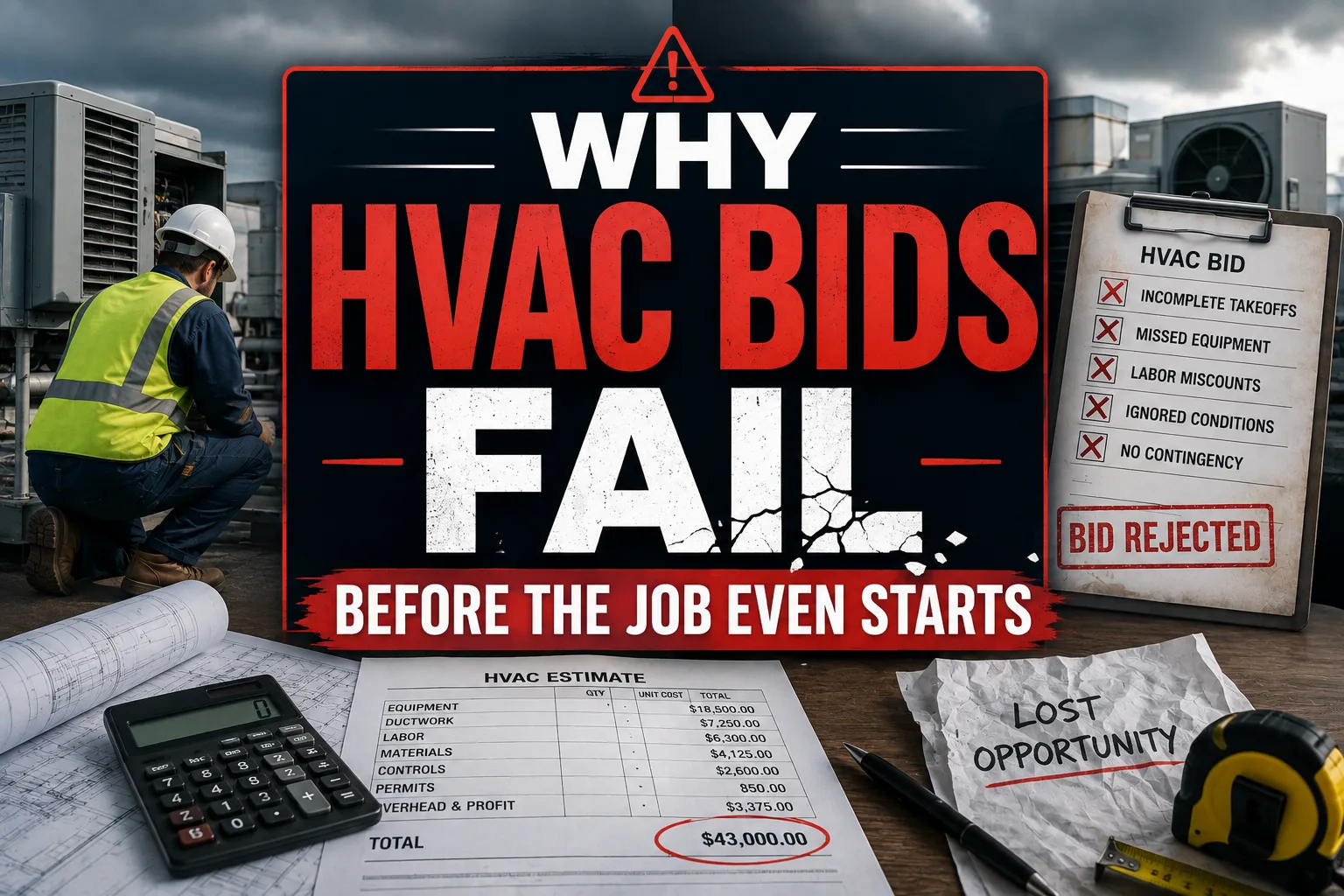
Ask any mechanical contractor about their worst project, and there's a good chance it doesn't start with a construction problem at all. It starts with a bid one that came in too low, missed a piece of ductwork, or priced equipment based on a supplier quote that was already out of date by the time the job began.
HVAC systems are some of the most complicated components in any building. Between ductwork, piping, controls, and equipment that varies wildly by manufacturer and model, a small oversight in the estimate can turn a profitable contract into a break-even job, or worse.
Why HVAC Estimating Is Harder Than It Looks
Unlike simpler trades where materials are relatively uniform, HVAC systems involve dozens of interdependent components that all need to be measured, priced, and coordinated correctly.
The Sheer Number of Moving Parts
A single HVAC package might include ductwork, casings, condensing units, exhaust fans, insulation, piping, pumps, hangers, and building automation controls. Miss the quantity on any one of these, and the error doesn't stay isolated; it ripples through labor calculations, material orders, and ultimately the final bid.
System Variety Across Project Types
Residential, commercial, and industrial buildings all call for very different HVAC approaches. A single-family home might need a straightforward split system, while a hospital or manufacturing plant could require chilled water plants, clean room systems, or energy management controls. Estimators without deep familiarity across system types tend to default to generic pricing, which rarely holds up once the job is underway.
Equipment Pricing That Changes Constantly
Compressor and equipment pricing shifts with supply chain conditions, manufacturer lead times, and regional availability. An estimate built on last month's supplier pricing can already be inaccurate by the time a project breaks ground, especially on jobs with long bid-to-award timelines.
Common Mistakes That Sink HVAC Bids
Underestimating Labor Hours
Ductwork installation, especially in retrofit or renovation projects, often takes longer than initial estimates assume. Tight ceiling spaces, existing structural conflicts, and coordination with other trades all add hours that a rushed estimate tends to overlook.
Overlooking Building Automation and Controls
Modern commercial buildings increasingly rely on building automation systems and energy management controls layered on top of the physical HVAC equipment. Estimators focused only on ductwork and units sometimes treat controls as an afterthought, when in reality they can represent a meaningful share of total project cost.
Ignoring Site-Specific Conditions
A rooftop unit installation on a high-rise with limited crane access costs dramatically more than the same unit going into a single-story building with open site access. Generic per-unit pricing that doesn't account for site logistics is one of the most common ways HVAC bids come in too low.
Skipping a Detailed Takeoff
Rough, eyeballed quantity estimates might save time upfront, but they almost always cost more later. A proper takeoff counting every duct run, fitting, hanger, and piece of equipment from the actual drawings is what separates a bid that holds up from one that unravels mid-project.
What a Reliable HVAC Estimate Should Actually Include
A trustworthy HVAC estimate goes well beyond a single lump-sum number. It should break down into clear, itemized categories that a contractor can actually build a bid around.
- Material quantities and pricing ductwork, casings, insulation, piping, and equipment counted directly from project drawings
- Labor units hours calculated by task and crew type, not a flat percentage guess
- Equipment and fixture counts condensing units, exhaust fans, pumps, and hangers itemized individually
- Overhead, permits, and taxes the often-overlooked line items that quietly erode margin
- Color-coded takeoff sheets a visual reference that makes it easy to verify what was measured and where
When each of these pieces is broken out clearly, a contractor can walk into a bid meeting with confidence instead of crossing their fingers.
Should Contractors Handle HVAC Estimating In-House?
For contractors running a handful of small residential jobs, in-house estimating might be manageable. But once projects scale into commercial or industrial territory hospitals, manufacturing plants, multi-unit residential buildings the complexity of HVAC takeoffs often outpaces what a generalist estimator or a busy project manager can reliably handle alongside everything else on their plate.
This is where specialized support becomes worth considering. Firms that focus specifically on mechanical systems bring a level of detail that's difficult to match without dedicating a full-time team to it. For contractors and fabricators who'd rather not gamble on a rushed in-house takeoff, working with a dedicated provider of HVAC estimating services can mean the difference between a bid built on real quantities and one built on rough guesswork.
Questions to Ask Before Choosing an HVAC Estimating Partner
- Do they have experience across residential, commercial, and industrial HVAC systems, or just one segment?
- What estimating software do they use, and does it integrate with your existing workflow?
- Can they turn around a detailed takeoff within your bid deadline?
- Do they provide itemized reports, or just a single final number?
The answers to these questions tend to separate estimating partners who genuinely reduce risk from ones who just add another layer of guesswork.
Final Thoughts
HVAC projects are unforgiving when it comes to estimating errors; the complexity of the systems means small oversights compound quickly into real financial losses. Contractors who invest in detailed, itemized takeoffs, whether built in-house or through a specialized partner, put themselves in a far stronger position to win bids that are actually worth winning.
A low bid built on guesswork isn't a win. A well-priced bid built on real numbers is.