
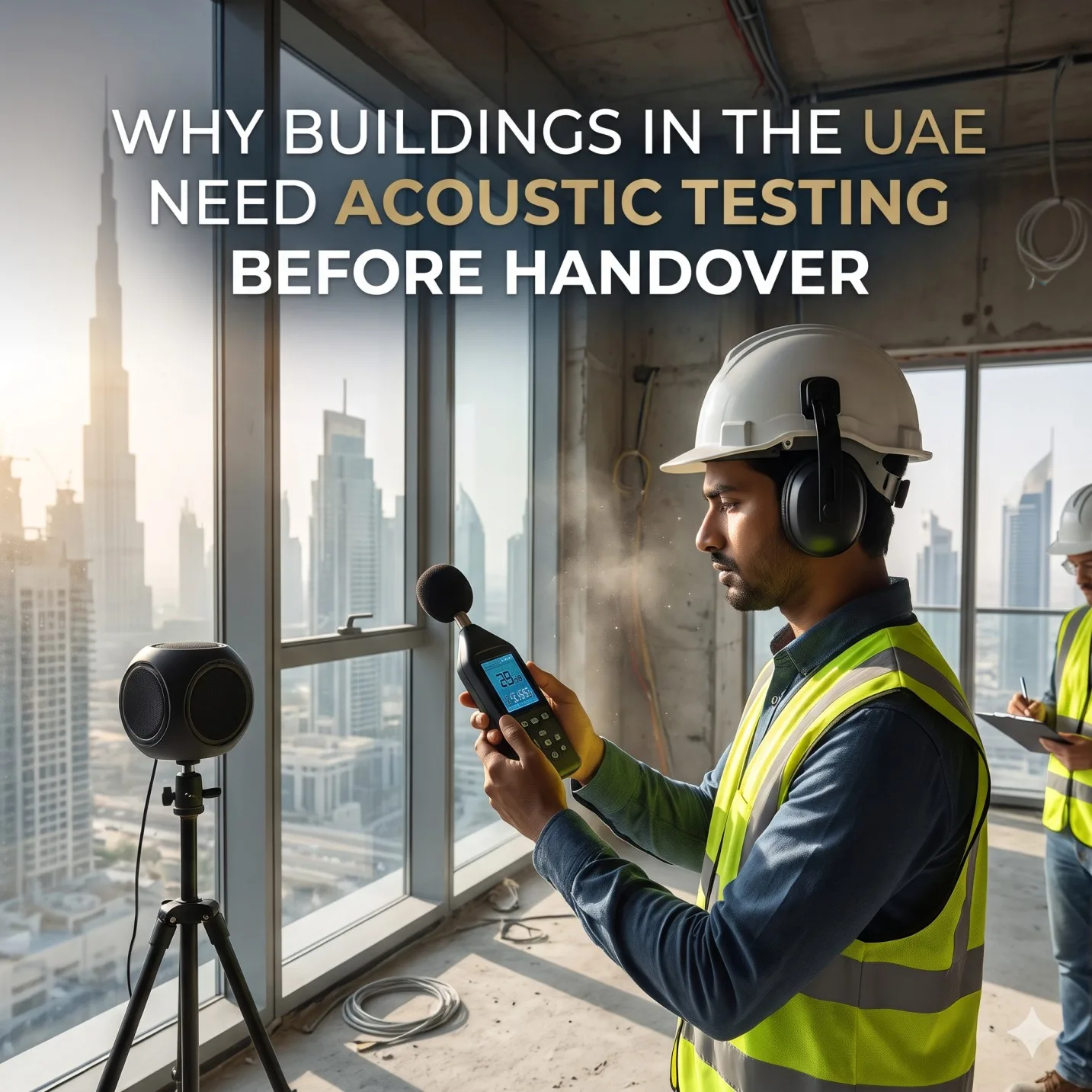
Noise is one of the most overlooked factors in building quality. A property can look flawless, meet every structural code, and still fail to deliver comfort if sound from traffic, adjoining units, or mechanical equipment travels freely through walls, floors, and ceilings. In a region like the UAE, where high-rise living, mixed-use towers, and busy urban corridors are the norm, this is not a minor inconvenience; it is a compliance issue that affects occupant wellbeing, resale value, and a developer's reputation. This is exactly where acoustic testing becomes essential.
Acoustic testing is the scientific process of measuring how sound behaves within a building element or space. It tells engineers, consultants, and developers whether a wall, floor, door, or façade actually performs the way it was designed to on paper. Without this verification, assumptions about noise control remain just that: assumptions, and every stakeholder deserves objective proof of performance before a building is handed over to its occupants.
Understanding Why Sound Performance Matters
At its core, this type of assessment involves using calibrated sound sources and precision measuring instruments to evaluate how sound is transmitted, absorbed, or blocked by a building component. This could mean measuring how much noise passes between two apartments through a shared wall, how much impact sound from footsteps travels through a floor slab, or how effectively a façade keeps out external road and aircraft noise. The results are expressed in standardized ratings that can be compared directly against building codes and project specifications.
For the UAE market specifically, this evaluation has grown in importance alongside the rapid pace of vertical construction. Towers with dozens of floors, shared party walls, and mixed residential-commercial layouts create far more opportunities for sound to travel than low-rise developments. Add to this the region's reliance on HVAC systems running almost year-round, and it becomes clear why mechanical and airborne noise need to be assessed with real measurements rather than design assumptions. Developers who skip this step often discover problems only after residents move in, by which point remediation is expensive, disruptive, and damaging to a project's reputation.
The Core Types of Sound Assessments Used in Construction
This field is not a single procedure but a family of related measurements, each targeting a different way that sound can compromise a building's performance. Understanding these distinctions helps developers know exactly what to request and why.
- Airborne sound insulation measurement checks how effectively a wall, partition, or floor blocks sound that travels through the air, such as voices, television audio, or traffic noise. This is one of the most commonly requested checks in residential and hospitality projects because it directly affects privacy between units.
- Impact sound insulation measurement evaluates how much noise from footsteps, dragged furniture, or dropped objects transmits through a floor into the space below, particularly relevant in multi-story residential buildings and hotels.
- Façade and building envelope noise assessment checks how well exterior walls, windows, and cladding resist external sources like traffic, aircraft, or nearby construction, which is critical in cities with heavy road networks.
- Reverberation time measurement captures how long sound persists in a room after its source stops, which matters in auditoriums, mosques, classrooms, and open-plan offices where speech clarity is a priority.
- Mechanical and HVAC noise assessment measures sound generated by rooftop units, chillers, pumps, and ductwork, ensuring building services do not become a disruptive source of background noise.
Each of these assessments follows internationally recognized standards, and the choice of which ones to perform depends on the building type, its intended use, and the regulatory framework it must satisfy.
How the Testing Process Actually Works
A properly conducted acoustic testing procedure follows a structured, repeatable methodology so that results are accurate and defensible. While the exact setup varies depending on whether the test is for airborne sound, impact sound, or façade performance, the general approach follows similar principles.
A calibrated sound source, such as a loudspeaker generating pink or white noise, or a standardized tapping machine for impact measurement, is positioned in the source room or on the test surface. Precision sound level meters are then placed in the receiving room to capture how much sound energy passes through the separating element, while background noise is recorded separately and subtracted from the readings to isolate the true transmission loss.
This data is then processed across multiple frequency bands, because sound insulation performance is not uniform across all frequencies: a wall might block high-pitched sounds well but perform poorly against low-frequency bass or mechanical hum. This frequency-by-frequency analysis allows engineers to calculate single-number ratings that can be compared against code requirements or green building benchmarks. A detailed report is then issued documenting the methodology, equipment used, environmental conditions, and final results, with a clear pass or fail determination against the applicable standard.
Timing matters too. Testing too early, before finishes and fit-outs are complete, can produce misleading results that don't reflect the final as-built condition. Testing too late, after occupancy, makes remediation far more disruptive and costly. The ideal window is near practical completion, when the building fabric is finished but before final handover documentation is signed off.
Common Issues Uncovered During Sound Assessments
Experience across projects shows that certain problems appear again and again when a thorough acoustic testing programme is carried out. Recognizing these patterns helps project teams anticipate and avoid them during design and construction.
- Flanking transmission, where sound bypasses the main separating wall or floor through a shared structural element, ductwork, or continuous flooring, is one of the most frequent causes of poor performance.
- Gaps and penetrations around electrical outlets, pipework, and service risers often act as unintended sound leaks, undermining an otherwise well-built partition.
- Poorly isolated mechanical equipment, including HVAC units and pumps mounted without adequate vibration isolation, can transmit low-frequency noise through the building structure itself.
- Inadequate door and window seals on façade systems frequently reduce the overall rating of an otherwise high-performing envelope, particularly in units facing busy roads.
- Floor finishes installed without appropriate underlayment can significantly increase impact sound transmission, even when the base slab was designed to meet code requirements.
Identifying these issues before handover allows contractors to implement corrective measures while access is still straightforward, rather than after walls have been finished and units occupied.
Why Professional Expertise Matters
Acoustic testing requires more than owning the right equipment. Accurate results depend on correct instrument calibration, proper test setup, careful control of background noise, and sound engineering judgment when interpreting frequency-dependent data. A poorly executed test can produce results that look official but do not reflect real-world performance, creating false confidence and leaving genuine noise problems undetected.
This is why working with an experienced, independent testing and inspection partner matters. Cornerstone Middle East has built its reputation on this kind of technical rigor, offering specialized testing services that go well beyond a simple checklist. Its engineers combine calibrated instrumentation with real project experience across the UAE and wider GCC region, ensuring every report is technically sound and practically useful for contractors resolving issues before handover.
What distinguishes Cornerstone Middle East is how sound performance is integrated into a broader building evaluation approach. Rather than treating noise insulation as an isolated metric, its engineers consider it alongside air leakage, water penetration, and overall envelope integrity, since the same defects that compromise airtightness often compromise acoustic performance too. This gives clients a clearer picture of where a building's fabric needs attention, rather than a series of disconnected certificates.
The Business Case for Sound Testing in UAE Developments
Beyond compliance, there is a strong commercial argument for investing in acoustic testing. Noise complaints are among the most common sources of disputes between residents and building management in dense urban developments, and they translate into reputational damage, costly retrofit work, and sometimes legal liability if a unit fails to meet promised performance standards.
For developers pursuing green building certifications such as LEED, Estidama, or BREEAM, sound performance is frequently a scored credit category, and verified results can strengthen a project's sustainability credentials. Hotels, in particular, rely heavily on guest comfort reviews, and poor sound insulation between rooms is one of the most frequently cited complaints online, making proactive testing a direct investment in brand reputation.
Facility management teams also benefit from having this data on file. When a tenant raises a noise complaint years after occupancy, a documented baseline from commissioning-stage testing allows the team to quickly determine whether the issue stems from a construction defect or normal variation, rather than starting an investigation from scratch.
Choosing the Right Testing Partner
Selecting a provider for acoustic testing should involve more than comparing quotes. Project teams should look for demonstrable experience across the specific building type in question, whether residential towers, healthcare facilities, schools, or hospitality venues, since each sector carries different acoustic expectations and regulatory references. Equipment calibration records, adherence to recognized international standards, and the clarity of final reporting are all practical indicators of reliability.
Timeliness also matters. Construction schedules in the UAE move quickly, and a testing partner who can mobilize efficiently, deliver clear results, and explain remediation options without delay adds real value to a project's critical path. Cornerstone Middle East has positioned itself around exactly these priorities, combining certified expertise, advanced instrumentation, and a customer-focused approach that keeps contractors informed throughout the process rather than leaving them to interpret a dense report alone.
Final Thoughts
Sound may be invisible, but its effects on comfort, compliance, and long-term building value are very real. Acoustic testing gives developers, contractors, and facility managers the objective data they need to confirm that walls, floors, façades, and mechanical systems perform as designed, rather than hoping they do. In a construction market as fast-moving and competitive as the UAE's, building this verification step into every project is no longer optional; it is a mark of genuine quality assurance.
Working with a specialized, experienced partner removes the guesswork from this process. Cornerstone Middle East brings together technical precision, regional regulatory knowledge, and a track record of successful projects across the UAE and GCC to help developers deliver buildings that are structurally sound and genuinely comfortable to live and work in. For any project where noise performance matters, involving Cornerstone Middle East early, rather than after complaints start arriving, is the difference between reactive fixes and proactive, verified quality.