
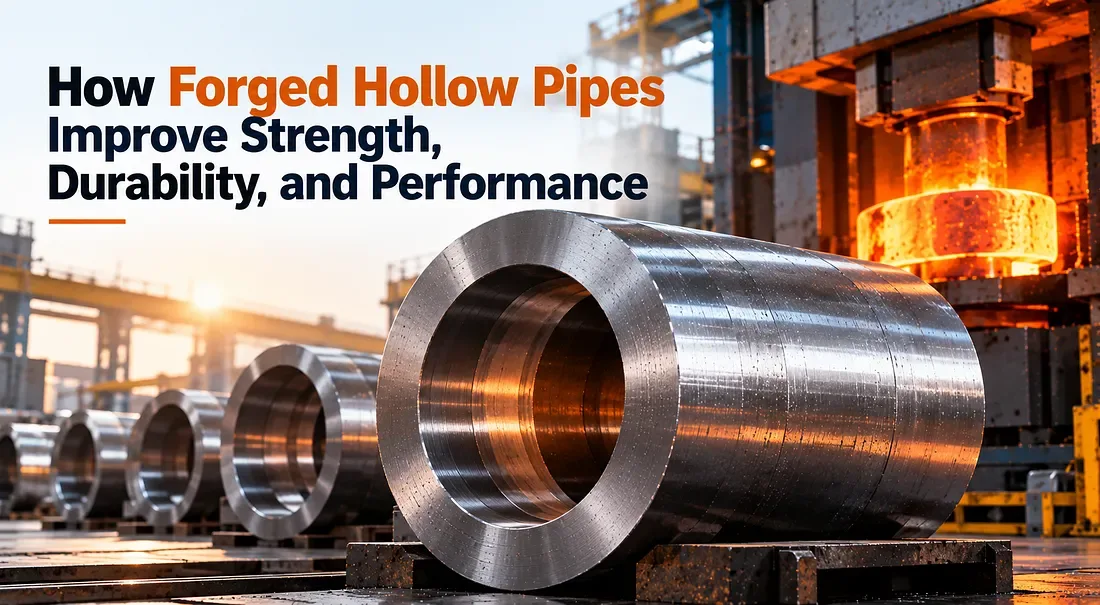
Forged hollow pipes are metal components manufactured through forging processes to achieve specific dimensions and mechanical properties. They are considered for demanding industrial applications where structural integrity, material efficiency, and reliable performance are important.
Unlike conventional solid components that require extensive material removal to create a hollow centre, appropriately designed hollow forgings can reduce machining requirements and improve material utilisation. Their actual performance depends on the material grade, manufacturing process, wall thickness, heat treatment, and application requirements.
For industries such as oil and gas, power generation, mining, and heavy engineering, understanding these factors helps OEMs select the right components for their equipment.
What Are Forged Hollow Pipes?
Forged hollow pipes are hollow metal components produced by shaping heated metal under compressive force. Depending on the manufacturing route, the process may involve piercing, mandrel forging, or other specialised forging techniques to create the required internal and external geometry.
These components can be manufactured from carbon steel, alloy steel, stainless steel, and other suitable alloys, depending on the intended application.
Forged hollow components are used as starting forms for products such as hollow shafts, sleeves, cylinders, rings, and specialised industrial parts. Their suitability depends on the component design, dimensions, material requirements, and applicable engineering standards.
It is important to distinguish forged hollow components from seamless pipes produced through other manufacturing routes. Although both may have a hollow structure, their manufacturing processes, dimensional capabilities, and mechanical properties can differ.
How Do Forged Hollow Pipes Improve Strength?
Forging can improve the structural integrity of metal components by shaping the material through controlled compressive deformation. Under suitable process conditions, it can refine the grain structure and develop grain flow that follows the component's general geometry.
This can help produce components with mechanical properties suited to demanding industrial applications.
Several factors influence the strength of a forged hollow component:
- Material grade: Determines important characteristics such as strength, toughness, and resistance to particular operating conditions.
- Forging process: Influences material deformation, grain flow, and potential internal defects.
- Wall thickness: Affects load-bearing capacity, stiffness, and resistance to deformation.
- Heat treatment: Helps achieve the required mechanical properties and microstructure.
- Quality inspection: Helps verify that the finished component meets specified requirements.
A hollow component is not automatically stronger than a solid one. Its performance must be evaluated against the intended loads, dimensions, material properties, and design requirements.
What Are the Main Benefits of Forged Hollow Components?
Forged hollow components can offer several advantages when the manufacturing process and component design are matched to the application.
1. Efficient Material Utilisation
Hollow geometry can reduce the amount of metal used in the central region of a component compared with an equivalent solid design.
When a suitable hollow forging can be produced directly, it may also reduce the material that would otherwise be removed during machining.
This can help manufacturers optimise material usage, reduce machining effort, and potentially lower production costs.
The actual savings depend on component dimensions, manufacturing yield, tolerances, and the finishing operations required.
2. Strength and Structural Integrity
Forging applies compressive forces to shape metal. When the process is properly controlled, it can produce a favourable grain structure and mechanical properties for demanding applications.
This makes forged components worth considering for industrial equipment exposed to significant mechanical loads or repeated operating cycles.
However, strength depends on the complete manufacturing process—not forging alone. Material selection, heat treatment, design, and inspection remain essential.
3. Durability Under Demanding Conditions
Industrial components may be exposed to vibration, pressure, temperature variations, cyclic loads, or corrosive environments.
Forged hollow components can be designed for such conditions when their material, geometry, manufacturing process, and quality requirements are appropriate.
Manufacturers must control important production stages, including raw material verification, forging, heat treatment, machining, and final inspection.
Correct specification and maintenance are also important for achieving the intended service life.
4. Customised Dimensions and Engineering Flexibility
Heavy-industry applications often require components with specific internal diameters, external diameters, wall thicknesses, lengths, and material properties.
Forging can support the manufacture of customised hollow components for suitable applications.
Early collaboration between OEM engineering teams and the forging manufacturer helps determine whether the requested dimensions and tolerances are practical, which manufacturing route is appropriate, and what additional machining or testing may be required.
5. Potentially Lower Manufacturing Costs
The cost of a hollow component depends on more than its initial purchase price.
A suitable forged hollow blank may reduce machining time, material waste, and the number of manufacturing operations compared with an alternative production route.
To evaluate the overall cost, OEMs should consider raw material utilisation, forging yield, machining requirements, inspection, transportation, and expected component life.
The most cost-effective option is the one that meets the engineering specification while minimising total manufacturing and lifecycle costs.
How Are Forged Hollow Pipes Manufactured?
The manufacturing process varies according to the material, component geometry, dimensions, and required properties. A typical process may include the following stages.
Step 1: Raw Material Selection
The manufacturer selects a suitable metal grade based on the component's mechanical, thermal, environmental, and dimensional requirements.
Material certificates and incoming inspections help verify that the starting material meets the specification.
Step 2: Controlled Heating
The material is heated within an appropriate temperature range to allow it to be deformed during forging.
Temperature, heating time, and material condition must be controlled to minimise problems such as cracking, excessive oxidation, or undesirable grain growth.
Step 3: Forging and Hollow Formation
The heated material is shaped using a suitable forging process. Depending on the component, this may include piercing, mandrel-based operations, or other methods for forming the hollow section.
The manufacturing route must be selected according to the required dimensions, material behaviour, and component design.
Step 4: Heat Treatment
Heat treatment may be used to achieve the required hardness, strength, toughness, and microstructure.
The specific treatment depends on the alloy and the applicable technical specification.
Step 5: Machining and Finishing
Machining brings the component to its required dimensions and tolerances. Critical features may include internal diameter, external diameter, wall thickness, length, and surface finish.
Step 6: Inspection and Testing
The finished component is checked against the required specifications. Depending on the application, testing may include dimensional inspection, hardness testing, mechanical testing, chemical analysis, and non-destructive testing.
Traceability and documentation help establish that the component meets the customer's requirements.
Where Are Forged Hollow Pipes Used?
Forged hollow components are used in a range of industrial applications where their geometry and mechanical properties meet specific engineering requirements.
Oil and gas: Selected pressure-containing equipment, specialised fittings, and engineered components may require hollow forgings manufactured from suitable materials and qualified to the relevant specifications.
Power generation: Hollow shafts, sleeves, and other engineered components may be used in equipment designed for demanding mechanical and thermal conditions.
Mining and construction: Heavy machinery may incorporate hollow components where weight, structural requirements, and manufacturing geometry make them suitable.
Heavy engineering: Industrial machinery and process equipment can require customised hollow forgings for specialised assemblies.
Not every application is suitable for a forged hollow component. Engineers must assess operating pressure, loading, temperature, corrosion exposure, fatigue, and applicable industry standards before selecting the manufacturing route.
How Should OEMs Select a Forged Hollow Pipe Manufacturer?
OEMs should evaluate a manufacturer's technical capabilities before placing an order. The most important considerations include:
- Material expertise: Can the manufacturer work with the specified steel or alloy grade?
- Dimensional capability: Can it produce the required internal diameter, external diameter, wall thickness, and length?
- Forging capability: Does it have a suitable process and production capacity for the component?
- Heat treatment and machining: Can the manufacturer achieve the specified mechanical properties and final dimensions?
- Inspection and testing: Are the required testing methods and documentation available?
- Traceability: Can the component be linked to its raw material and manufacturing records?
- Industry experience: Does the manufacturer understand the technical requirements of the intended application?
These checks help procurement and engineering teams assess suppliers based on capability, quality, and suitability—not price alone.
CHW Forge: Forging Capabilities for Industrial Applications
CHW Forge is an Indian forging manufacturer serving industrial sectors including heavy engineering, power generation, oil and gas, mining, construction, and aerospace.
For OEMs evaluating hollow forgings and other engineered components, the relevant considerations include manufacturing capacity, material selection, component dimensions, heat treatment, machining, inspection, and compliance with customer specifications.
CHW Forge's official website and industry pages provide further information about its industrial applications and manufacturing capabilities.
OEMs should confirm the availability of a specific hollow component, its dimensions, material grade, testing requirements, and applicable certifications directly with the manufacturer before placing an order.
Frequently Asked Questions About Forged Hollow Pipes
Are forged hollow pipes stronger than conventional pipes?
Not necessarily. Strength depends on the material, manufacturing process, dimensions, heat treatment, and quality requirements. Forging can provide favourable material properties under suitable conditions, but performance must be verified against the intended application.
What is the difference between a forged hollow pipe and a seamless pipe?
A forged hollow component is shaped through a forging-based process, potentially involving piercing or mandrel operations. Seamless pipes can be manufactured through other processes, such as rotary piercing and rolling. The manufacturing route affects the component's dimensions, properties, and suitability for a particular application.
Which materials are used for forged hollow components?
Common options include carbon steel, alloy steel, and stainless steel. Specialised alloys may be required for particular temperature, corrosion, pressure, or mechanical conditions. The material should always be selected according to the engineering specification.
Do forged hollow pipes reduce machining costs?
They can. When the hollow geometry is produced during forging, less material may need to be removed during machining. Savings depend on the component design, starting dimensions, machining allowances, production volume, and manufacturing yield.
How is the quality of forged hollow components checked?
Quality checks may include dimensional inspection, material verification, mechanical testing, hardness testing, and non-destructive testing such as ultrasonic examination when specified. The required inspection plan depends on the component and its application.
How can OEMs choose the right forged hollow component?
OEMs should define the operating conditions, material grade, dimensions, mechanical properties, inspection requirements, and applicable standards. They should then evaluate manufacturers based on their ability to meet those specifications consistently.
Final Thoughts
Forged hollow pipes and hollow forgings can provide an effective manufacturing solution when industrial applications require carefully engineered geometry, reliable mechanical properties, and efficient material utilisation.
Their performance depends on the relationship between material selection, forging technique, heat treatment, machining, inspection, and component design.
For OEMs, the best sourcing decision begins with a clear understanding of the application's requirements and a thorough evaluation of the manufacturer's capabilities.
As heavy industries demand increasingly specialised components, forged hollow components remain an important option for engineering solutions where strength, durability, dimensional accuracy, and manufacturing quality matter.