Blockchain startups often begin with the part of the product that feels most differentiated: smart contracts, token mechanics, consensus rules, or protocol design. But a working contract is not the same thing as a working product.
Teams evaluating blockchain software development services increasingly have to think beyond contract deployment and consider the backend infrastructure, data systems, integrations, wallets, operational tools, and user workflows surrounding the blockchain.
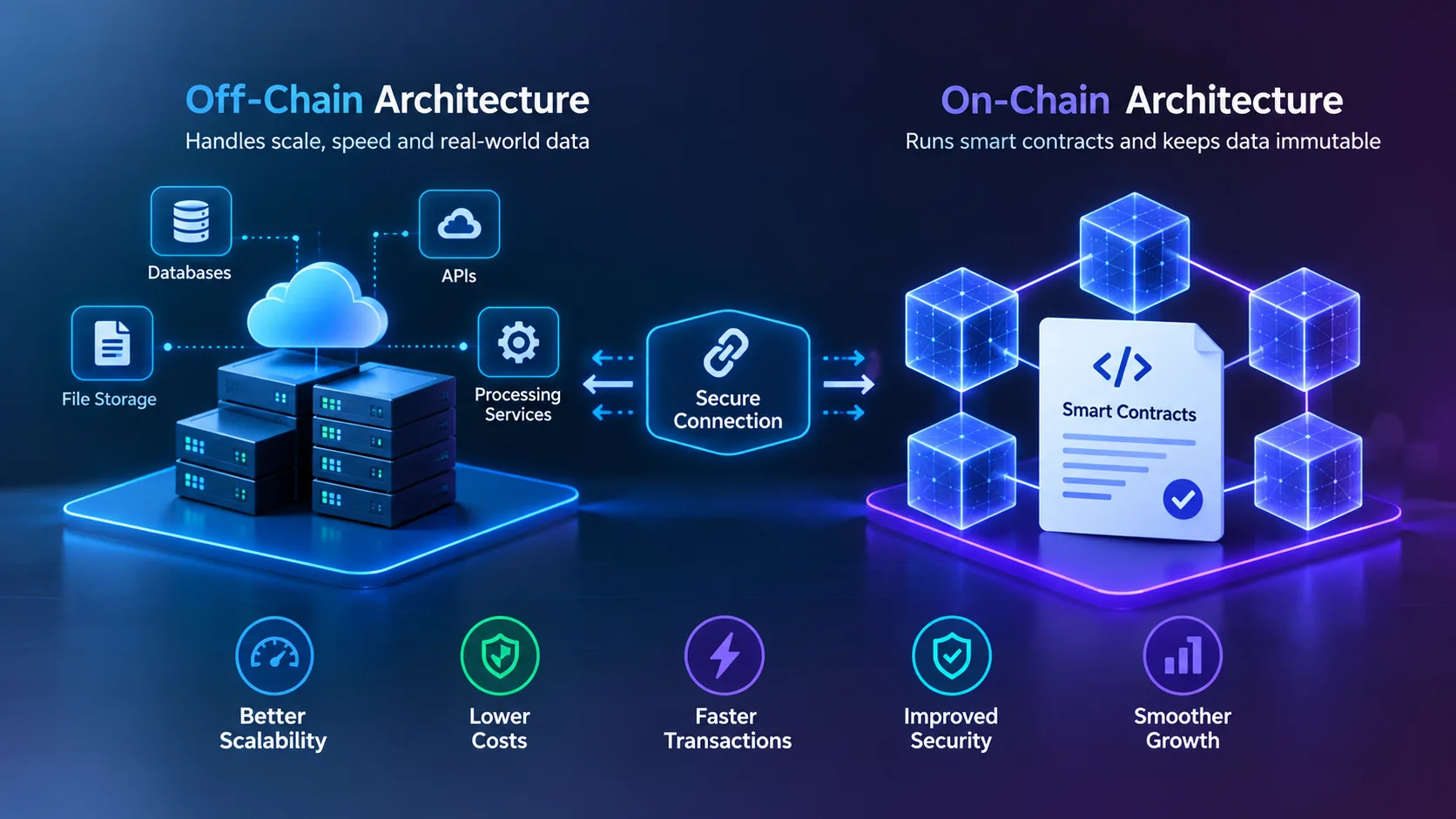
Smart contracts may define what can happen on-chain. Off-chain architecture determines whether people can actually use it reliably.
Smart Contracts Are Not the Whole Product
A smart contract can define ownership, execute a swap, distribute tokens, enforce collateral requirements, or record an asset transfer. It cannot, by itself, provide the complete experience users expect from software.
Users still need to create or connect wallets, understand transaction states, search historical activity, receive notifications, recover from errors, manage permissions, and interact with customer support.
Businesses need even more: dashboards, reporting, monitoring, APIs, analytics, access controls, transaction reconciliation, compliance workflows, and administrative tools.
This means decentralized applications are rarely entirely decentralized systems. Instead, they usually combine on-chain logic with substantial off-chain infrastructure.
For many blockchain startups, that infrastructure eventually becomes a larger engineering surface than the smart contracts themselves.
Why Startups Underestimate Off-Chain Complexity
Early blockchain teams naturally concentrate on the protocol layer because it contains the technical innovation they are trying to prove.
A DeFi startup may focus on liquidity mechanics. A tokenization company may concentrate on asset issuance. A Web3 marketplace may spend months refining contract-based ownership and settlement.
Once the product reaches real users, however, different problems appear.
The team needs blockchain indexing so the interface can display activity quickly. Wallet onboarding has to work for users unfamiliar with seed phrases or gas fees. Backend systems need to synchronize blockchain events with application records.
Additional requirements soon appear around:
· transaction monitoring and reconciliation;
· API integrations;
· user permissions;
· gas management;
· notification infrastructure;
· customer support tools;
· admin dashboards;
· compliance reporting;
· fraud and risk controls.
None of these problems disappear simply because the core transaction happens on-chain.
The Product Risks of Weak Off-Chain Architecture
Poor off-chain systems can make technically sound blockchain applications feel unreliable.
Consider a tokenization platform where an asset transfer succeeds on-chain but the user dashboard continues displaying the previous owner for several minutes. Technically, the blockchain worked. From the user’s perspective, the product did not.
Similar problems occur when a transaction fails but the application cannot explain why, when indexing delays cause incomplete histories, or when a support team cannot reconstruct what happened during a user’s interaction.
Weak architecture can also create operational problems.
Compliance teams may lack usable audit trails. Customer service agents may have no internal view of wallet activity. An application may repeatedly query blockchain nodes for information that should have been indexed and cached, increasing both latency and infrastructure costs.
The result is a product whose blockchain layer may be robust while everything surrounding it remains fragile.
Off-Chain Architecture Is Where Usability Happens
Most mainstream users do not want to think in terms of smart contract calls, signatures, block confirmations, nonce conflicts, or RPC errors.
They want to know whether a payment succeeded.
They want to understand what they are signing.
They want to see where their assets are.
And when something goes wrong, they want an explanation.
That experience depends heavily on off-chain architecture.
Wallet connection flows can simplify authentication. Account abstraction can reduce the amount of blockchain knowledge required from users. Transaction services can translate blockchain states into understandable statuses such as pending, confirmed, failed, or awaiting another action.
Event-processing systems can trigger notifications when transactions settle. Backend services can prepare transactions before presenting them for signatures. Recovery processes can help users resolve failed workflows without exposing the underlying protocol complexity.
In successful Web3 product development, the blockchain frequently operates in the background rather than dominating the interface.
Data Indexing Is a Core Blockchain Product Requirement
Blockchains contain enormous amounts of useful information, but that does not mean the information is immediately suitable for an application.
Product teams often need to transform raw events and transactions into structured application data.
A DeFi interface, for example, may need to reconstruct positions, deposits, withdrawals, rewards, collateral ratios, and liquidation activity from several contracts. A tokenization platform might need to combine token ownership with off-chain information about the underlying asset.
An NFT marketplace needs searchable metadata, ownership history, listings, offers, and pricing information. A supply-chain application may combine blockchain events with shipments, organizations, documents, IoT devices, and external databases.
These products require indexing services that read blockchain events, validate them, organize them into useful models, and make them available through fast APIs.
Caching also matters. Querying a blockchain node every time a user opens a dashboard is rarely the best architecture for a scalable consumer application.
Blockchain data must therefore be treated as source data rather than automatically product-ready data.
When Blockchain Startups Need Custom Architecture
Different blockchain products require very different combinations of on-chain and off-chain components.
A DeFi protocol may prioritize high-frequency transaction monitoring, pricing data, liquidation infrastructure, and wallet analytics.
A tokenization platform could require identity verification, document management, investor eligibility checks, asset administration, reporting, and integrations with traditional financial systems.
A blockchain marketplace may need search infrastructure, messaging, reputation systems, payment workflows, and dispute management.
Wallet applications have their own requirements around authentication, signing, recovery, transaction simulation, security, and network support.
For products like these, custom blockchain development often involves designing the complete application architecture around the blockchain rather than treating smart contracts as an isolated development project. User workflows, data models, APIs, security boundaries, integrations, and scaling requirements need to work as one system.
The correct architecture therefore depends on what the product actually needs to accomplish, not simply which blockchain it uses.
Security Does Not Stop at the Smart Contract
Smart contract audits are critical, particularly when contracts control significant financial value.
But an audited smart contract does not make the entire application secure.
Attackers may target APIs, cloud infrastructure, databases, administrator accounts, wallet integrations, session management, private keys, signing services, or third-party integrations instead.
Administrative tooling deserves particular attention. A highly secure protocol connected to an inadequately protected admin panel can still create significant risk.
Blockchain startups should therefore model security across the full system.
That includes access controls, secrets management, API authentication, transaction authorization, infrastructure monitoring, logging, dependency management, key storage, incident response, and appropriate separation between privileged components.
The attack surface extends far beyond Solidity or whichever smart contract language the startup uses.
How Blockchain Startups Can Build Without Overengineering
Recognizing the importance of off-chain infrastructure does not mean building an enormous platform before launching.
Startups still need to preserve speed.
A practical sequence is:
1. Define the specific reason blockchain is necessary.
2. Decide which operations genuinely need to happen on-chain.
3. Map complete user workflows before expanding the contract layer.
4. Plan how blockchain events will be indexed and stored.
5. Design understandable transaction states and error handling.
6. Build wallet onboarding and recovery processes appropriate for the target audience.
7. Give operations and support teams the internal tools they need.
8. Monitor transactions, infrastructure costs, failures, and system performance.
9. Secure backend services and privileged workflows alongside the contracts.
10. Add architectural complexity only when actual product usage justifies it.
This approach keeps blockchain startup development focused on product requirements rather than technical novelty.
It also makes architecture easier to evolve. Teams can keep critical trust-sensitive actions on-chain while using conventional infrastructure where it improves performance, cost, privacy, or usability.
The Best Blockchain Products Will Feel Simple
Blockchain products do not become more valuable by exposing more blockchain complexity.
For most users, the ideal experience is the opposite.
Transactions should be understandable. Wallet interactions should feel predictable. Data should appear quickly. Failures should have useful explanations. Support teams should be able to diagnose problems. Compliance and operational teams should have the information they need.
Smart contracts remain an important foundation for many decentralized applications, but they are only one layer of a production system.
The blockchain may determine how value and ownership move. Off-chain architecture determines whether the resulting product can operate as dependable software.
For startups trying to move from protocol concept to scalable product, building that architecture may be more important than adding the next smart contract.