
Nobody walks into a dental appointment hoping to hear they need a filling. And when the dentist starts talking about material options- composite versus amalgam, white dental fillings versus silver- it can feel like being handed a pop quiz you did not study for. The truth is, both types of filling have been used successfully for a very long time. But they are not the same, and the choice between them matters more than most people realise. Especially now, with amalgam being phased down across the UK, and patient expectations shifting toward something that looks and feels more natural.
Here is the good news. You do not need a dental degree to make a smart decision about this. You just need the right information laid out plainly. At Turriff Dental Care, their team have these conversations with patients regularly, and we know the questions that come up most. In this blog, we will walk through the real differences between white and amalgam fillings, cover what the NHS will and will not pay for, and give you a practical checklist you can use before your next visit.
Why White Dental Fillings Keep Winning People Over?
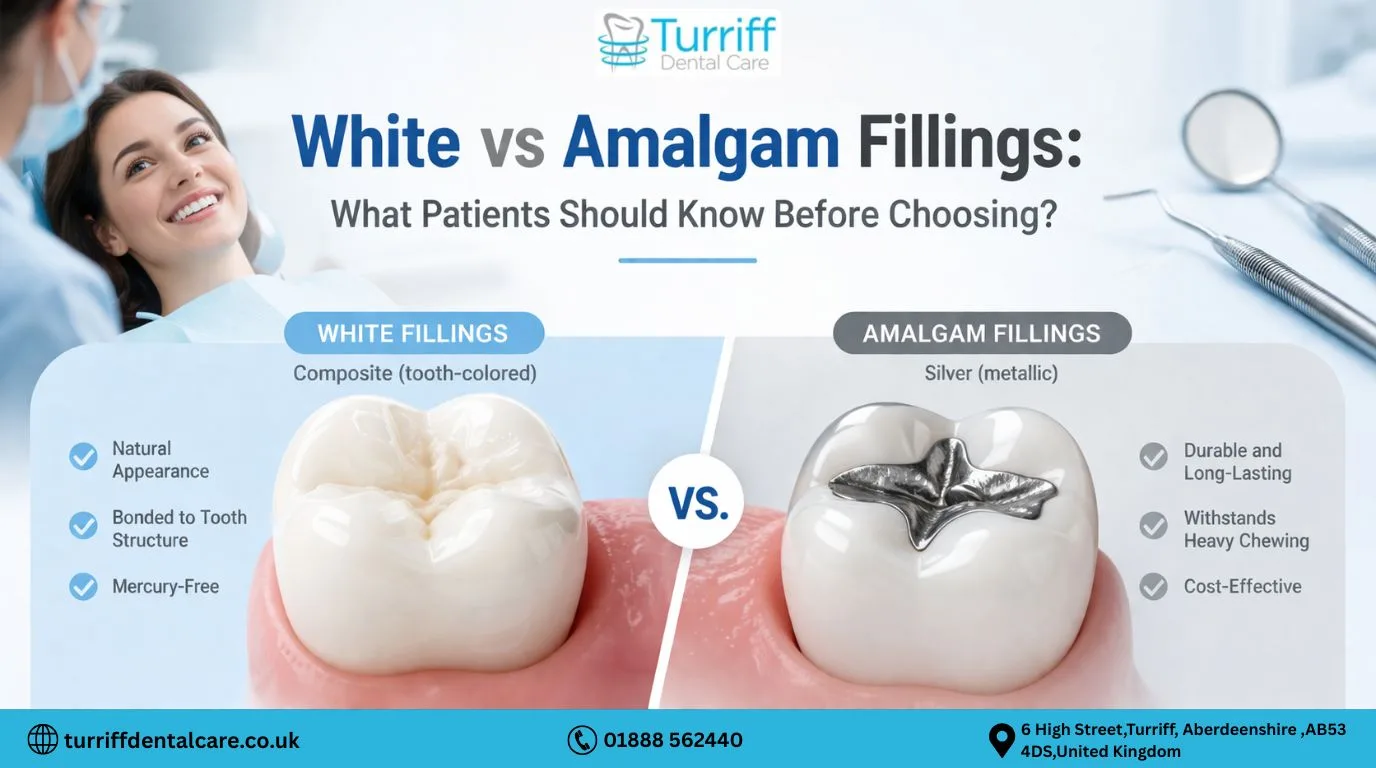
White dental fillings are made from a tooth-coloured composite resin. Your dentist colour-matches them to your actual teeth, so once the filling is in, most people cannot tell it is there. That natural appearance is a big reason patients gravitate toward them- but it is far from the only one.
A few things that set them apart-
- The material bonds directly to your tooth, so less drilling is needed, and more healthy structure stays intact.
- If a piece chips off a few years later, your dentist can usually patch it without starting from scratch.
- No mercury. No metals. That peace of mind matters to a lot of people.
- They work well whether the filling goes on a front tooth or a back one.
White dental fillings are not some trendy new option. They have been around for decades. What has changed is that the materials have gotten significantly better, and patients have gotten more particular- quite rightly- about what goes into their mouths.
Does Amalgam Still Have a Place?
You could argue it does- just a much smaller one than before.
Amalgam has been used in dentistry for close to two hundred years. It is a mix of silver, tin, copper, and mercury, and it is undeniably tough. For large cavities on back molars- the teeth doing the heaviest lifting- it has historically been a reliable workhorse.

What still works in its favour-
- It lasts. Ten to fifteen years is typical, and plenty of amalgam fillings go well beyond that.
- It costs less, particularly through the NHS.
- It handles biting force on back teeth without flinching.
But here is where the tide has turned. People do not love the look of silver in their mouth. They have questions about mercury, even though the levels are considered safe. And placing amalgam means removing more of the healthy tooth than composite requires. Add in the fact that supply is literally drying up as regulations tighten, and amalgam starts to feel like yesterday's answer to today's question.
White Fillings and the NHS: What Is Actually Covered?
This trips people up more than almost anything else, so let us keep it simple.
If you need a filling on a front tooth, the NHS will typically provide a white one. No argument, no drama. Front teeth get composite as standard because, well, nobody wants visible silver at the front of their smile.
Back teeth are a different story. The NHS has traditionally used amalgam for molars because it was cheaper and faster. White fillings NHS coverage on back teeth only kicks in when there is a genuine clinical reason- an allergy to one of the metals in amalgam, or a specific situation where composite is the better clinical call.

Want a white filling on a back tooth just because you prefer how it looks? Completely reasonable. But you will probably need to cover it privately.
Numbers-wise, NHS Band 2 treatment is £75.30. At Turriff Dental Care, private fillings start from about £135 for white composite and £80.50 for amalgam, with final costs depending on the tooth and complexity.
Your Pre-Appointment Checklist
Walk into your next dental visit with a bit of clarity. Run through these before you sit down in the chair-
- Where is the cavity? Front teeth almost always get composite. Back teeth give you more to think about.
- Does appearance matter to you? If you want something invisible, white is the only real option.
- What can you spend? NHS coverage has limits. Know whether you are comfortable going private if needed.
- Any allergies or sensitivities? Metal allergies can take the decision out of your hands entirely.
- How many healthy teeth get preserved? Ask your dentist- it is a fair and important question.
- Think about the long game. Composite may cost more today, but the option to repair rather than replace can save money over time.
- Talk to your dentist openly. The team at Turriff Dental Care will lay out your options honestly, without pressure.
When a Filling Is Not Going to Cut It
Sometimes the problem goes deeper than a filling can reach. That is worth knowing upfront so you are not blindsided.
- Root canal treatment - When decay hits the nerve, a filling alone will not fix things. Patients regularly ask about teeth root canal treatment cost, and a good dental practice will always walk you through the numbers before any work starts.

- Dental implants - If a tooth cannot be saved, an implant is often the best long-term replacement. Patients looking into dental implants in Ellon or dental implants in Fraserburgh are finding that the technology has come a long way. The results look natural, feel natural, and last.
Final Words
Both types of filling have been done right by millions of patients. That is a fact. But dentistry moves forward, and right now, the momentum sits firmly with white dental fillings. Better aesthetics, less drilling, no mercury, and materials that keep getting stronger year on year. For most people, composite is the sensible pick.
Still not sure? That is exactly what a good consultation is for. At Turriff Dental Care, their team takes the time to explain everything without jargon or pressure- just straightforward advice tailored to your teeth, your budget, and your priorities. If a filling is on your radar, book a consultation and let us help you make the call with confidence.
FAQs
Are white dental fillings as strong as amalgam?
They have come a long way and handle most situations brilliantly, though amalgam may still hold a slight advantage for very large cavities on heavy-use molars.
Can I get white fillings on the NHS for back teeth?
Only if there is a clinical reason, like an amalgam allergy, does cosmetic preference alone usually mean paying privately.
Is it safe to have old amalgam fillings removed?
Yes, as long as your dentist follows proper safety protocols, including rubber dam isolation and high-volume suction during the procedure.
How many years do white dental fillings last?
Most hold up for 7 to 10 years with good oral hygiene, and many last even longer depending on where they are placed.
Do white fillings always cost more?
Privately, yes- typically £140 to £300 compared to £90 to £160 for amalgam. But NHS front tooth fillings are covered under the standard Band 2 charge.