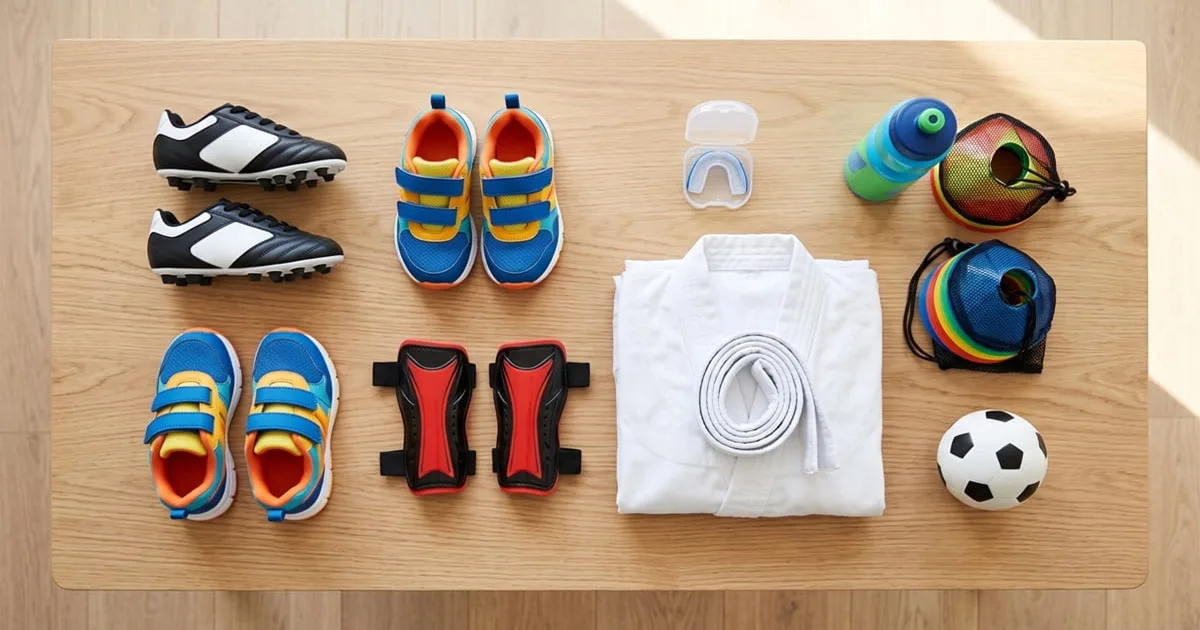
For your child's first sports class you need three things: shoes that match the surface, clothes that suit the weather, and protection where the rules require it. Everything else can wait a month.
This guide is about a child's first kit, not an adult's. Children's feet and bodies change fast, they outgrow things long before they wear them out, and protection has to fit them exactly, so every tip below is chosen with a growing child in mind.
Most parents overspend in week one: a full branded kit, then the club turns out to supply jerseys and the coach wants a different glove. This guide covers football, running, fitness and martial arts, with five categories for each: footwear, clothing, protection, bags and accessories. Ask the coach for the required list first, because it overrides every general rule below.
Six Steps to Choose Your Child's Gear
- Sport and surface. Grass, turf, gym floor, asphalt or mat decide the shoe.
- Safety. Cover teeth, shins, groin and joints first; never buy protection "to grow into."
- Size. Try shoes on in the afternoon, in training socks, with about a thumb's width of space at the toe.
- Wear. Children usually outgrow gear before they wear it out, so skip premium models.
- Season. Dress in layers: a thermal base, a windproof jacket and reflective details for dark evenings.
- Budget. Spend on shoes and protection first, clothing second, bags and extras last.
Football: Boots and Shin Guards
Shin guards are compulsory equipment under the Laws of the Game, and players are responsible for their size and suitability.
- Footwear: boots for the surface. Artificial-grass (AG) or firm-ground (FG) boots are the flexible first pair, turf shoes suit hard pitches, and flat-soled indoor shoes suit futsal halls. Check league rules before buying studs.
- Clothing: jersey, shorts and long socks, often supplied by the club. Add a thermal layer in autumn.
- Protection: shin guards that cover from just below the knee to the top of the foot, worn under the socks.
- Bags: a bag with a separate ventilated pocket for muddy boots.
- Accessories: water bottle, spare socks and a ball in the size your coach recommends.
Running: Spend on Shoes and Socks
Running needs the least gear, so put the money into the part that prevents blisters and sore knees.
- Footwear: light, cushioned running shoes that feel comfortable at once. Do not rely on breaking them in.
- Clothing: synthetic top and shorts or tights, plus seamless socks. Avoid cotton, which stays wet.
- Protection: visibility. A reflective band or vest and a small light matter on autumn and winter evenings.
- Bags: a small backpack for a bottle and a spare layer, or nothing at all.
- Accessories: a cap or buff by season and gloves in the cold. A sports watch can wait.
Fitness: Stability First
Kids' fitness, gymnastics and general physical training need stable shoes and clothes that allow full movement.
- Footwear: training shoes with a flat, firm sole and lateral support. Gymnastics often uses soft slippers or bare feet, so ask the coach.
- Clothing: breathable, stretchy shorts or leggings and a top that does not ride up, plus a spare top.
- Protection: usually none at the start. Technique and supervision matter more than pads.
- Bags: a bag with a pocket for damp clothes.
- Accessories: towel, water bottle, shower sandals and a mat if the gym does not provide one.
Martial Arts: Protection Comes First
Equipment differs a lot between judo, karate, taekwondo, boxing and MMA, so the coach's list decides.
- Footwear: most arts train barefoot, so you need sandals for the changing room. Boxing boots and wrestling shoes only if the coach asks.
- Clothing: a uniform (gi or dobok) bought by height, or shorts and a top for boxing.
- Protection: a mouthguard, hand wraps, gloves and groin protection are the usual starter set. The American Dental Association recommends mouthguards for sports with impact risk, and the children's guidance covers boil-and-bite and dentist-made options. For glove size, follow the coach's advice.
- Bags: a ventilated bag with a separate sack for sweaty kit.
- Accessories: water bottle, towel and short, clean nails, which protect training partners.
Size, Wear, Season and Budget
- Size: buy shoes and protection for the foot and body your child has now. Extra room causes blisters and slipping; a thicker sock is a safer way to buy a little time. Clothes and jackets can go up one size. Recheck toe space every couple of months, because children's feet grow quickly.
- Wear: shin guards, gloves and boots usually fail by size before they fail by damage. Replace a mouthguard that tears, develops holes or becomes loose.
- Season: autumn and winter call for thermal underwear, a windproof jacket, gloves and reflective details. Seasonal clothing is cheaper at the end of the season, so double-check sizes.
- Budget: a reasonable split is roughly 35–45% on footwear, 25–35% on protection, 15–25% on clothing and the rest on bags and extras. Buy fast-outgrown clothing on sale or second-hand, but never used mouthguards, helmets or padding.
Quick Checklist
- I have the coach's required list
- Shoes fit my child now, tried on with training socks
- Required protection is bought in the right size
- Two synthetic outfits suit the season
- Bag, bottle, towel and sandals are packed
Expensive extras are postponed for a month
The Takeaway
Buy in this order: shoes for the surface, required protection, clothing for the season, then everything else. For a child, add one rule: buy for the size they are today, not the size they will be next year. If you shop in Moldova, the kids' sports sections at Sportlandia group footwear, clothing and accessories by sport (football, martial arts, swimming and more), in the Romanian-language version of the site.
Sources
- Gear up for summer: mouthguard tips (Wisconsin Dental Association)
- ADA says mouthguard important piece of children's athletic gear (DentistryIQ)