If you've applied for jobs online, you might have heard of the term ATS more than once. You might have also heard that an ATS can "reject your resume," "scan for keywords in your resume," or that it decides whether your resume reaches a recruiter.
But what actually happens after you hit Apply ?
An ATS doesn't really read your resume like a recruiter, does it? What keywords does it really scan for? What is ATS screening, and how does this system decide which applications should go to a recruiter? The short answer is that an Applicant Tracking System (ATS) is recruitment software that helps companies collect, arrange, search, filter, and manage job applications. Depending on the platform and a company's configuration, an ATS can parse resume information, apply screening rules, help recruiters search for skills and experience, and sometimes provide matching or ranking features.
So, instead of thinking of an ATS as one big robot that simply says yes or no to your resume, it's better to think of it as part of the company's recruiting workflow.
Let's get into what that exactly means.
What is ATS screening?
ATS screening is the process of using an Applicant Tracking System in order to collect and assess job applications based on information that you provided and criteria set by the employer.
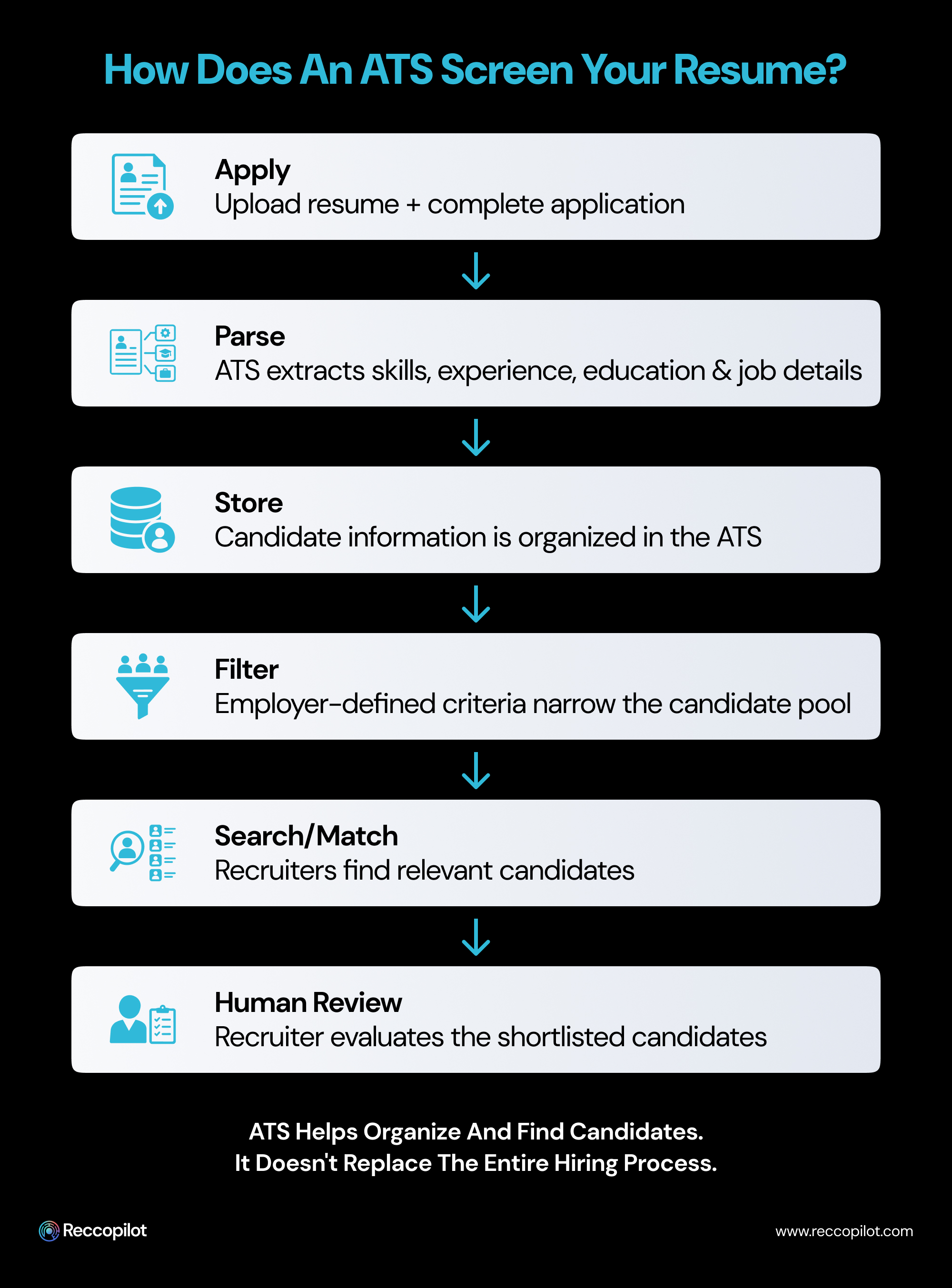
When you apply for a job online, your resume typically goes through an ATS or a connected recruitment platform. This system can extract information from your resume, such as your name, contact information, job titles, employers, education, dates, and skills. That information is then stored in a structured candidate profile that a recruiter can also search and filter.
For example, say a company receives 800 applications for a software developer job.
A recruiter probably isn't going to open all 800 resumes and then find the ones with Python, SQL, and five years' experience. The ATS can help the recruiter to filter the applications by using information that was extracted such as:
- Skills
- Job titles
- Years of experience
- Education
- Location
- Certifications
- Work authorization
- Application responses
- Qualifications
- Keywords or phrases
- And other criteria set up by the employer
That's where ATS filtering comes into play.
The exact process can differ per ATS, and a company can configure their system differently. Some platforms can also provide AI-assisted matching or recommendations.
What is an ATS scan?
An ATS scan generally refers to the Applicant Tracking System processing your resume and extracting the information from it. Think of your resume as a document with lots of information. Your resume might say
Marketing Manager | ABC Company | 2022–Present
The ATS would then look to understand that your job title is Marketing Manager, your employer is ABC Company, and your employment dates are 2022–Present. The system can also extract skills, education, certifications, contact information, and other relevant details. This process is often referred to as resume parsing. The goal is to put the information in your resume into structured, searchable data that's easy for a recruiter to find later. If a resume is hard to parse, it doesn't necessarily mean the resume will be rejected outright. It just means that the recruiter might not be able to find the information easily.
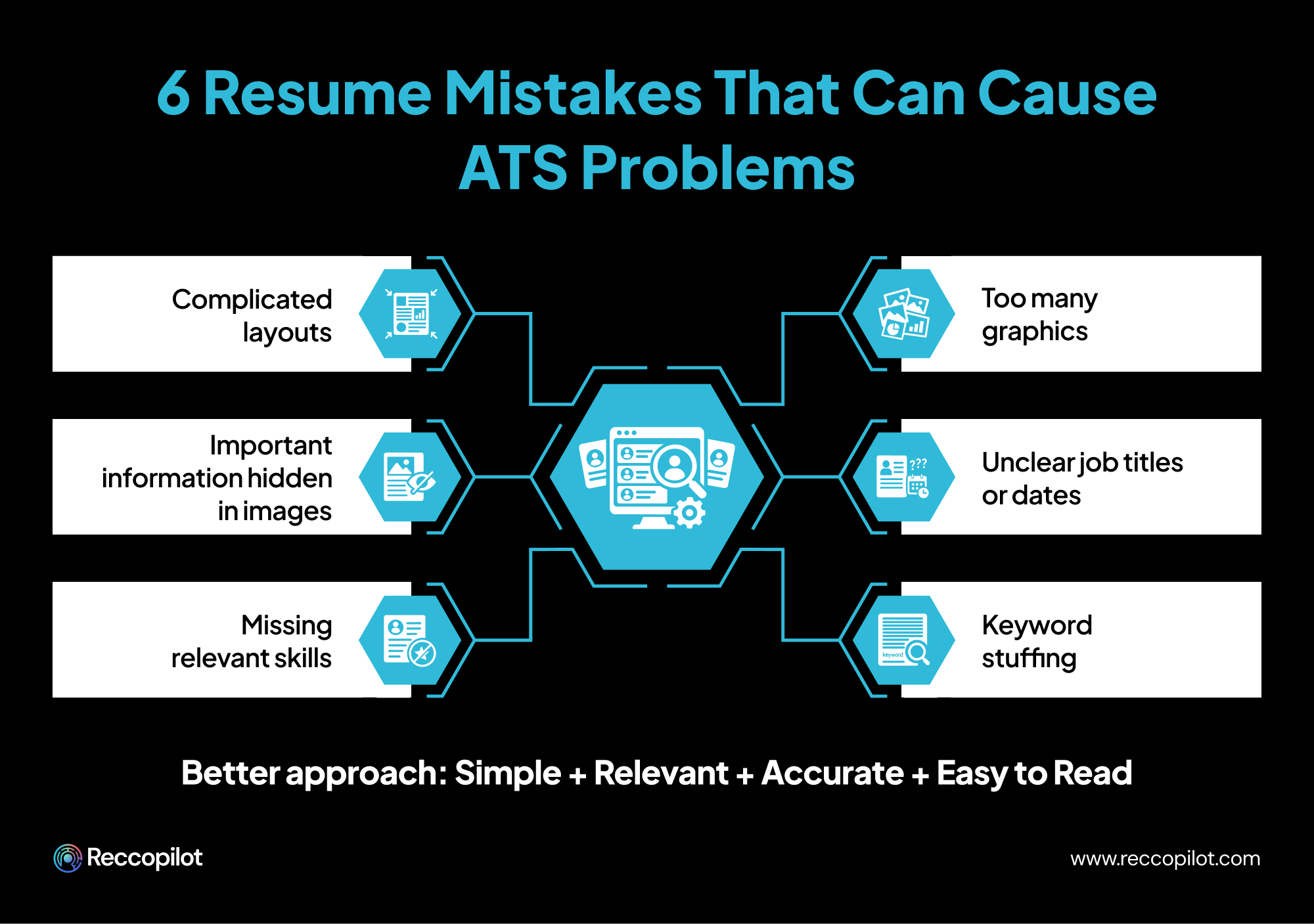
A resume with lots of visual design and columns, graphics or icons, a lot of text boxes or charts, and/or information in headers or footers can have parsing issues depending on the ATS.
How does ATS screening work?
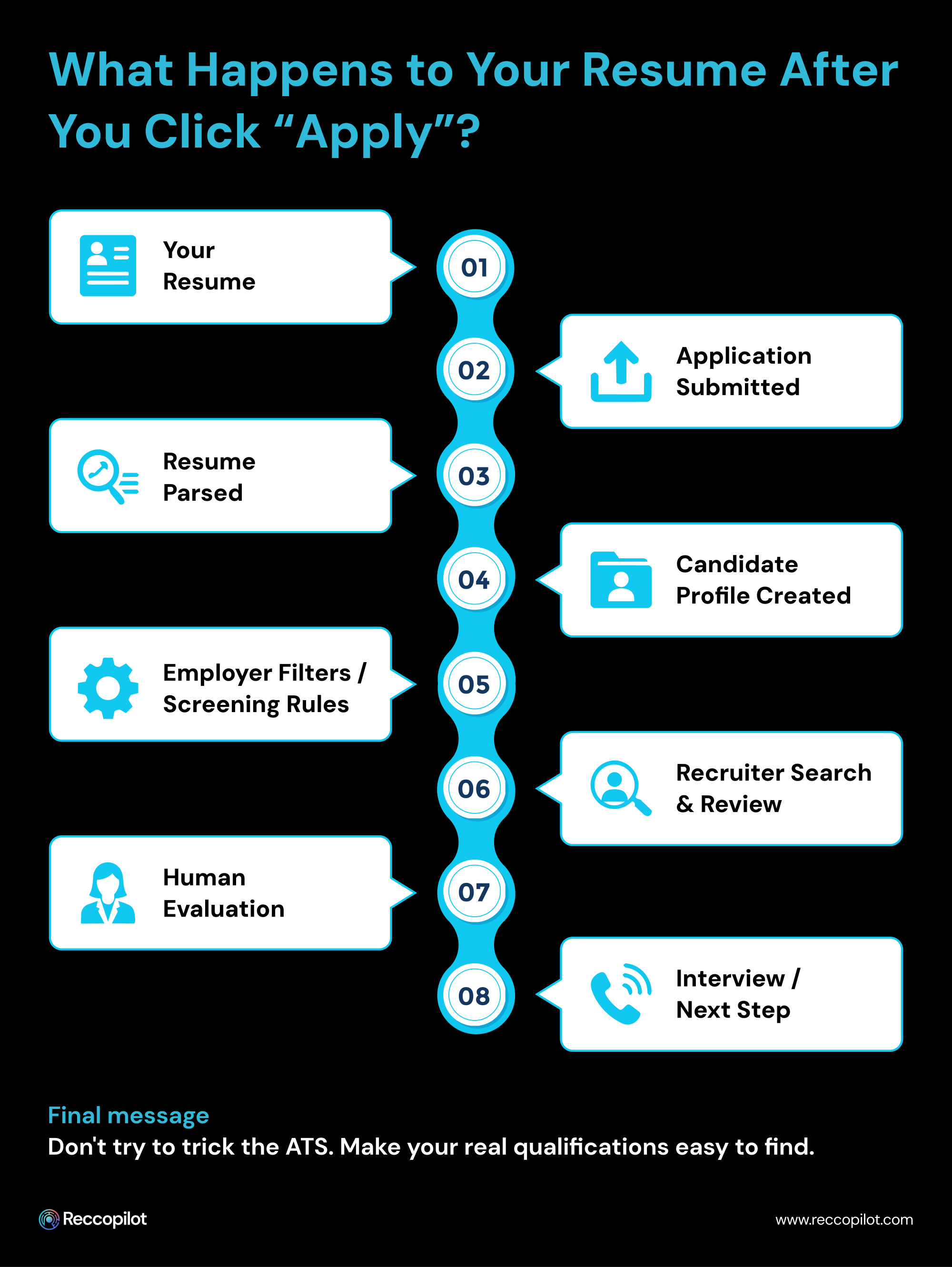
So, what happens after you upload your resume? Here is an overview of the process:
1. You submit your application
First, you apply through the company's career website, job board, or other application channel. You might upload your resume and fill out additional questions about your experience, location, work authorization, salary, availability, education, or other requirements. Your resume and application answers can then become part of your candidate record.
2. The ATS parses your resume
The next step is that the ATS parses your resume. It can extract information such as:
- Name and contact information
- Professional experience
- Job titles
- Company names
- Employment dates
- Education
- Skills
- Certifications
- Languages
And other relevant information
This step is especially important because the information needs to be readable and organized in order for recruiters to find it.
3. The system stores your information
The information extracted from your resume can now be stored in the company's candidate database.
This makes the information easier to find later, for example, if a recruiter wants to search for candidates with "SEO," "Google Analytics," and "content marketing" experience. It can search or filter the candidate database with those terms.
4. ATS filters may be applied
This is another part of the process where candidates can get confused.
5. Recruiters search and review candidates
After all the applications are stored in the system, recruiters can search, filter, sort, or use matching features to identify candidates that appear relevant. The recruiter then reviews the candidate's information and decides who they'll move forward with.
In other words, ATS screening isn't necessarily the "last step" for a hiring decision to be made.
What are ATS filters?
ATS filters are criteria that can help recruiters narrow down large candidate pools. Depending on the ATS and employer, the filters can include things such as:
- Skills
- Years of experience
- Job title
- Location
- Education
- Certifications
- Work authorization
- Qualifications
- Application-question responses
Some employers might also use knockout questions. For example, a job might require work authorization, a particular certification, or a certain level of experience. If a candidate's answer doesn't meet an employer's requirement, the application can be screened out.
That's why it's not always accurate to think of an ATS as a system that purely counts keywords and screens out applications with a lower percentage.
What is ATS filtering?
ATS filtering is the process of narrowing down applicants using criteria that are relevant to a specific job.
Let's say a company is looking for a Digital Marketing Specialist. The job description might include skills such as:
- SEO
- Google Analytics
- Content Marketing
- Keyword Research
- SEM
- 3+ years of experience
A recruiter can use these requirements when searching or filtering candidates. If your resume clearly includes relevant skills and experience, it will be easier for the recruiter and ATS to find your profile. That's why it's important to tailor your resume to the job description.
But there is a difference between simply including relevant keywords and keyword stuffing.
Adding the same word 25 times won't make you a better candidate. Instead, use relevant terminology in your professional summary, skills, work experience, and project descriptions where it makes sense.
Instead of:
SEO SEO SEO SEO SEO
you could write:
Developed SEO strategies, conducted keyword research, optimized website content, and monitored organic search performance using Google Analytics and Search Console.
This way, you give both the ATS and the recruiter context.
What are ATS filters looking for?
There is no single ATS filter that every company looks for. Different ATS platforms provide different functionalities, and the employer might configure their ATS differently.
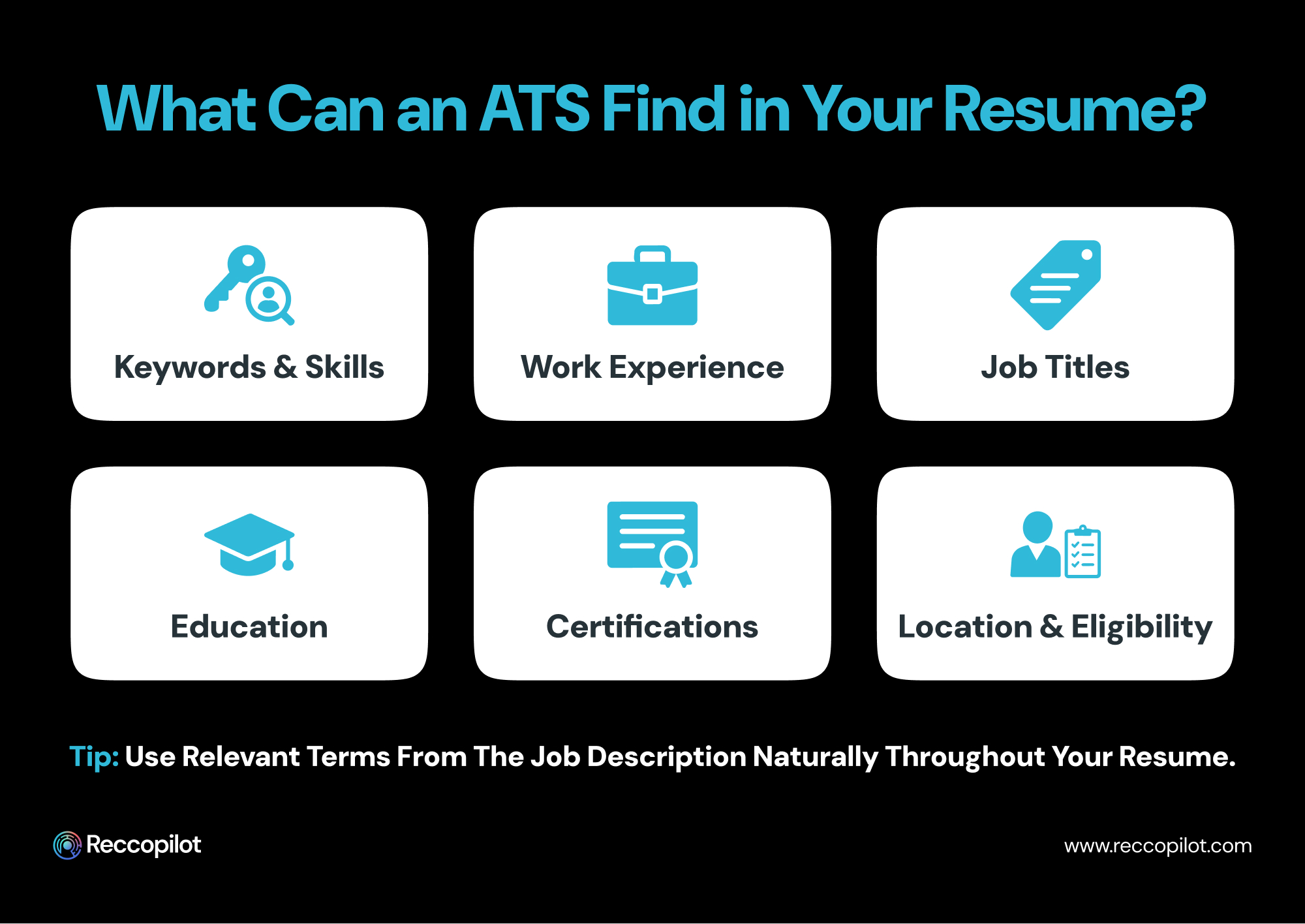
Common criteria to search for candidates might include:
Keywords and skills
The system or recruiter might look for skills mentioned in the job description. For example:
- Java
- Python
- Salesforce
- SEO
- Recruitment
- Project Management
- Data Analysis
- Job titles
Previous job titles can also help recruiters find relevant candidates. For example, if the employer is looking for a Talent Acquisition Specialist, other relevant job titles might include Recruiter, Talent Acquisition Partner, or Technical Recruiter.
Experience
Recruiters might look for candidates with a certain amount or type of experience. For example:
5+ years of experience in B2B SaaS marketing
Your resume should make it easy to understand your relevant experience.
Education and certifications
Depending on the position, education and certifications can also be a screening criterion. For example:
- MBA
- CPA
- PMP
- AWS certification
- Nursing license
- Bachelor's degree
- Location and eligibility
Some positions have location, work authorization, relocation, or other eligibility requirements. These might be collected in your application, rather than from your resume.
What do companies use to scan resumes?
So, what do companies use to scan resumes?
Companies tend to use an Applicant Tracking System, or ATS, to manage their applications and candidate data.
There is no single ATS that all employers use - different organizations use different recruitment platforms. Some of the most common platforms include Workday, Greenhouse, Lever, iCIMS, SmartRecruiters, Oracle, SAP SuccessFactors, and many more. The features for parsing, filtering, searching, matching, and ranking can vary per platform and configuration. Some companies might also use job boards, recruitment CRM systems, assessment platforms, AI-assisted recruitment tools, or integrations connected to their ATS.
The important thing to keep in mind for candidates is that a resume should be easy to read, parse, and relevant to the job, without any unnecessary design elements that can hurt parsing.
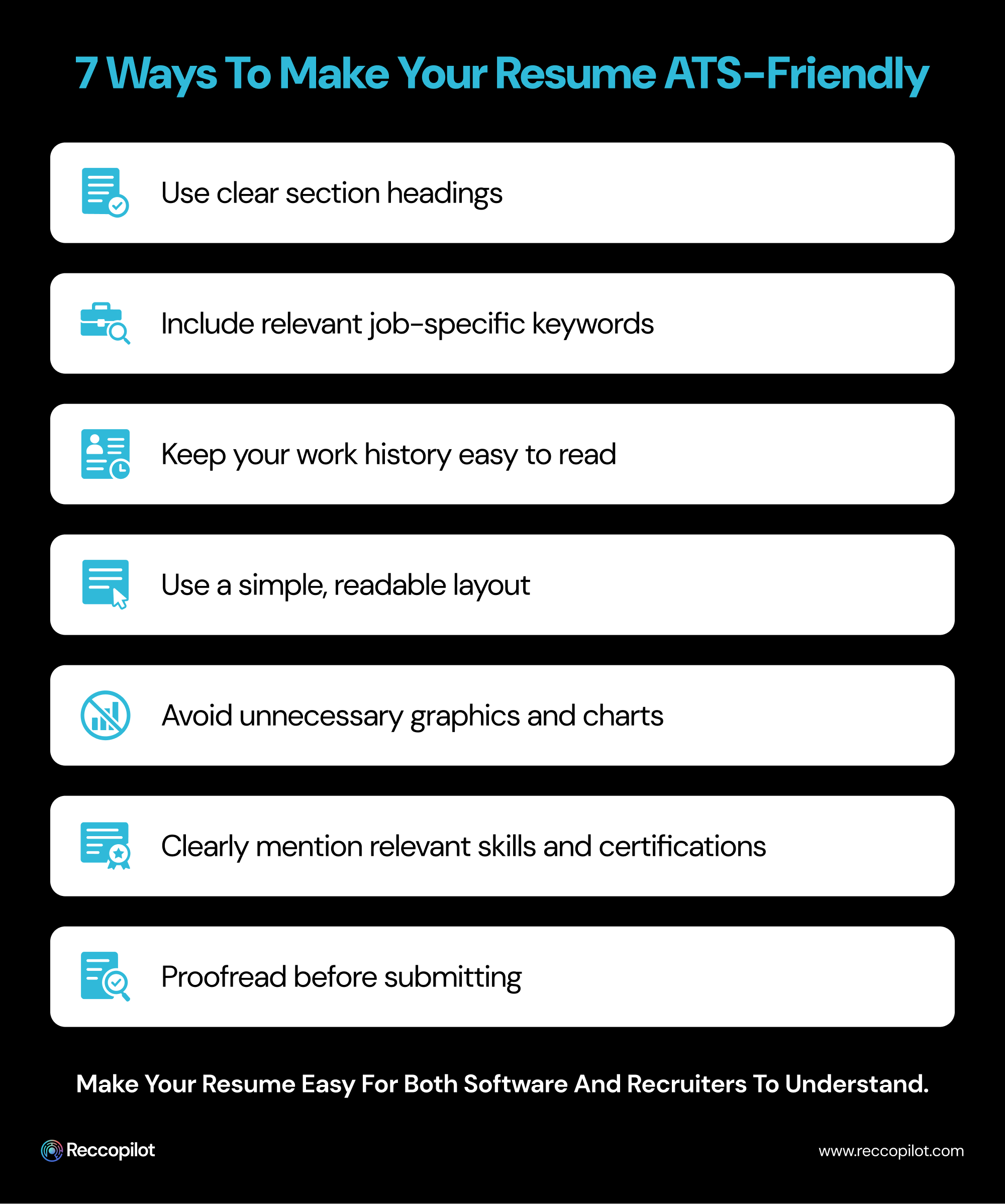
How to make your resume ATS-friendly
You don't need to make a boring resume just because you're concerned with an ATS. You simply need to make sure that the important information is there and easy to find.
Use standard section headings
Use standard headings such as Professional Summary , Work Experience , Education , Skills , Certifications , and Projects . These are generally recognizable and easy to parse.
Match relevant keywords naturally
Make sure to read the job description carefully and match relevant keywords naturally. If the employer specifies "applicant tracking systems" and you have experience with ATS, use that terminology instead of "recruitment software." The same goes for technical skills, certifications, tools, and other relevant terminology.
Avoid excessive graphics
Graphics, charts, and icons might make a resume pretty to look at, but it can make it harder to parse important information. Indeed also recommends avoiding graphics and charts in your ATS-friendly resume.
Keep your job history clear
Make sure to keep your company names, job titles, and dates easy to identify. For example:
Marketing Specialist
ABC Technologies | January 2023 – Present
This way, the information is easy to recognize instead of putting it in a visual graphic.
Do not keyword stuff
The goal is not to trick an ATS. Your resume should be an accurate reflection of your skills and experience. If the job description asks for content strategy and you have that experience, make sure to mention it. If you don't have experience with a certain technology, adding it 10 times on your resume won't help you during an interview.
Is ATS screening the same for every company?
No.
And that's one of the biggest misconceptions about ATS screening. There is no single ATS algorithm that every company uses. One employer might use the ATS as a database and recruiter search tool, while another might use screening questions, automated workflows, matching, assessments, or other integrations.
Some platforms even have AI-assisted features that can help a recruiter identify potentially relevant candidates. That's why it's best to avoid claims such as "every ATS rejects your resume when it has less than 80% keyword matching." There's no such thing as a universal ATS rule like that. The best thing to do is to focus on what you can control.
Make sure your resume has relevant content, accurate information, and clear formatting. Tailor it to the actual job rather than a generic job title.
What is ATS in resume screening?
When people ask "what is ATS in resume screening?" they are usually asking how recruitment software plays a role before a recruiter reviews an application. In short, an ATS helps companies sift through the large amount of information during recruitment.
Instead of having thousands of resumes in email inboxes and folders, a company can store all information in one system. The ATS can help organize candidate records, extract resume information, search for qualifications, apply filters, track hiring stages, schedule activities, and manage communication.
As a candidate, that means your resume should be written for both technology and humans. Your resume needs to be readable and parsed correctly by technology, but it also needs to be useful and relevant when a recruiter actually looks at it.
The biggest ATS resume mistake to avoid
The biggest ATS resume mistake is thinking that you should only focus on the ATS. Your goal should not be to write a resume that will get recognized by a robot. Your goal should be to make your qualifications easy to understand for both the technology and the recruiter.
A good ATS-friendly resume should answer three questions:
- What can you do?
- What experience do you have?
- Why are you relevant for this particular job?
If your resume answers those three questions and uses terminology that's relevant to the job description, you're already off to a good start.
Final thoughts
So, what is ATS screening? It's about using recruitment software to process, organize, search, filter, and sometimes match or rank job applications based on criteria set by the employer.
An ATS can scan and parse information from your resume, but it isn't one big robot that makes every decision for the hiring process. Different ATS platforms and configurations make it difficult to have one-size-fits-all advice. The best thing to do is to keep your resume clear, use relevant keywords naturally, highlight the skills that the employer asks for, avoid unnecessarily complicated formatting, and make sure everything on your resume is accurate.
You're not trying to beat the ATS. You're trying to make it easy for the right recruiter to find and recognize your qualifications.
Frequently Asked Questions
What is ATS screening?
ATS screening is the process of using an Applicant Tracking System to collect, parse, organize, search, and filter job applications. Depending on the employer and ATS, the system can also support matching, ranking, screening questions, and other automated recruitment workflows.
What is an ATS scan?
An ATS scan is the process of an Applicant Tracking System processing your resume and extracting the information from it.
What are ATS filters?
ATS filters are criteria that can be used to narrow down large applicant pools.
What is ATS filtering?
ATS filtering is the process of narrowing down candidates using information that was stored in the recruitment system.