Have you ever swapped tokens on a decentralized exchange and received fewer tokens than you expected? High slippage could be the reason. Slippage is a common challenge in decentralized trading. It can happen when token prices change, liquidity is low, or a large trade affects the market price. Understanding why it happens can help traders make better decisions and help businesses build more reliable DEX platforms.
In this guide, we’ll explain the main causes of high slippage on a decentralized exchange and explore practical ways to manage it.
What Is Slippage in a Decentralized Exchange?
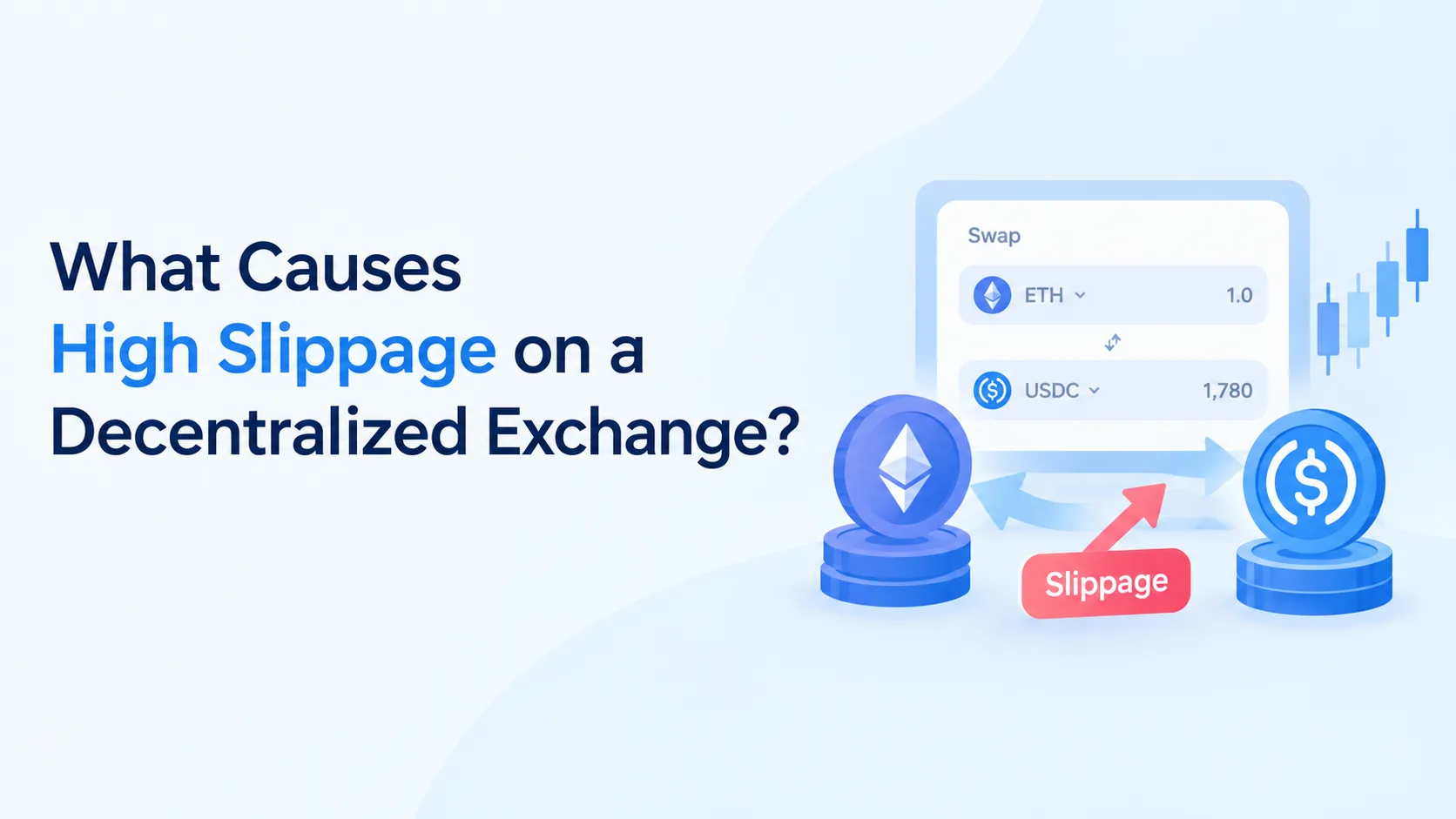
Slippage is the difference between the expected price of a token swap and the actual price at which the trade executes.
For example, imagine you want to swap 1 ETH for 3,000 USDC. Before your transaction is completed, the market price changes, and you receive only 2,970 USDC.
The difference between the expected and actual output represents slippage.
Slippage can work in either direction. You might receive fewer tokens than expected or, in some cases, more. However, negative slippage is the main concern for traders because it reduces the value they receive from a swap.
How Does Slippage Occur During a DEX Swap?
A decentralized exchange typically uses smart contracts to process token swaps. Depending on the DEX design, trades may use liquidity pools, order books, or other execution mechanisms.
Here’s how slippage can occur during a typical liquidity-pool swap:
- You select the token pair and enter the amount you want to swap.
- The DEX estimates the output using the available pool liquidity and pricing mechanism.
- Your transaction is submitted to the blockchain.
- Before execution, the pool state or market price may change.
- The smart contract executes the swap according to its rules and any applicable slippage limit.
If the final output differs from the original estimate, slippage occurs.
The time between submitting and executing a transaction can matter, especially during periods of heavy trading activity or network congestion.
What Causes High Slippage on a DEX?
Several factors can increase slippage on a decentralized exchange.
- Low liquidity: When a liquidity pool has fewer available assets, even a relatively small trade can move the price significantly.
- Large trade sizes: A large swap may consume a substantial portion of the available liquidity, causing the price to move against the trader.
- Market volatility: Rapid price changes can make the quoted exchange rate outdated before a transaction executes.
- High trading activity: Many traders interacting with the same pool can change its token balance and price between quote and execution.
- Transaction delays: Network congestion and delayed execution can increase the time during which market conditions may change.
- Poor swap routing: A DEX that cannot find an efficient route across available liquidity sources may offer a less favorable execution price.
These factors can overlap. For example, a large swap during a volatile market may experience more slippage than the same trade under normal conditions.
How Do Liquidity Pools Affect Slippage?
Liquidity pools play an important role in many decentralized exchanges. They hold token reserves that traders use when swapping assets.
When a pool has deep liquidity, a trade usually represents a smaller proportion of its reserves. This can help limit price impact.
However, when a pool has limited liquidity, a trade can significantly change the ratio between its token reserves. That change can result in a less favorable swap price.
For example, swapping a small amount of a popular token in a deep liquidity pool may have minimal price impact. Swapping the same dollar value in a thinly traded token pool may result in much higher price impact.
Liquidity also varies between trading pairs and platforms. A token may have strong liquidity on one DEX but limited liquidity on another.
For this reason, traders should review available liquidity and estimated output before confirming a swap.
How Do Large Trades Increase Slippage?
Trade size is another major factor behind high slippage.
Many automated market maker (AMM) exchanges calculate prices based on the balance of assets in a liquidity pool. When a trader makes a large swap, the pool's balance changes more substantially, affecting the execution price.
Consider two scenarios:
- Small trade: The swap uses only a small portion of the pool's available liquidity, resulting in limited price impact.
- Large trade: The swap consumes more available liquidity, pushing the execution price further from the initial quote.
Traders can sometimes reduce this effect by splitting a large order into smaller transactions. However, this approach is not always better because each transaction may involve gas fees, market movements, and additional execution risks.
The best approach depends on the pool's depth, the trading pair, and current market conditions.
How Do Market Volatility and Price Impact Affect Slippage?
Market volatility and price impact are related to slippage, but they are not the same thing.
Market volatility refers to how quickly and significantly an asset's market price changes over time. During volatile periods, the price displayed when a trader submits a swap may change before execution.
Price impact is the effect a trade has on the price available through a particular liquidity source. It generally increases when a trade is large relative to the available liquidity.
For example, a token's price may change quickly because of sudden buying or selling activity. At the same time, a large swap in a shallow liquidity pool may move the pool price even further.
Both factors can contribute to a difference between the expected and executed swap price.
Understanding these factors helps traders assess whether a swap is likely to execute at a favorable rate.
What Is the Difference Between Slippage and Price Impact?
Although these terms are often used together, they describe different things.
FactorMeaningSlippageThe difference between the expected execution price and the actual execution pricePrice impactThe effect a trade has on the available price when it interacts with liquidityMarket volatilityPrice fluctuations caused by changing market conditionsSlippage toleranceThe maximum price movement or minimum acceptable output permitted by the transaction settingsPrice impact can be estimated before a transaction is submitted. Slippage can also arise from changes between the quote and execution.
The exact calculations and terminology may vary between DEX interfaces. Traders should check how their platform defines these values rather than assuming every interface uses identical calculations.
How Can You Reduce Slippage When Trading on a DEX?
You cannot eliminate slippage entirely, but several practices can help reduce its impact.
Choose pools with sufficient liquidity. Compare available liquidity and estimated output across suitable trading pairs or platforms.
Review the trade size. If a swap is large relative to pool liquidity, consider whether a smaller trade or an alternative execution route would be more suitable.
Check market conditions. During periods of rapid price movement, waiting for more stable conditions may help, although prices can move in either direction.
Compare swap routes. Some DEXs or aggregators can route trades through multiple pools. Compare the estimated output and total costs before choosing a route.
Set an appropriate slippage tolerance. A suitable limit can protect against execution beyond your accepted price range. However, setting it too low may cause transactions to fail, while setting it too high may expose you to worse execution prices.
Review transaction costs. Gas fees and other costs can affect the overall value of a trade, especially when splitting orders into smaller swaps.
Always review the final quote, minimum output, and transaction details before confirming a trade.
How Does Slippage Tolerance Work in a Decentralized Exchange?
Slippage tolerance defines how much the execution price or output can differ from the quoted amount before a transaction is rejected, according to the DEX's transaction rules.
For example, suppose a swap is quoted to return 1,000 tokens and the interface applies a 1% tolerance. In a simple minimum-output model, the transaction would require at least 990 tokens to execute.
If the output falls below that minimum, the transaction may revert.
A lower tolerance can limit the amount of price movement accepted, but it may also cause more failed transactions. A higher tolerance gives the transaction more room to execute under changing conditions, but it does not guarantee a better price.
Slippage tolerance is not a tool for improving liquidity or preventing market movements. It is an execution safeguard that defines the acceptable limit for a swap.
Traders should use a setting appropriate to the token pair and market conditions rather than automatically selecting the highest available value.
How Does DEX Development Help Manage Slippage?
Managing slippage is an important consideration when designing a decentralized exchange. Platform architecture and execution logic can influence the prices users receive and how clearly trading risks are communicated.
A well-planned DEX can incorporate features such as:
- Liquidity monitoring: Display available liquidity and help users identify thinly traded pools.
- Price-impact estimates: Show the estimated effect of a proposed trade before confirmation.
- Slippage controls: Allow users to configure acceptable execution limits.
- Swap routing: Identify suitable liquidity sources and routes based on available options.
- Minimum-output checks: Use smart contract rules to reject swaps that fall below the specified minimum output.
- Transaction previews: Present estimated output, fees, price impact, and relevant execution details in a clear interface.
These features cannot eliminate market risk or guarantee successful trades. Their purpose is to improve transparency and give users better information before they confirm transactions.
Businesses planning a DEX can explore decentralized exchange development company services to understand how liquidity integration, smart contract functionality, swap routing, and user-facing trading controls can fit into their platform requirements.
Final Thoughts
High slippage on a decentralized exchange often results from low liquidity, large trades, market volatility, or changes in pool conditions before execution.
Traders can manage these risks by comparing liquidity, reviewing price impact, checking swap routes, and setting sensible slippage tolerance limits.
For businesses building a DEX, transparent transaction previews, appropriate smart contract checks, and efficient liquidity routing can help users understand their trades before confirming them.
Ultimately, better visibility into liquidity, pricing, and execution limits helps users make more informed trading decisions.