
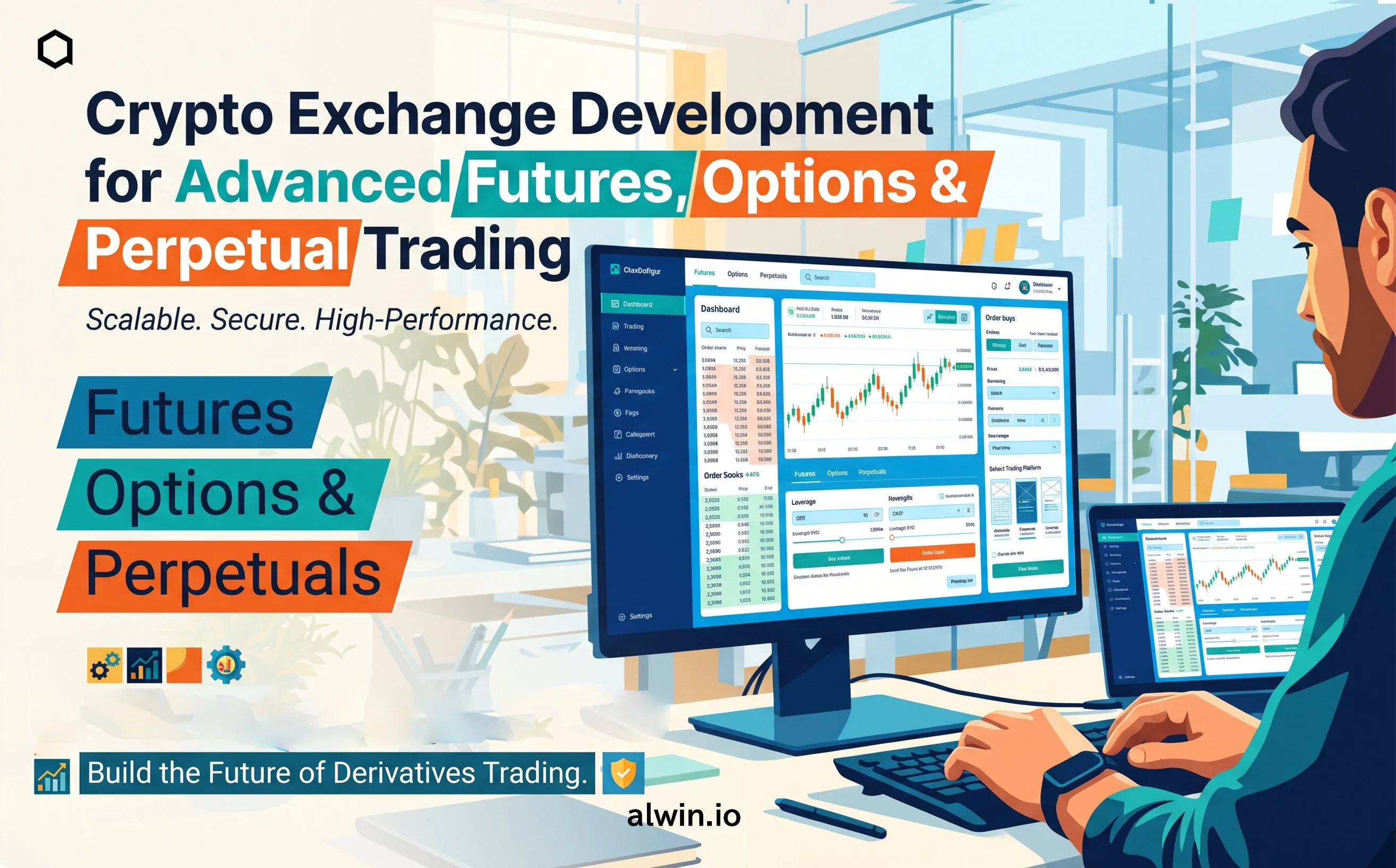
The cryptocurrency market is moving beyond traditional spot trading. Futures, options, and perpetual contracts are gaining popularity because they give traders more ways to manage price movements, reduce market exposure, and apply different trading strategies.
For businesses planning to enter the digital asset market, crypto exchange development creates opportunities to introduce advanced trading services. However, developing a derivatives exchange requires a high-performance matching engine, accurate market data, liquidity integration, margin management, and strong security.
Partnering with a professional crypto exchange development company can help businesses develop an exchange that supports multiple derivatives products and changing market requirements.
Understanding Futures Trading, Options Trading, and Perpetual Contracts
Crypto derivatives are financial contracts whose value depends on an underlying cryptocurrency, such as Bitcoin or Ethereum. Traders use these contracts to gain price exposure without directly purchasing the underlying asset. Futures, options, and perpetual contracts are the three major types of crypto derivatives.
Futures Trading
Futures trading allows traders to agree to buy or sell an asset at a predetermined price on a specific future date. Traders can take long or short positions based on their market expectations. These contracts are commonly used for speculation and hedging against price changes.
Options Trading
Options trading gives buyers the right, but not the obligation, to buy or sell an asset at a specified price before or on an expiration date. Call options provide the right to buy, while put options provide the right to sell. Traders use options to manage potential losses and apply different market strategies.
Perpetual Contracts
Perpetual contracts are derivatives without fixed expiration dates. Traders can maintain their positions as long as they meet the required margin conditions. These contracts use funding rate mechanisms to help keep their prices close to the underlying spot market price.
Current Market Growth and Trends in Crypto Derivatives Trading
Crypto derivatives have become an important part of digital asset trading. According to CoinGlass, the market recorded approximately $35.08 trillion in derivatives trading volume during the first half of 2026, while average daily open interest reached approximately $112.7 billion.
Several developments are shaping this market:
Perpetual Trading Growth: Traders are increasingly using contracts without fixed expiration dates.
Options Market Expansion: Options are gaining attention for hedging and volatility-based strategies.
Institutional Participation: Professional investors are showing greater interest in crypto derivatives.
Decentralized Derivatives: Blockchain-based platforms are expanding on-chain trading services.
Advanced Trading Infrastructure: Exchanges are investing in faster execution, liquidity, and risk management.
These developments are increasing demand for advanced derivatives trading platforms.
How Crypto Exchange Development Supports Advanced Derivatives Trading?
Developing a derivatives exchange requires specialized technology to manage different contracts and trading activities. Unlike a basic spot exchange, the platform must handle complex pricing, margin calculations, position monitoring, and automated settlement.
The matching engine processes buy and sell orders, while the contract management system handles futures expiration dates, options strike prices, and perpetual funding schedules. A margin management system calculates initial and maintenance margins to monitor traders' positions.
The platform also requires accurate index and mark prices, liquidity integrations, and automated settlement mechanisms. Together, these components support efficient order execution and derivatives trading operations.
Different Types of Crypto Derivatives Exchange Platforms
Businesses can select different exchange models based on their technical requirements, target audience, and operating strategy.
1. Centralized Derivatives Exchange: Operates through a company-managed trading engine, order book, liquidity system, and user account infrastructure.
2. Decentralized Derivatives Exchange: Uses blockchain technology and smart contracts to support trading and contract settlement.
3. Hybrid Derivatives Exchange: Combines centralized order matching with selected blockchain-based trading and settlement features.
4. Institutional Trading Platform: Provides professional traders with advanced APIs, deeper liquidity, portfolio management, and specialized trading tools.
Selecting the right model helps businesses determine their infrastructure requirements and development priorities.
Essential Features of a Futures, Options, and Perpetual Trading Platform
An advanced derivatives exchange needs features that support different trading strategies while providing a simple user experience. Multi-contract support allows traders to access futures, call options, put options, and perpetual contracts from one platform.
An advanced trading dashboard should display real-time prices, interactive charts, order books, trading history, and open positions. Multiple order types, including market, limit, stop-loss, and take-profit orders, help traders manage their positions.
Other important features include:
Leverage and Margin Management: Displays available leverage, margin requirements, and liquidation prices.
Automated Liquidation: Closes positions when maintenance margin requirements are not met.
Funding Rate Management: Calculates and processes perpetual contract funding payments.
Options Chain: Displays strike prices, premiums, expiration dates, and options Greeks.
Trading APIs: Connects external applications and automated trading systems.
Admin Dashboard: Helps operators monitor users, trading activity, fees, and platform performance.
Benefits of Integrating Derivatives Trading into a Crypto Exchange
Adding futures, options, and perpetual contracts can expand an exchange's services and create additional business opportunities. It helps attract different types of traders, including retail users, professional investors, and institutional participants.
Derivatives trading also supports advanced strategies such as hedging, speculation, and arbitrage. Exchanges can generate additional revenue through trading fees, institutional services, and premium subscriptions. Offering multiple contract types can also strengthen an exchange's market positioning and expand its trading services.
Step-by-Step Crypto Exchange Development Process
Developing a derivatives exchange requires proper planning and technical execution. The process generally begins with market research to identify target users, supported cryptocurrencies, trading products, and business requirements.
Next, developers select the exchange architecture and design the user interface. The matching engine, order management system, and contract management components are then developed to support futures, options, and perpetual trading.
The next stages involve integrating liquidity providers, market data sources, margin calculations, and automated settlement systems. Security controls, including authentication, encryption, and risk management, are also implemented.
Finally, the platform undergoes functional testing, load testing, and security assessments before deployment. Continuous monitoring and maintenance help maintain performance after launch.
Security, Risk Management, and Regulatory Requirements for Derivatives Exchanges
Security is essential because leveraged trading increases financial exposure and operational risks. A derivatives exchange should include multi-factor authentication, encryption, secure wallet management, withdrawal monitoring, and regular security audits.
Risk management systems should support accurate margin calculations, real-time position monitoring, automated liquidation, exposure limits, and reliable price feeds. These controls help manage market risks and reduce operational issues.
For businesses targeting the United States, regulatory requirements depend on the products and services offered. The Commodity Futures Trading Commission (CFTC) oversees commodity futures and certain derivatives activities, while the Securities and Exchange Commission (SEC) regulates securities-related activities within its jurisdiction. Customer verification, AML procedures, registration obligations, and asset protection requirements may also apply. Legal guidance is important before launching.
Crypto Exchange Development Costs and Revenue Models
The cost of developing a derivatives exchange depends on its features, trading engine, security architecture, liquidity integrations, and supported contract types. A basic platform may require an estimated investment of $50,000 to $100,000, while an advanced exchange may cost between $100,000 and $250,000. Enterprise platforms with institutional features can exceed $250,000.
Exchanges can generate revenue through several business models, including trading fees, institutional trading services, premium subscriptions, and eligible listing and integration services. The final development budget should also account for hosting, liquidity, security audits, and ongoing maintenance.
Future Trends in Crypto Futures, Options, and Perpetual Trading
The future of crypto derivatives trading will be influenced by improvements in trading technology and market infrastructure. AI-powered risk monitoring, advanced options pricing tools, and automated trading systems are expected to play important roles.
Other developments include expanding perpetual contracts across different asset categories, blockchain-based derivatives trading, institutional-grade liquidity, and advanced portfolio margin systems. These technologies can help exchanges introduce more flexible trading services while improving operational efficiency.
Conclusion
Futures, options, and perpetual contracts are expanding the possibilities of cryptocurrency trading. Developing an exchange that supports these products requires advanced trading technology, accurate pricing, liquidity integration, and strong risk management.
Choosing the right crypto exchange development strategy and partnering with a professional crypto exchange development company can help businesses establish an advanced derivatives trading platform that meets their technical and business requirements.
Planning to develop a crypto exchange with futures, options, and perpetual trading? Start with the right technology, security, and trading infrastructure.