Blocked fallopian tubes are responsible for approximately twenty to thirty percent of all female infertility cases — yet most women who have them have no idea until a fertility evaluation reveals the obstruction. The tubes themselves rarely signal that a problem exists. The damage happens silently, often years before a woman begins trying to conceive, caused by conditions she may not have known she had.
Understanding what causes fallopian tube blockage is clinically valuable — not to create anxiety, but to identify whether any risk factors apply and to ensure that fallopian tube assessment is included in fertility evaluation at the right time.
At Dr. Aravind's IVF Fertility & Pregnancy Centre, the best fertility centre in Madurai, fallopian tube assessment is a standard component of every female fertility consultation. Because the causes described in this blog are far more common than most women realise — and because identifying them changes treatment decisions significantly.
What the Fallopian Tubes Do and Why Blockage Matters
Each fallopian tube connects an ovary to the uterus. After ovulation, the tube picks up the released egg through its finger-like fimbriae — the delicate projections at its end — and moves it toward the uterus. Sperm travels up through the uterus and into the tubes, where fertilisation occurs. The resulting embryo then travels down the tube to the uterus for implantation.
When a tube is blocked at any point along its length, this pathway is interrupted. The blockage may be at the fimbriated end near the ovary, at the isthmic midpoint, or at the cornual end where the tube joins the uterus. Location matters clinically — it influences which treatment approach is most appropriate and what the probability of surgical correction looks like.
For women wanting to understand the full clinical picture of blocked fallopian tubes including symptoms, diagnosis, and when to seek specialist evaluation, this resource covers every detail.
The Most Common Causes of Blocked Fallopian Tubes
Pelvic Inflammatory Disease
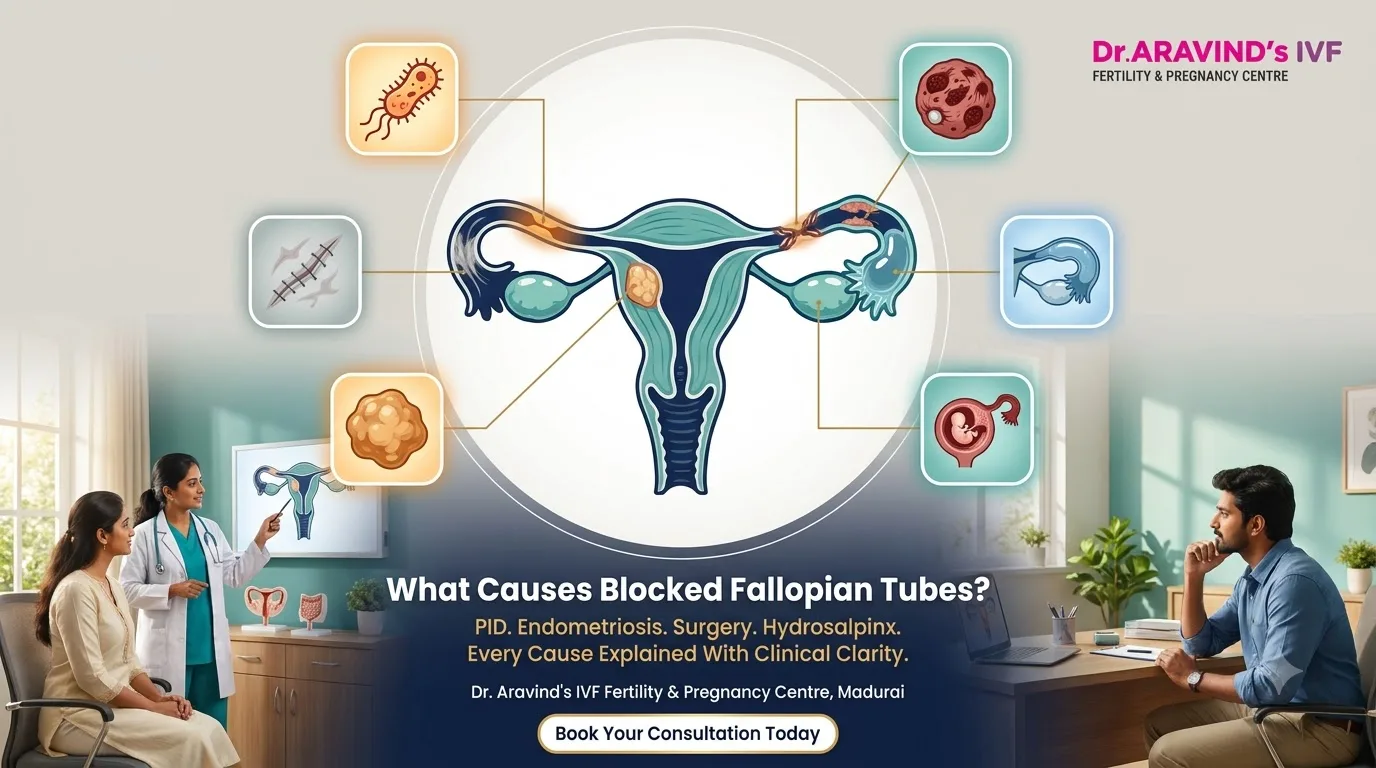
Pelvic inflammatory disease — commonly referred to as PID — is the single most common cause of fallopian tube blockage globally. It is an infection of the female reproductive tract, typically caused by sexually transmitted bacteria — most commonly chlamydia and gonorrhoea — that ascends from the cervix into the uterus and tubes.
The infection itself may clear without intervention. But the inflammatory response it triggers causes scar tissue formation inside and around the fallopian tubes. This scarring narrows the tubal lumen, disrupts the delicate cilia that move the egg along the tube, and in more severe cases creates complete obstruction.
The challenge is that PID is frequently asymptomatic or mildly symptomatic. Many women who develop PID from chlamydia — which is itself asymptomatic in approximately seventy percent of cases — have no knowledge that infection or tubal damage occurred. The first indication is often unexplained infertility years later.
Endometriosis
Endometriosis affects ten to fifteen percent of women of reproductive age and is one of the most significant causes of fallopian tube blockage and pelvic adhesion formation. In endometriosis, tissue similar to the uterine lining grows outside the uterus — on the ovaries, tubes, pelvic peritoneum, and surrounding structures. Each menstrual cycle, these deposits bleed internally, triggering an inflammatory response that creates adhesion formation over time.
These adhesions can envelop the fallopian tubes, distort their structure, compress their lumen, or block the fimbriated ends that capture the egg. They can also damage the ovaries and create endometriomas — chocolate cysts that affect egg quality alongside the structural tube damage.
Endometriosis is a major reason why women undergoing 7 steps to getting pregnant with blocked fallopian tubes pathways need a specialist who understands both the structural and inflammatory dimensions of the condition — not just the mechanical blockage.
Prior Abdominal or Pelvic Surgery
Any surgery in the abdominal or pelvic cavity carries a risk of adhesion formation. The body's natural wound healing response creates fibrous tissue — adhesions — that can bind structures together and distort their relationship to each other. When these adhesions involve the fallopian tubes, they can kink, compress, or partially obstruct them without producing any ongoing symptoms.
Prior caesarean section, appendectomy — particularly when the appendix has ruptured before removal — ovarian cystectomy, myomectomy for fibroid removal, and any laparoscopic or open pelvic procedure all carry this risk. The adhesion formation occurs as part of normal healing and does not indicate any surgical error or complication — it is simply a physiological consequence that sometimes affects fallopian tube function.
Hydrosalpinx
Hydrosalpinx is a specific form of fallopian tube damage where the tube becomes blocked at its fimbriated end and fluid accumulates inside the tube, causing it to distend and lose function. It is typically caused by prior infection — usually PID — or by endometriosis. The tube becomes a fluid-filled sac that is both non-functional and, critically, harmful to IVF outcomes if left untreated.
The fluid inside a hydrosalpinx can leak back into the uterine cavity and reduce endometrial receptivity and embryo implantation rates. At the IVF treatment center in Madurai level of care, hydrosalpinx is always assessed before IVF treatment begins — and is typically managed by surgical removal or occlusion of the affected tube before embryo transfer.
Less Commonly Recognised Causes
Uterine Fibroids
Fibroids that develop at the cornual region — where the fallopian tube enters the uterus — can grow large enough to compress or obstruct the tubal opening from the inside. This cornual blockage is one of the less commonly identified causes of tube obstruction but is clinically significant because it may not appear on standard HSG assessment unless the investigation is specifically designed to assess cornual patency.
Uterine Polyps
Endometrial polyps near the tubal ostia — the openings of the tubes inside the uterine cavity — can obstruct tubal entry, preventing sperm from reaching the tube and the egg from descending into the uterus. These are typically identified during hysteroscopy rather than HSG and are surgically removable with a straightforward hysteroscopic procedure.
Congenital Malformations
A small proportion of women have congenital structural variations in the fallopian tubes that affect patency — including segmental absence, tubal diverticula, or congenital narrowing — that are present from birth rather than acquired through infection or surgery. These are identified during laparoscopy and influence treatment planning significantly.
Prior Ectopic Pregnancy
An ectopic pregnancy — where a fertilised egg implants inside the fallopian tube rather than the uterus — requires emergency treatment that either removes the affected tube entirely or treats it medically. Either approach leaves the affected tube less functional or completely absent, which reduces natural conception probability and makes the remaining tube's health critically important.
Women who have experienced an ectopic pregnancy are at elevated risk of recurrence and should have both tubes formally assessed before attempting subsequent conception.
Diagnosis and Treatment in Madurai
Identifying the specific cause of fallopian tube blockage requires appropriate investigation — HSG as the first-line assessment, laparoscopy for definitive evaluation and simultaneous treatment when indicated. The cause identified through investigation shapes the treatment recommendation entirely.
Mild adhesions from prior surgery may respond to laparoscopic surgical division. Hydrosalpinx is addressed by surgical removal or occlusion of the affected tube before IVF. Endometriosis deposits causing tubal involvement are treated laparoscopically, improving both the structural tubal picture and the pelvic inflammatory environment. For significant bilateral blockage from PID scarring or extensive adhesion formation, IVF bypasses the tubes entirely and provides the most direct and reliable path to pregnancy.
As one of the best IVF centre in India, Dr. Aravind's IVF Fertility & Pregnancy Centre approaches every fallopian tube blockage case with the diagnostic precision and treatment breadth that these varied causes require — because the right treatment depends entirely on which cause is actually driving the blockage.
Conclusion
Blocked fallopian tubes are caused by a range of conditions — from common infections and endometriosis to prior surgery and congenital factors — each requiring a different clinical response. Understanding the cause is not just academic. It determines whether surgical correction, direct IVF, or a combination approach gives the best probability of successful pregnancy.
As the best fertility centre in Madurai and a leading name among the best IVF centres in India, Dr. Aravind's IVF Fertility & Pregnancy Centre provides complete fallopian tube evaluation and personalised treatment planning for every woman whose fertility journey includes this diagnosis — with clinical honesty, diagnostic depth, and the full range of treatment options under one roof.
FAQ
Q1. What is the most common cause of blocked fallopian tubes in women?
Pelvic inflammatory disease — most commonly caused by untreated chlamydia or gonorrhoea — is the single most common cause of fallopian tube blockage globally. The infection triggers scar tissue formation inside the tubes that can narrow or completely obstruct the tubal lumen, often without producing any ongoing symptoms that would alert a woman to the damage.
Q2. Can endometriosis cause blocked fallopian tubes?
Yes. Endometriosis is one of the most significant causes of fallopian tube damage and pelvic adhesion formation. Each menstrual cycle triggers internal bleeding from endometriosis deposits, creating an inflammatory response that generates adhesions over time — adhesions that can envelop, distort, or obstruct the fallopian tubes alongside affecting ovarian function.
Q3. Does a prior C-section or appendectomy increase the risk of blocked tubes?
Yes. Any abdominal or pelvic surgery carries a risk of adhesion formation as part of the healing process. These adhesions can involve the fallopian tubes and reduce their function without producing any symptoms. Women with prior pelvic surgery should discuss fallopian tube assessment specifically with their fertility specialist when planning a pregnancy.
Q4. What are 7 steps to getting pregnant with blocked fallopian tubes?
The pathway to pregnancy with blocked fallopian tubes typically involves: confirming the diagnosis through HSG or laparoscopy, identifying the specific cause, assessing severity and location of blockage, determining whether surgical correction is appropriate, treating hydrosalpinx if present before IVF, completing ovarian reserve and male fertility evaluation, and proceeding with either surgical restoration or IVF depending on findings. The best fertility centre in Madurai builds this pathway around each couple's specific diagnostic picture rather than a fixed protocol.
Q5. When should a woman in Madurai seek evaluation for blocked fallopian tubes?
Any woman who has been trying to conceive for six months or more without success, who has a history of pelvic infection, endometriosis, prior pelvic surgery, ectopic pregnancy, or unexplained pelvic pain should request fallopian tube assessment as part of her fertility evaluation. At Dr. Aravind's IVF Fertility & Pregnancy Centre, fallopian tube assessment is included as standard in every female fertility workup — because silent blockage is the most common presentation.