Most people judge their water with their senses. If it runs clear, smells like nothing and tastes fine, it must be safe. That instinct works reasonably well for rust or sulfur. It fails completely for bacteria, viruses and parasites, which you can't see, smell or taste at levels that will make you sick.
If you're on city water, a utility disinfects it and tests it on a schedule set by federal law. If you're one of the more than 43 million Americans on a private well, nobody is doing that for you. The CDC is blunt about it: federal drinking water rules don't cover private wells, and the owner is responsible for making sure the water is safe.
Below are seven signs your water deserves a closer look, followed by an honest account of what UV disinfection can and can't do about it.
1. Your water comes from a private well, and no one is treating itThis is the baseline sign, and it applies to every well owner. Municipal water leaves the treatment plant carrying a small chlorine residual that keeps suppressing germs all the way to your tap. Well water has nothing like that. Whatever enters the aquifer, the casing or the pressure tank goes straight to your glass.
The EPA estimates that more than 23 million U.S. households drink from private wells. A long-running U.S. Geological Survey study of about 2,100 of those wells found that roughly one in five contained at least one contaminant above a human-health benchmark. Being on a well isn't a problem in itself. It does mean safety is your job.
2. A lab has found total coliform or E. coli, even onceColiform bacteria rarely make people sick on their own. They matter because they travel the same routes as the germs that do: surface runoff, sewage and animal waste. A positive result means there's a pathway into your water. A positive E. coli result means fecal contamination has already used it.
This is more common than most owners assume. In the USGS survey of domestic wells sampled between 1991 and 2004, total coliform turned up in about 34% of wells and E. coli in about 8%. Many owners shock-chlorinate after a bad result, retest clean and move on. If the pathway is still open, the bacteria usually come back.
3. The well is shallow, old, or dug by handDepth buys you filtration. Rainwater that soaks down through hundreds of feet of soil and rock gets strained along the way. Water drawn from near the surface has had much less time and distance to clean up.
The USGS data shows the gap clearly. In aquifers where sampled wells had a median depth of 100 to 200 feet, half tested positive for total coliform. Where the median depth was over 200 feet, only 9% did. Dug wells, springs and older wells with cracked casings, missing grout or loose caps sit at the risky end of that range.
4. Your water changes after heavy rain or snowmeltIf your water turns slightly cloudy, picks up an earthy taste or changes color a day or two after a big storm, surface water is probably reaching your well faster than it should. Runoff carries whatever it picked up on the way, from lawn soil to manure to septic seepage.
The CDC lists a change in taste, color or smell as a reason to test right away, along with nearby flooding. After an actual flood, state health departments go further. Vermont's guidance, for example, tells owners to assume the water is contaminated and not to use it until a test shows it's safe.
5. A septic system, livestock or fertilized fields sit close to the wellheadRural properties often pack a well, a septic drainfield and sometimes a barn onto a few acres. Every one of those is a potential source of bacteria and nitrates. The CDC names septic systems, animal waste and farm runoff among the leading sources of nitrate in well water.
A rising nitrate reading is worth paying attention to even though UV won't remove nitrate. It often signals the same short path from the surface that lets bacteria in. If your nitrate numbers climb over a few annual tests, look hard at your microbial results too.
6. Stomach trouble keeps circling through the householdRecurring diarrhea, cramps or nausea that no one can pin on food is a reason to test the water. It's especially telling when guests or new family members get sick while longtime residents seem fine, since people drinking the same water for years can build some tolerance to local microbes.
This isn't something to self-diagnose. See a doctor, and send a water sample to a state-certified lab at the same time. If a baby joins the household or someone becomes pregnant, the CDC recommends testing then too, because infants and pregnant women are more vulnerable to both bacteria and nitrate.
7. You're relying on one clean test from years agoThis is the sign people least expect. A single negative result is a snapshot of one glass on one day. Contamination in wells is often intermittent, tied to rainfall, pumping and the season.
New Jersey's private well testing program shows how much one test can miss. After analyzing more than 93,000 samples from over 78,000 wells, researchers found that detection rates rose the more often a well was sampled. They estimated that 90% of wells would show total coliform at least once if each were tested ten times. The CDC's minimum recommendation is one test a year. Plenty of owners haven't tested since the house changed hands.
What UV actually does
If one or more of these signs sound familiar, UV water treatment is usually the first disinfection method a water professional will suggest for a private well. It's worth understanding how it works before you buy anything.
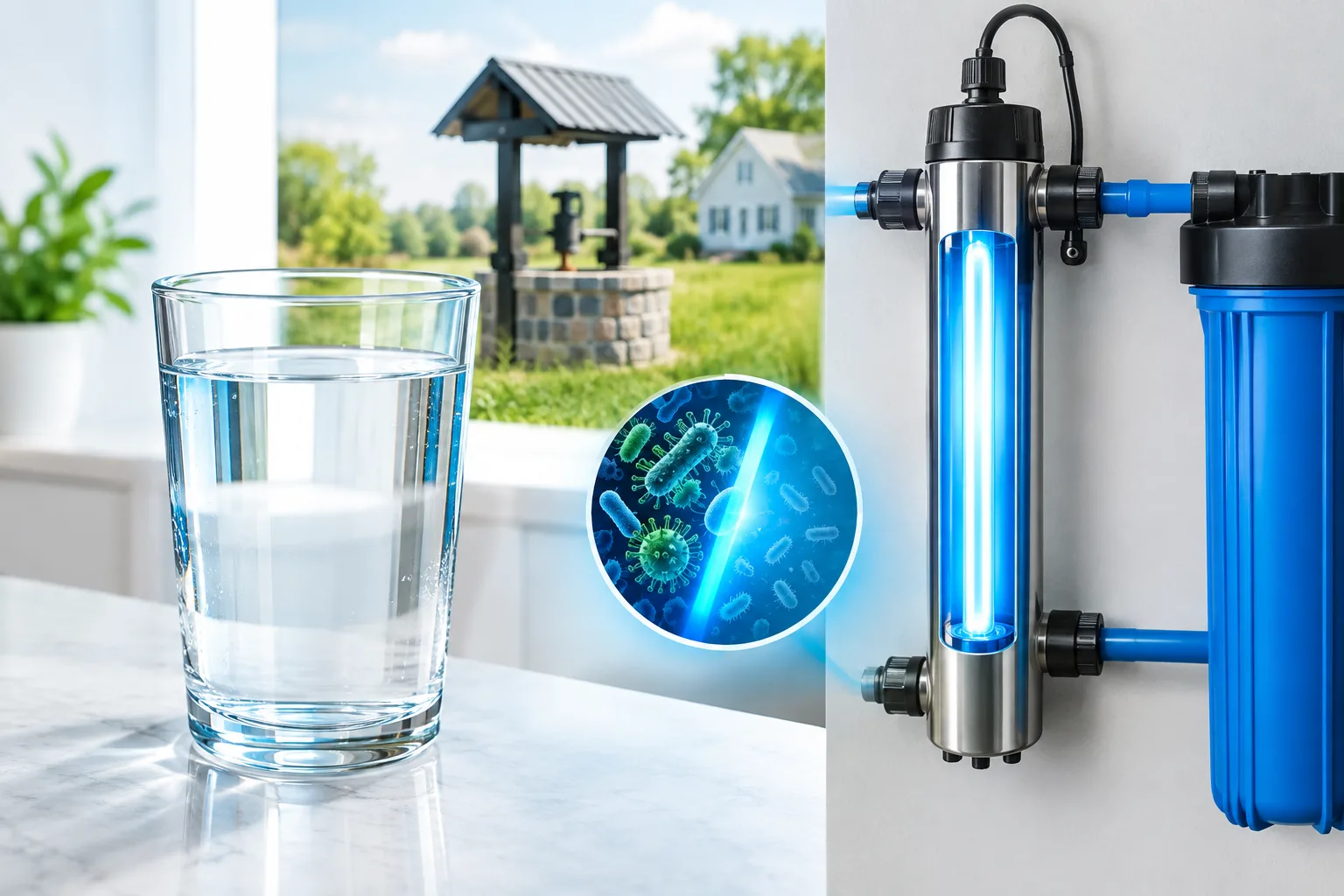
An ultraviolet light water purifier runs your water past a lamp that emits UV-C light at 254 nanometers. That light scrambles the DNA and RNA of bacteria, viruses and protozoa, so they can't reproduce or cause infection. Nothing is added to the water. Taste, odor and pH stay exactly as they were. UV also handles Cryptosporidium, a parasite that tolerates chlorine well enough to survive in treated swimming pools.
Three limits are worth knowing before you commit:
- UV only treats living organisms. It does nothing for nitrate, arsenic, lead, iron, hardness or PFAS. If your test shows any of those, you'll need a separate treatment stage.
- UV needs clear water. Sediment shades microbes from the light, and iron, manganese and hardness coat the quartz sleeve around the lamp. Industry guidance generally calls for turbidity under 1 NTU, iron under 0.3 mg/L, manganese under 0.05 mg/L and hardness under about 7 grains per gallon, plus a sediment filter directly ahead of the unit.
- UV leaves no residual. Water is disinfected only while it passes the lamp. A UV disinfection water treatment setup belongs at the point of entry, as the last stage before water reaches your plumbing. It won't fix a cracked well cap, so repair the well itself too.
None of this calls for panic. Most wells deliver perfectly good water most of the time. The problem is that "most of the time" is hard to tell apart from "always" when you can't see what's in the glass. A certified lab test tells you where you stand, and a properly sized, properly maintained UV system turns a sometimes-risky well into a dependable one.