
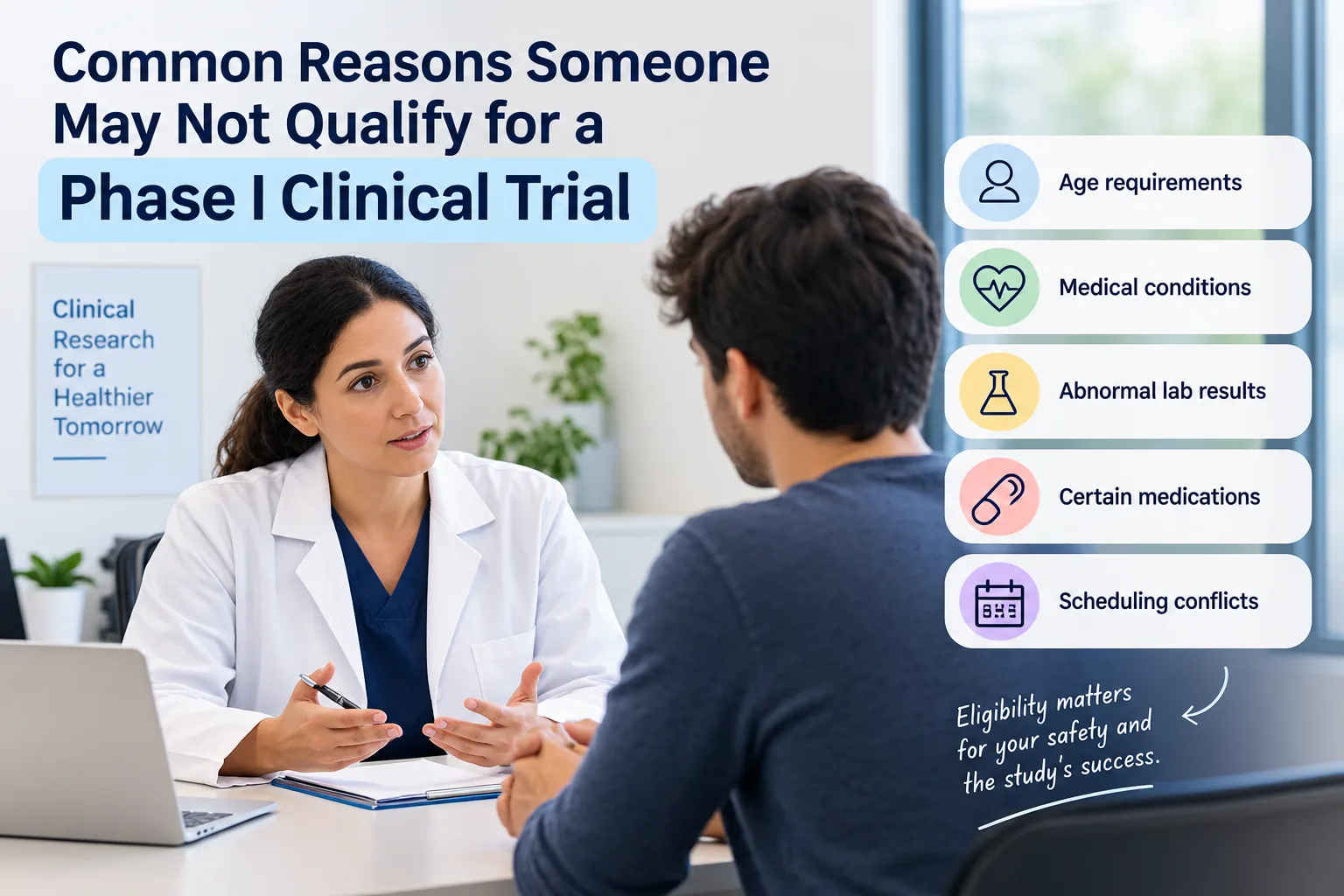
Finding a Phase I clinical trial that looks like a good fit can be exciting. You may meet the age requirement, feel healthy, and be interested in helping with medical research. But after completing a screening questionnaire or health assessment, you may find out that you are not eligible.
This can be disappointing, but it does not necessarily mean there is anything wrong with your health.
Clinical trials have specific inclusion and exclusion criteria that determine who can safely participate and who best fits the research question. These requirements can vary significantly from one study to another. In Phase I studies, eligibility requirements can be particularly important because researchers are often evaluating how an investigational drug behaves in the human body and carefully monitoring its safety.
So, why might someone not qualify for a Phase I clinical trial?
Here are some of the most common reasons.
1. Age Does Not Match the Study Requirements
Age is one of the first things researchers may look at during screening.
A Phase I clinical trial may be designed for adults within a specific age range. For example, one study may be looking for adults between 18 and 45, while another may have a different age range.
This is not necessarily because people outside that range cannot safely take part. The study may simply have been designed to answer a particular research question in a specific population.
If your age falls outside the study's requirements, you may not qualify even if you are otherwise healthy.
2. Your Overall Health Does Not Match the Study Criteria
Many Phase I studies involve healthy volunteers. In this type of research, investigators generally want participants without significant health problems that could affect the study results or increase potential risks.
During screening, the research team may review your medical history and perform health assessments, physical examinations, or laboratory tests.
A condition that seems minor in everyday life may still matter for a particular study. Researchers need to understand participants' baseline health before evaluating an investigational drug.
The NIH describes healthy volunteers as people without known significant health problems who participate in research, often to help researchers understand a new drug or intervention.
3. Certain Medical Conditions May Affect Eligibility
Having a current or previous medical condition can sometimes prevent participation.
For example, a study may exclude people with a history of certain:
- Heart conditions
- Liver problems
- Kidney conditions
- Respiratory disorders
- Neurological conditions
- Gastrointestinal conditions
- Metabolic disorders
- Other significant medical conditions
The reason depends on the study.
A medical condition may affect how a drug is absorbed, processed, or removed from the body. It could also make it more difficult for researchers to determine whether a symptom is related to the investigational drug or an existing condition.
FDA guidance notes that medical conditions and other participant characteristics can affect both safety and the interpretation of clinical trial results.
4. Your Laboratory Results Fall Outside the Required Range
Feeling healthy does not always mean that every screening test will fall within a study's required range.
Phase I clinical trials may include blood or urine testing and other assessments during screening. Researchers may review measurements related to areas such as blood counts, liver function, kidney function, glucose levels, or other markers depending on the protocol.
If a result falls outside the range allowed by the study, you may not qualify.
Importantly, one abnormal result does not automatically mean that you have a serious medical problem. Sometimes results can vary for temporary or harmless reasons. The research team determines eligibility according to the specific protocol.
5. You Take Certain Prescription or Over-the-Counter Medications
Medications can also affect whether someone is eligible for a Phase I clinical trial.
Some drugs can interact with an investigational medication. Others may affect how the body absorbs, metabolizes, or eliminates a study drug.
For this reason, a protocol may restrict certain prescription medications, over-the-counter medicines, or other products.
You should always tell the research team about everything you currently take rather than leaving something out because it seems unrelated. This can include medications, supplements, and other products.
FDA guidance recognizes that concomitant medications can affect participant safety and may influence whether someone can appropriately participate in a particular study.
6. Recent Participation in Another Clinical Trial
Taking part in another clinical study recently can sometimes affect eligibility.
This is because researchers need to know what substances or interventions have recently entered your body before you receive another investigational product.
A previous study may also involve follow-up periods or restrictions designed to protect participants.
For this reason, a Phase I protocol may require a certain amount of time to have passed since your last clinical trial or investigational drug exposure.
The required waiting period is different from study to study, so it is important to provide accurate information about previous research participation.
7. Your Weight or BMI Falls Outside the Study Range
Some Phase I clinical trials have specific requirements related to body weight or BMI.
This can be particularly relevant when researchers are studying how an investigational drug is absorbed, distributed, metabolized, and eliminated.
The purpose is not to judge someone's body size. Instead, the study protocol may require a defined participant group so researchers can interpret the results consistently.
It is worth remembering that eligibility requirements are study-specific. Being outside the required range for one Phase I clinical trial does not mean you will be excluded from every clinical research study.
8. Smoking, Alcohol, or Other Lifestyle Factors
Certain lifestyle habits can affect eligibility.
For example, a study may have restrictions involving:
- Smoking or nicotine use
- Alcohol consumption
- Recreational drug use
- Caffeine intake
- Specific dietary habits
- Strenuous exercise
These restrictions may be temporary or may apply throughout the study.
Researchers sometimes control these factors because they can influence laboratory measurements, drug metabolism, sleep, heart rate, or other study outcomes.
If a study has lifestyle restrictions, the research team should explain them before enrollment so you understand what participation involves.
9. Pregnancy or Breastfeeding Requirements
Some clinical trials have specific reproductive safety requirements.
Depending on the investigational drug and study design, women who are pregnant or breastfeeding may not be eligible.
A study may also have contraception requirements for participants who could become pregnant. Pregnancy testing may be part of the screening process when appropriate.
These requirements are related to protecting participants and potential pregnancies from unknown risks associated with an investigational product.
The exact requirements depend on the individual clinical trial protocol.
10. You Cannot Commit to the Study Schedule
Eligibility is not always about medical history.
Phase I clinical trials can involve several visits, blood draws, physical examinations, questionnaires, dosing periods, or overnight stays. Some studies may require participants to remain at a research facility for a specified period.
If you cannot be available for the required visits or do not think you can follow the study schedule, you may not qualify.
This is important because missing study procedures can affect both participant safety and the quality of the research data.
Before enrolling, ask the study team about the expected schedule, visit frequency, length of stay, dietary restrictions, and other participation requirements.
11. You Do Not Meet a Specific Study Requirement
Every Phase I clinical trial is different.
One study may require healthy adults within a narrow age range. Another may focus on a specific group of participants. Some studies may require particular characteristics because of how the investigational drug is being studied.
The NIH explains that inclusion criteria identify factors that allow someone to participate, while exclusion criteria identify factors that prevent participation. These criteria are established for scientific and safety reasons.
This means that being rejected from one study does not mean you are generally unsuitable for clinical research.
Another study may have completely different eligibility requirements.
12. You Do Not Meet All of the Requirements During Screening
Sometimes people assume that completing an initial questionnaire means they have officially qualified for a study.
Usually, screening is a process rather than a single step.
You may first answer questions online or over the phone. If your answers appear to match the basic requirements, the research team may invite you for additional screening.
Further assessments may include medical history, physical examination, laboratory testing, or other study-specific procedures.
Only after the required screening steps can the research team determine whether you meet the protocol's eligibility requirements.
Being Ineligible Does Not Mean You Did Anything Wrong
One of the most important things to remember is that not qualifying for a Phase I clinical trial is not a personal rejection.
Clinical trial eligibility criteria exist because researchers need a defined group of participants and must consider safety when designing the study. The NIH specifically notes that inclusion and exclusion criteria are not intended to reject people personally; they help identify appropriate participants and protect their safety while producing useful research data.
If you do not qualify for one study, another study may have different requirements.
For people interested in participating in research, it can be useful to regularly check available clinical studies for healthy volunteers and review the eligibility requirements before beginning the screening process. Resources such as AXISpays can help people explore currently available study opportunities and learn more about participation requirements.
How to Improve Your Chances of a Smooth Screening Process
You cannot change the eligibility requirements of a clinical trial, but you can make the screening process easier by being prepared.
Before screening:
- Be honest about your medical history.
- Make a list of medications and supplements you take.
- Know when you last participated in a clinical trial.
- Ask about the study's time commitment.
- Follow any fasting or other pre-screening instructions.
- Tell the research team about relevant health changes.
- Read the study information carefully.
- Ask questions if you do not understand a requirement.
Most importantly, do not stop taking prescribed medication or change your normal medical care simply to try to qualify for a study. If you have questions about your health or medications, speak with your healthcare provider and the clinical research team.
Final Thoughts
Phase I clinical trials play an important role in the development of new medicines. These early studies are generally closely monitored and often involve healthy volunteers, although some Phase I studies may involve patients. Researchers use them to learn more about how an investigational drug behaves in humans, including its pharmacologic effects, metabolism, and potential side effects.
Not qualifying for a particular study can happen for many reasons—from age and laboratory results to medications, previous study participation, lifestyle factors, or scheduling conflicts.
The key point is simple: eligibility is specific to each study.
If one Phase I clinical trial is not the right match, that does not necessarily mean another clinical research opportunity will not be. Understanding the screening process and checking the requirements carefully can help you find studies that are a better fit for your circumstances.
Frequently Asked Questions
1. Why would someone be excluded from a Phase I clinical trial?
Someone may not qualify because of their age, medical history, laboratory results, medications, BMI, lifestyle factors, recent participation in another clinical trial, or other requirements specific to the study protocol.
2. Can healthy people be rejected from a Phase I clinical trial?
Yes. Being healthy does not automatically mean you qualify. Researchers may have specific requirements for age, weight, medical history, medications, laboratory values, and other factors.
3. What can disqualify you from a clinical trial?
Common factors include certain medical conditions, abnormal lab results, use of restricted medications, recent participation in another study, pregnancy or breastfeeding, smoking or alcohol restrictions, and inability to meet the study schedule.
4. Can I join another clinical trial if I do not qualify for one?
Yes. Eligibility requirements vary between clinical trials. Not qualifying for one study does not necessarily prevent you from participating in another study if you meet its specific criteria.
5. What happens if I do not qualify during clinical trial screening?
The research team will let you know that you do not meet the requirements for that particular study. Depending on the situation, you may be able to look for another clinical research study with different eligibility criteria.