On the spreadsheet, outsourcing software development appears straightforward: cheaper day rates, quicker hiring of a team and one that can be expanded or contracted as necessary. That spreadsheet doesn't show up the risks. They come six months later, when everyone involved in the launch has forgotten about them or when no one at the company can access the code or the supplier that has the keys to your customer information.
The demand is still not abating. IT services spending worldwide is projected to hit $1.57 trillion in 2026, representing a 5.3% increase, according to Gartner. The landscape of security, however, is growing more complex: third parties were involved in 48% of breaches, compared to 30% in the previous year, said the 2026 Verizon Data Breach Investigations Report. Before you sign a contract for offshore development outsourcing in UK, you need to think through these risks.
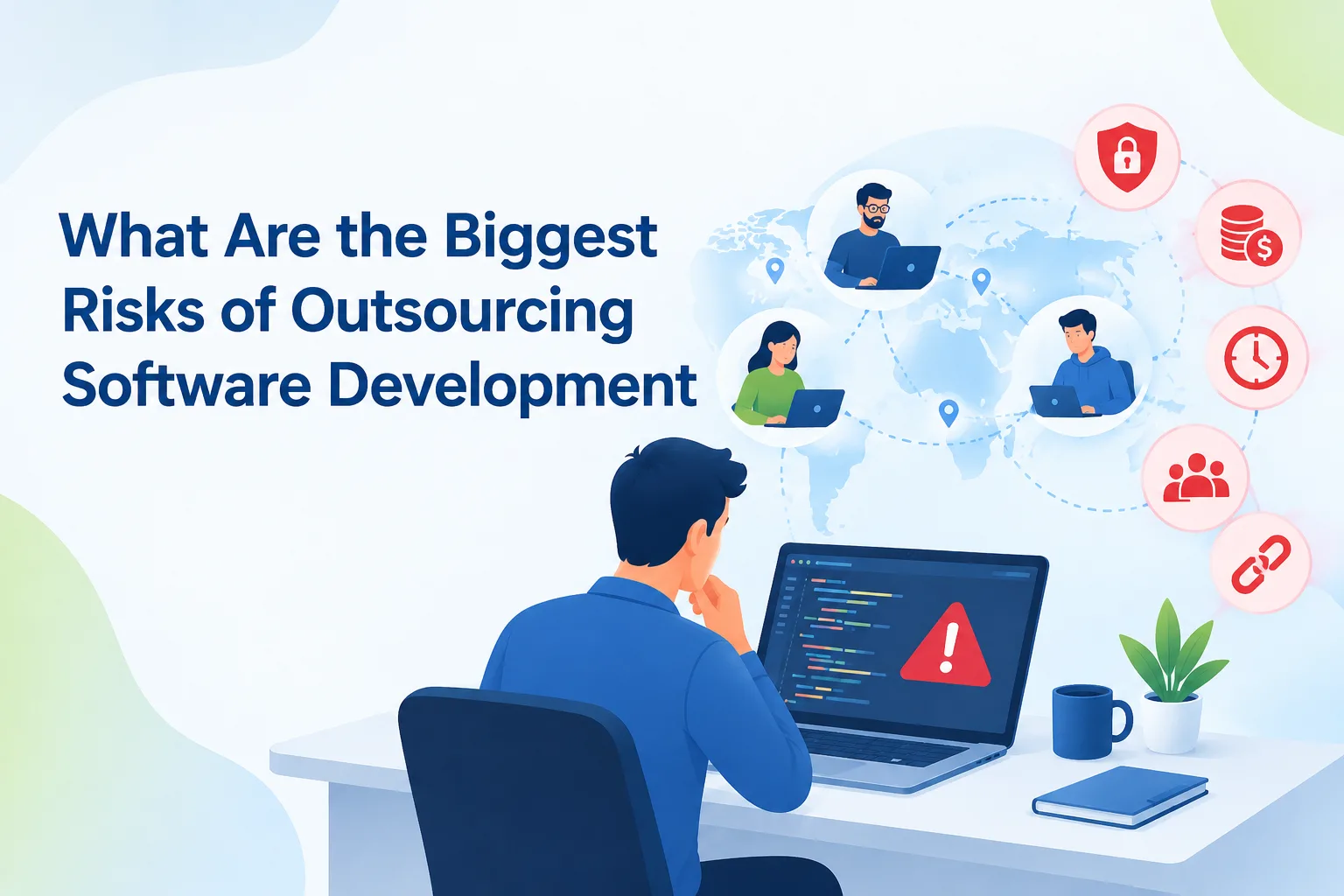
What Are the 7 Biggest Risks of Outsourcing Software Development?
1. Hidden code quality problems
Software can pass a demo and still be badly built. Missing tests, duplicated logic and thin documentation only show up when you try to change something. The real twist with AI coding tools is that many vendors already employ them and Veracode's 2026 GenAI Code Security Report revealed that AI-generated code had a 56% success rate in passing security tests. Inquire about reviewing code, not how quickly it is written.
2. Data security and UK GDPR exposure
An outsourced team typically must gain access to your systems, test data or live environments. However, providing an overseas supplier with personal data is regarded as a restricted transfer, even if the data is not actually “sent”, under UK GDPR. The ICO’s own example is a UK business giving an Indian service provider access to its systems. This requires UK adequacy measures or a safeguard like the International Data Transfer Agreement (IDTA), along with a transfer risk assessment. That's where data security in an offshore software development service for companies in the UK turns into a legal question, in addition to a technical one.
3. Supply chain cyber risk
Your supplier’s weaknesses become yours. A flaw in the MOVEit file-transfer tool used by the payroll provider Zellis, has led to names, dates of birth and National Insurance numbers being made public for BBC, British Airways and Boots staff in 2023. However, according the UK Government's Cyber Security Breaches Survey 2025/26, only 15% of businesses assess the cyber risks of their immediate suppliers and only 6% assess the cyber risks of their wider supply chain.
4. Unclear IP ownership
Many buyers assume that paying for code means owning it. In the UK, that is not automatic. Under the Copyright, Designs and Patents Act 1988 the author is automatically the copyright owner of his works, and only the employer is automatically the copyright owner of the employees' work. If a code is to be developed by an agency or a contractor, there should be a written and signed assignment to transfer the code to you.
5. Communication and time-zone gaps
The majority of outsourcing failures are not technical. Requirements get lost between a product owner in London and a team four and a half to five and a half hours ahead. Some warning signs are issues being raised late, stand-ups reporting status and not blockers, and being “yes” people.
6. Hidden costs and scope creep
The low day rate does not equal low project cost. Rework, management time, change requests beyond a fixed price and the transfer of knowledge are all factors that all add up. Include in the business case even if two days per week is required to manage the supplier.
7. Vendor lock-in and weak governance
Switching becomes painful if only the supplier knows your architecture, has the cloud accounts and controls deployments. The cautionary tale is of TSB, whose IT migration in 2018 caused a serious service disruption for a large portion of its 5.2 million customers, and which was subsequently fined by regulators for failing to manage the risk of the IT outsourcing arrangements with a critical third-party supplier. Accountability for the work is never delegated when the work is outsourced.
Outsourcing Risks at a Glance: Warning Signs and Fixes
RiskEarly warning signHow to reduce itHidden code quality issuesNo automated tests or code review processIndependent code review and a test coverage targetData security and UK GDPRSupplier wants production data "to save time"Anonymised test data, IDTA and a transfer risk assessmentSupply chain cyber riskNo security certification or policies on requestCyber Essentials Plus or ISO 27001, plus the NCSC principlesUnclear IP ownershipContract is silent on copyrightSigned written IP assignment on paymentCommunication gapsProblems surface only at sprint reviewsOverlap hours, one accountable lead, written acceptance criteriaHidden costsFrequent change requests on a fixed pricePaid discovery phase and a clear change processVendor lock-inSupplier owns the repositories and cloud accountsClient-owned accounts and a documented exit planHow Do You Reduce the Risks of Outsourcing Software Development?
Whichever offshore software development services UK businesses shortlist, the same seven safeguards apply:
1. Check the supplier is real
Check its Companies House listing, years in business, directors, and obtain references to call.
2. Ask for security evidence
Cyber Essentials or Cyber Essentials Plus is a sensible minimum; ISO 27001 is stronger. The NCSC’s 12 supply chain security principles make a good checklist.
3. Put IP and data in the contract
Include an IP assignment, a data processing agreement and an IDTA or Addendum where personal data leaves the UK.
4. Own the keys
Keep repositories, cloud accounts and domains in your company’s name. The supplier gets access, not ownership.
5. Start with a paid pilot
A short discovery phase or one sprint to test the quality and communication prior to commitment.
6. Test independently
Do not leave code to be marked by the supplier, use code reviews and automated tests or independent software testing.
7. Agree the exit on day one
Ensure that there is documentation of the handover, knowledge transfer and notice periods are incorporated into the contract.
Frequently Asked Questions
1. What is the biggest risk of outsourcing software development?
In most businesses, it's losing control over code quality, data or intellectual property. With third parties involved in almost half of all breaches, security and data access deserve the closest scrutiny, followed by IP ownership and how easily you could switch supplier.
2. Who owns the code when you outsource software development?
Under UK copyright law, the supplier is the owner of the copyright automatically. Ownership can only be transferred with a written assignment signed by the supplier – ensure that your contract will assign ownership of the source code, designs and documentation to you after the payment has been made.
3. Is it safe to outsource software development to India?
It is, as long as the supplier has robust security measures and the data transfer complies with UK GDPR. You will typically require an IDTA or the Addendum along with a transfer risk assessment unless there are UK adequacy regulations which apply to the destination and should avoid using personal data in test environments.
4. How do you choose a low-risk outsourcing partner?
Check Companies House, obtain security certifications and references, and test drive with a paid pilot. A good partner will welcome an IP assignment clause, client-owned repositories and independent testing. If the supplier does not agree to any of these, it is a red flag.
So, What Are the Biggest Risks of Outsourcing Software Development?
Poor coding quality, data and IP exposure, supply chain exposure and vulnerability, communication issues, hidden costs and lock-in. All these risks are the same in that they are neither based on the place of developers nor depend on the gaps in the contracts, access and oversight. Address those gaps and outsourcing becomes a possibility to scale up without giving up control.
Having a local legal entity with an IT outsourcing company in UK can make it easier to sign contracts and hold them accountable, but the protections outlined above still apply regardless of location.
At RSK Business Solutions, our Kent-based team works alongside a development centre near Delhi, and client-commissioned IP is agreed as client-owned before development starts, so if you are planning to outsource and want a second opinion on the risks, book a free consultation with us.