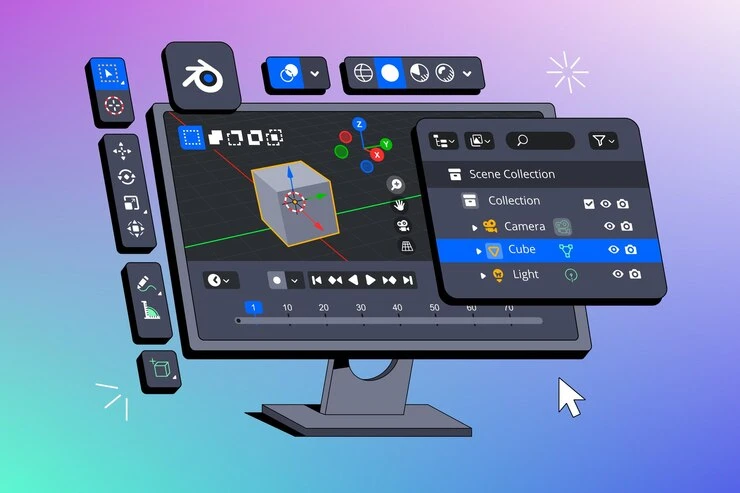
3D animation has become a powerful tool across industries, transforming how ideas are visualized, communicated, and experienced. By creating digital objects with depth, movement, and realism, 3D animation allows businesses, educators, and creators to present information in ways that are both visually compelling and easy to understand. From entertainment to healthcare, the applications of 3D animation continue to expand as technology evolves.
Entertainment and Media
One of the most recognizable applications of 3D animation is in the entertainment industry. Animated movies, television series, and video games rely heavily on 3D animation to create immersive worlds and expressive characters. Modern audiences expect high-quality visuals, realistic motion, and detailed environments, all of which are made possible through advanced animation techniques.
In gaming, 3D animation enhances gameplay by providing lifelike character movements, interactive environments, and cinematic storytelling. In film and television, it enables filmmakers to create scenes and effects that would be difficult or impossible to capture using traditional filming methods.
Advertising and Marketing
3D animation plays a major role in modern advertising and marketing. Brands use animated videos to showcase products, explain services, and tell brand stories in a visually engaging way. Product animations, in particular, allow companies to highlight features, internal mechanisms, and benefits with complete control over lighting, angles, and motion.
With the support of professional 3D animation services, marketers can create high-impact visuals for websites, social media, digital campaigns, and presentations. Animated content often achieves higher engagement rates because it simplifies complex messages and captures attention quickly.
Architecture and Real Estate
In architecture and real estate, 3D animation is widely used for visualization and planning. Architects and developers create realistic 3D walkthroughs, flythroughs, and exterior visuals to present projects before construction begins. These animations help clients understand scale, layout, lighting, and design details more clearly than traditional drawings.
For real estate marketing, 3D animations help potential buyers visualize properties, interior spaces, and future developments, making them a valuable tool for sales and presentations.
Education and E-Learning
3D animation has transformed education by making learning more interactive and engaging. Complex concepts in science, engineering, and technology can be visualized in a way that is easy to understand. For example, animated models can demonstrate physics principles, mechanical systems, or biological processes with clarity.
In e-learning and corporate training, 3D animation improves knowledge retention by combining visuals with storytelling. Businesses often rely on specialized 3D animation services to create instructional videos, safety training modules, and simulations.
Healthcare and Medical Visualization
In the healthcare industry, 3D animation is used to visualize anatomy, medical procedures, and treatment processes. Medical animations help doctors explain diagnoses and procedures to patients in a clear and accessible way. They are also used in medical education to train students and professionals.
Because accuracy is critical in this field, high-quality 3D animation services play an important role in ensuring scientific precision and visual clarity.
Manufacturing and Industrial Applications
3D animation is widely applied in manufacturing and industrial sectors to explain complex machinery, workflows, and production processes. Animated videos can demonstrate how equipment operates, how products are assembled, or how systems function internally.
These animations are commonly used for employee training, technical presentations, and trade shows, where visual clarity and efficiency are essential.
Technology, AR, and VR Experiences
With the rise of augmented reality (AR) and virtual reality (VR), 3D animation has become a foundation for immersive digital experiences. From virtual product demos to interactive exhibitions and simulations, 3D animated content enhances realism and user engagement.
Companies offering 3D animation services often work closely with AR and VR developers to create interactive environments that bridge the gap between the physical and digital worlds.
Conclusion
The applications of 3D animation are vast and continually growing. From entertainment and marketing to education, healthcare, and technology, 3D animation helps communicate ideas more effectively and creatively. As industries increasingly rely on visual storytelling and immersive experiences, professional 3D animation services have become an essential tool for innovation, engagement, and success in a digital-first world.