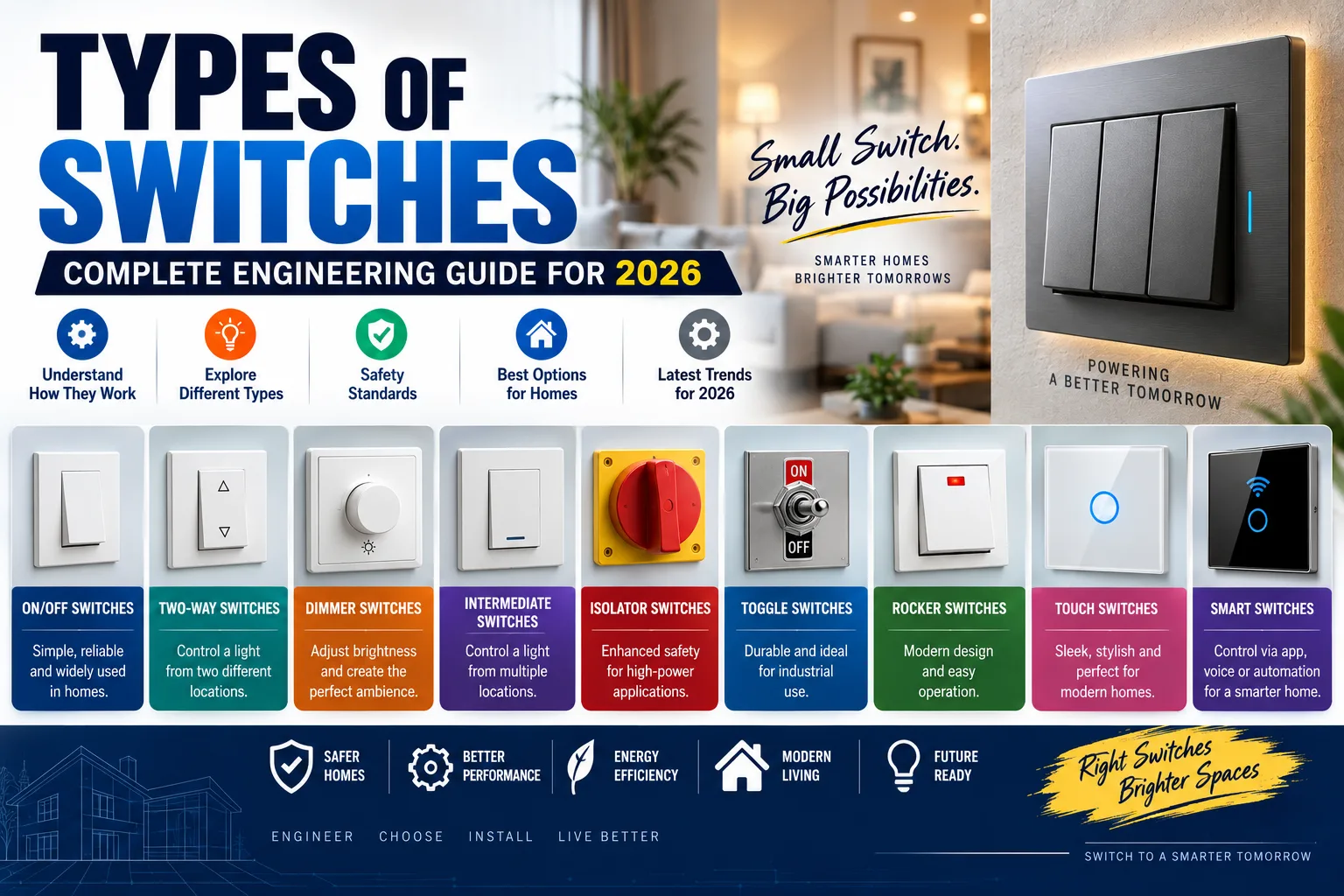
Electrical switches are among the most frequently used components in residential, commercial, industrial, and infrastructure electrical systems. From a simple wall switch controlling a lamp to sophisticated industrial switching equipment controlling high-power machinery, switches play a fundamental role in controlling electrical circuits.
With the growing popularity of modern interiors, modular electrical systems, smart homes, automation, and connected devices, consumers now have more choices than ever. Anyone searching for Best Switches, Switches in India, Best Switches In India, or Switches for Home will encounter numerous products with different mechanisms, ratings, designs, and applications.
Understanding the Types of switches is therefore important before purchasing or specifying an electrical product. A switch should not be selected only because it looks attractive or has a familiar brand name. Electrical rating, application, installation method, environmental conditions, safety requirements, compatibility, durability, and applicable standards should all be considered.
This engineering guide explains the major Types of Switches and Sockets, their working principles, applications, advantages, limitations, and selection considerations for modern electrical installations in 2026.
What Is an Electrical Switch?
An electrical switch is a device used to make, break, or control the flow of electric current in a circuit.
In its simplest form, a switch has conductive contacts that can be opened or closed.
When the contacts are closed, current can flow through the circuit. When they are open, the circuit is interrupted.
Although this principle sounds simple, electrical switches are engineered in many different forms to handle different voltages, currents, environments, switching frequencies, and control requirements.
Switches can be classified according to:
- Number of poles
- Number of throws
- Operating mechanism
- Installation method
- Electrical load
- Application
- Control method
- Environmental protection
- Automation capability
Why Understanding the Types of Switches Matters
Choosing the correct switch is important for both functionality and electrical safety.
For example, a switch designed for a lighting circuit may not be appropriate for directly controlling a high-current motor. Similarly, a conventional switch may not provide the functionality required for a smart-home automation system.
Understanding the different Types of switches helps homeowners, electricians, engineers, architects, contractors, and procurement teams select products based on actual requirements.
A good selection process considers:
- Voltage rating
- Current rating
- Load type
- Switching frequency
- Installation environment
- Mechanical durability
- Electrical safety
- Compatibility
- Required control configuration
- Applicable standards
Basic Classification of Electrical Switches
Electrical switches can broadly be categorized into several groups.
Based on Poles
- Single-pole
- Double-pole
- Three-pole
- Four-pole
Based on Throws
- Single-throw
- Double-throw
Based on Operation
- Toggle
- Rocker
- Push-button
- Rotary
- Slide
- Selector
- Momentary
Based on Application
- Lighting switches
- Fan controls
- Industrial switches
- Motor switches
- Safety switches
- Limit switches
- Appliance switches
- Smart switches
Based on Technology
- Mechanical switches
- Electronic switches
- Sensor-based switches
- Smart connected switches
1. One-Way or Single-Pole Switch
A one-way switch is one of the most common switches used in residential electrical installations.
It is typically used to control a light or other compatible load from a single location.
Applications
One-way switches are commonly used for:
- Bedroom lights
- Living-room lights
- Ceiling lights
- Outdoor lights
- Small electrical loads
Advantages
- Simple construction
- Easy operation
- Straightforward installation
- Widely available
- Suitable for basic lighting control
For ordinary household lighting, a properly rated one-way switch can be a practical solution.
2. Two-Way Switch
A two-way switching arrangement allows a load to be controlled from two different locations.
It is commonly used in:
- Staircases
- Hallways
- Bedrooms
- Large rooms
- Corridors
For example, a staircase light can be switched on from the bottom and switched off from the top.
Two-way switching is particularly useful where users need control from different points.
3. Intermediate Switch
An intermediate switch is used in switching arrangements where a single load needs to be controlled from more than two locations.
It is generally used alongside appropriate two-way switches.
Typical Applications
- Long corridors
- Staircases with multiple access points
- Large rooms
- Commercial buildings
The advantage is convenient control from multiple positions.
4. Double-Pole Switch
A double-pole switch controls two conductors simultaneously.
It can provide greater isolation than a simple single-pole switch in applications where simultaneous switching of multiple conductors is required.
Double-pole switches may be used for suitable appliances and circuits according to the electrical design.
Applications can include:
- Certain water heaters
- Appliances
- Dedicated circuits
- Equipment isolation
The appropriate switching arrangement should always be determined by the electrical system design and local requirements.
5. Push-Button Switch
A push-button switch operates when the button is pressed.
Push buttons may be:
- Momentary
- Maintained
A momentary push button returns to its original position after being released.
Applications
- Doorbells
- Control panels
- Machine controls
- Reset functions
- Signalling systems
Push-button switches are particularly useful when the action is intended to be initiated by pressing rather than by maintaining a conventional switch position.
6. Bell Push Switch
A bell push is a common example of a momentary push-button switch.
When pressed, it completes the relevant circuit and activates the connected device, such as a doorbell.
When released, the circuit returns to its normal state.
Its simple operation makes it a standard feature in residential and commercial entry systems.
7. Rocker Switch
A rocker switch uses a rocking mechanism to change between states.
Rocker switches are widely used in electrical and electronic equipment because they are easy to operate and visually indicate their position.
Applications include:
- Household equipment
- Power strips
- Appliances
- Lighting systems
- Electrical panels
Many modern modular wall switches use rocker-style mechanisms because of their convenient operation.
8. Toggle Switch
A toggle switch uses a lever that moves between positions.
Toggle switches are commonly encountered in electrical equipment, control systems, machinery, and specialized applications.
They can be configured for different pole-and-throw arrangements.
The key benefit is clear mechanical operation and tactile feedback.
9. Rotary Switch
A rotary switch uses a rotating mechanism to select between different circuits or operating positions.
Instead of simply switching between ON and OFF, rotary switches can provide several selectable positions.
Applications
- Equipment controls
- Measurement instruments
- Industrial control panels
- Selector systems
- Multi-speed equipment
A rotary switch can be useful when users need to select one of several operating modes.
10. Selector Switch
A selector switch allows the user to choose between different modes or circuits.
Industrial equipment commonly uses selector switches for functions such as:
- Manual/automatic selection
- Local/remote operation
- Operating-mode selection
- Machine control
Selector switches can be available in different configurations depending on the control system.
11. Slide Switch
A slide switch operates by moving a control element along a linear path.
These switches are frequently found in:
- Electronic equipment
- Portable devices
- Small appliances
- Consumer electronics
- Control interfaces
Their compact design makes them suitable for applications where space is limited.
12. Limit Switch
A limit switch is designed to detect the position or movement of a mechanical object.
It is commonly used in industrial automation.
For example, a limit switch can detect when a machine component has reached a particular position.
Applications
- Conveyor systems
- Machine tools
- Industrial automation
- Doors and gates
- Material-handling equipment
Limit switches are different from ordinary wall switches because their primary function is often position detection and control.
13. Safety Switch
Safety switches are designed to help protect people and equipment by providing a means of isolation or emergency control, depending on the specific product.
Examples include:
- Emergency-stop switches
- Disconnect switches
- Safety interlock switches
- Isolation switches
These products are especially important in industrial environments.
Safety functions should always be designed according to the relevant electrical and machinery safety requirements.
14. Emergency Stop Switch
An emergency-stop switch is used to quickly stop machinery or equipment during an emergency.
The familiar mushroom-shaped button is designed to be easily recognizable and quickly operated.
Emergency-stop systems are used in:
- Manufacturing plants
- Industrial machinery
- Conveyor systems
- Processing equipment
- Automated systems
The exact emergency-stop architecture should be designed according to applicable machinery-safety requirements.
15. Foot Switch
A foot switch allows an operator to control equipment using their foot.
It can be useful when both hands are occupied.
Applications include:
- Industrial machinery
- Medical equipment
- Workshop tools
- Production systems
- Specialized equipment
The switch should be selected according to the environment and required electrical rating.
16. Pull-Cord Switch
A pull-cord switch operates when a cord or cable is pulled.
It can be used in certain industrial or specialized applications where physical access to a conventional switch is inconvenient.
In industrial conveyor systems, pull-cord emergency switches can provide a means of stopping equipment along a defined area.
17. Proximity Switch
A proximity switch detects the presence or absence of an object without necessarily requiring physical contact.
Different sensing technologies include:
- Inductive
- Capacitive
- Magnetic
- Optical
Proximity switches are widely used in automation and industrial control.
18. Pressure Switch
A pressure switch responds to changes in pressure.
When pressure reaches a specified threshold, the switch changes its electrical state.
Applications include:
- Pumps
- Compressors
- HVAC systems
- Water systems
- Industrial equipment
Pressure switches are selected according to pressure range, medium, electrical rating, and environmental requirements.
19. Temperature Switch
A temperature switch changes its electrical state when temperature reaches a predetermined point.
It can be used for:
- Heating systems
- Cooling equipment
- Industrial processes
- Appliances
- Protection systems
Temperature switches differ from ordinary switches because their operation is triggered automatically by temperature.
20. Float Switch
A float switch detects liquid level using a floating mechanism.
It is commonly used in:
- Water tanks
- Sump pumps
- Drainage systems
- Industrial tanks
- Pump-control applications
The float moves with the liquid level and changes the switch state at a predetermined position.
21. Dimmer Switch
A dimmer allows compatible lighting to operate at different brightness levels.
Dimmer technology can vary, and compatibility is important.
Before installing a dimmer, users should check:
- Lamp type
- Load rating
- Minimum load
- Maximum load
- Compatibility
- Wiring requirements
Not every LED lamp is compatible with every dimmer.
22. Fan Regulator
Fan regulators control the operating speed of compatible fans.
Modern electronic regulators can provide smooth speed control.
When replacing an old regulator, compatibility with the fan type should be checked.
23. Smart Switch
Smart switches bring electrical switching into connected-home systems.
Depending on the technology, smart switches can provide:
- Smartphone control
- Voice control
- Scheduling
- Automation
- Remote operation
- Scene control
- Integration with smart-home ecosystems
Smart switches may use technologies such as Wi-Fi, Bluetooth, Zigbee, Z-Wave, or other communication protocols.
However, installation compatibility is critical.
Some smart switches require a neutral conductor, while others are designed for specific wiring configurations.
Best Switches for Home: How to Choose
Consumers searching for Switches for Home should begin with function rather than appearance.
Consider the following:
Room Requirements
Identify lights, fans, appliances, chargers, and other electrical loads.
Switch Type
Choose one-way, two-way, dimmer, fan-control, or other appropriate products.
Electrical Rating
Check the voltage and current rating.
Safety
Choose products suitable for the intended application and installation.
Design
Select a style that complements the interior.
Compatibility
Ensure the switch fits the electrical box and associated wiring system.
Future Requirements
Modern homes use more connected devices than ever. Plan sufficient sockets and control points.
Best Switches: What Should You Look For?
The term Best Switches does not refer to one universally superior product.
Instead, the best switch is one that satisfies the electrical and functional requirements of its application.
A quality product should offer appropriate:
- Electrical performance
- Mechanical operation
- Durability
- Safety
- Compatibility
- Design
- Availability
- Manufacturer support
Price should be considered alongside these factors.
Best Switches In India: Key Selection Factors
Consumers searching for the Best Switches In India can compare products using a structured approach.
1. Product Standards
Check whether the product complies with relevant Indian or applicable international standards for its category.
2. Electrical Rating
Ensure the rating matches the intended load.
3. Build Quality
Examine the mechanism, terminals, faceplate, and construction.
4. Manufacturer Reputation
Consider product history, availability, support, and warranty.
5. Design
Modern modular products can complement contemporary interiors.
6. Availability
A widely distributed product can be easier to replace.
7. Installation
Make sure the product is compatible with the electrical installation.
Also Read - Best Switches in India: Top Electrical & Modular Switch Guide
Switches in India: Modular Electrical Systems
The market for Switches in India has increasingly moved toward modular electrical systems.
Modular systems allow multiple electrical functions to be arranged within a common plate.
A modular plate might contain:
- Light switches
- Fan controls
- Dimmers
- Power sockets
- USB charging modules
- Data points
- Telephone connections
- TV connections
The exact configuration depends on the product range.
Switches and Sockets: Why They Work Together
Switches And Sockets form an important part of a complete electrical-accessory system.
Switches control circuits, while sockets provide connection points for appliances and devices.
Modern homes need both.
When planning a room, consider:
- Number of lighting circuits
- Fan controls
- Appliance sockets
- Charging points
- Data connectivity
- TV points
- Workstation requirements
- Future expansion
Poor planning can lead to excessive extension cords and overloaded outlets.
Types of Switches and Sockets
The Types of Switches and Sockets available depend on the electrical standard, application, manufacturer, and product range.
Common residential switch types include:
- One-way switches
- Two-way switches
- Intermediate switches
- Push buttons
- Dimmers
- Fan regulators
- Smart switches
Common socket categories include:
- General-purpose sockets
- Higher-current sockets
- USB charging sockets
- Specialized appliance outlets
- Data and communication modules
The appropriate socket should be selected according to the appliance's plug configuration and electrical requirements.
Electrical Safety When Selecting Switches
Safety should always take priority over appearance and price.
Before purchasing or installing switches:
- Verify electrical ratings.
- Use appropriate products for the application.
- Avoid damaged components.
- Do not overload sockets.
- Ensure correct earthing.
- Use suitable circuit protection.
- Follow installation instructions.
- Use qualified electrical professionals.
- Replace cracked or loose switches.
- Keep electrical installations appropriate for their environment.
For bathrooms, kitchens, outdoor areas, industrial environments, and other special locations, additional requirements may apply.
Switch Materials and Construction
The quality of a switch depends partly on its internal and external construction.
Important components can include:
Contacts
Electrical contacts establish or interrupt the circuit.
Springs
Springs can provide the force necessary for reliable switching action.
Terminals
Terminals provide connection points for conductors.
Insulating Housing
The housing provides electrical insulation and mechanical protection.
Faceplate
The visible faceplate contributes to appearance and user interaction.
High-quality construction can contribute to reliable operation over the product's service life.
Mechanical vs Electronic Switches
Traditional mechanical switches physically open and close electrical contacts.
Electronic switches use semiconductor or electronic components to control current.
Mechanical Switches
Advantages can include:
- Simple operation
- Familiar technology
- Clear tactile feedback
- Broad availability
Electronic Switches
Advantages can include:
- Automation
- Remote control
- Silent operation in some designs
- Advanced control functions
The right choice depends on the application.
Smart Homes and the Future of Switches
The future of residential switching is increasingly connected.
Smart switches can interact with:
- Mobile applications
- Voice assistants
- Sensors
- Automation systems
- Timers
- Security systems
- Energy-management platforms
For example, a smart lighting system can automatically switch lights based on schedules or sensors.
However, smart technology should not replace basic electrical safety principles.
How Architects and Interior Designers Select Switches
Electrical accessories are now considered part of interior design.
Architects and designers may evaluate:
- Switch placement
- Plate size
- Finish
- Color
- Room aesthetics
- Furniture positioning
- Accessibility
- Lighting controls
- Future requirements
A well-planned modular switch system can integrate into the overall design without becoming visually distracting.
Choosing Switches for Commercial Buildings
Commercial environments require a different approach from residential homes.
Offices, hotels, schools, hospitals, retail spaces, and other buildings may require:
- High durability
- Standardized products
- Large quantities
- Clear identification
- Easy maintenance
- Reliable replacement availability
- Appropriate ratings
- Project-level technical support
For large projects, consistency can be as important as initial purchase price.
How to Compare Switch Manufacturers
Before choosing a product, compare manufacturers on:
- Product portfolio
- Safety and compliance information
- Quality systems
- Product testing
- Availability
- Warranty
- Technical support
- Dealer network
- Design options
- Long-term replacement availability
This approach helps avoid making purchasing decisions based solely on brand recognition.
Common Mistakes When Buying Electrical Switches
Choosing Only by Appearance
A beautiful switch is not necessarily suitable for the electrical load.
Ignoring Electrical Ratings
Every product should be selected according to its intended application.
Installing Too Few Sockets
Modern households need many charging and appliance points.
Ignoring Compatibility
Smart switches, dimmers, regulators, and specialized products may have specific requirements.
Using Unqualified Installation
Improper wiring can create safety risks.
Buying Without Checking Standards
Electrical products should meet applicable requirements for their category.
2026 Trends in Electrical Switches
Several trends are shaping modern switching systems.
Modular Design
Consumers increasingly prefer flexible and aesthetically coordinated switch systems.
Smart Controls
Connected switches are becoming part of home automation.
USB and Charging Integration
Charging modules can reduce the need for separate adapters in some applications.
Touch Controls
Touch-based interfaces are available for certain premium and smart-home applications.
Energy Management
Smart switching can contribute to automated energy-use management.
Design Integration
Switches are increasingly available in finishes intended to complement contemporary interiors.
Frequently Asked Questions
What are the main Types of switches?
The major Types of switches include one-way, two-way, intermediate, double-pole, push-button, rocker, toggle, rotary, selector, limit, safety, dimmer, fan-control, pressure, temperature, float, proximity, and smart switches.
Which are the Best Switches for Home?
The Best Switches for Home are products that match the required electrical load, switching configuration, safety requirements, installation system, durability expectations, and interior design.
What are the Best Switches In India?
There is no single product that can universally be called the Best Switches In India. The right choice depends on application, electrical rating, safety, quality, design, compatibility, availability, and budget.
What are Switches And Sockets?
Switches And Sockets are electrical accessories used to control circuits and provide connection points for appliances and equipment.
What are the Types of Switches and Sockets?
The Types of Switches and Sockets include one-way switches, two-way switches, intermediate switches, push buttons, dimmers, fan regulators, smart switches, general-purpose sockets, higher-current outlets, USB charging modules, and specialized outlets.
Are modular switches better?
Modular switches can offer flexibility, modern appearance, and configurable combinations. Whether they are the best option depends on the installation and user's requirements.
Are smart switches suitable for every home?
Not necessarily. Smart switches may have specific wiring, load, connectivity, and compatibility requirements. These should be checked before installation.
Conclusion
Understanding the different Types of switches is essential for selecting the right electrical products for homes, offices, commercial buildings, and industrial applications.
From simple one-way switches to two-way and intermediate arrangements, push buttons, rocker switches, rotary controls, safety switches, limit switches, dimmers, fan regulators, sensor-based switches, and smart controls, each category has a specific purpose.
Consumers looking for Best Switches, Switches in India, or the Best Switches In India should avoid making decisions based solely on price or appearance. Electrical rating, safety, compatibility, construction quality, application, manufacturer support, and applicable standards are equally important.
For homeowners, selecting appropriate Switches for Home should begin with a room-by-room electrical plan. Lighting, fans, appliances, charging requirements, and future technology should all be considered before selecting switch and socket combinations.
Modern Switches And Sockets have also become an important element of interior design. Modular systems allow different functions to be combined within coordinated plates, while smart switches are bringing automation and connected control into residential environments.
The best electrical switch is ultimately not the most expensive or most technologically advanced product. It is the product that is appropriately rated, safely installed, compatible with the electrical system, reliable in operation, and suited to the user's specific requirements.
As electrical technology continues to evolve through modular design, smart-home integration, automation, connected devices, and improved user interfaces, switches will continue to move beyond simple ON/OFF control. For 2026 and beyond, informed selection based on engineering requirements and safe installation will remain the foundation of a dependable electrical system.