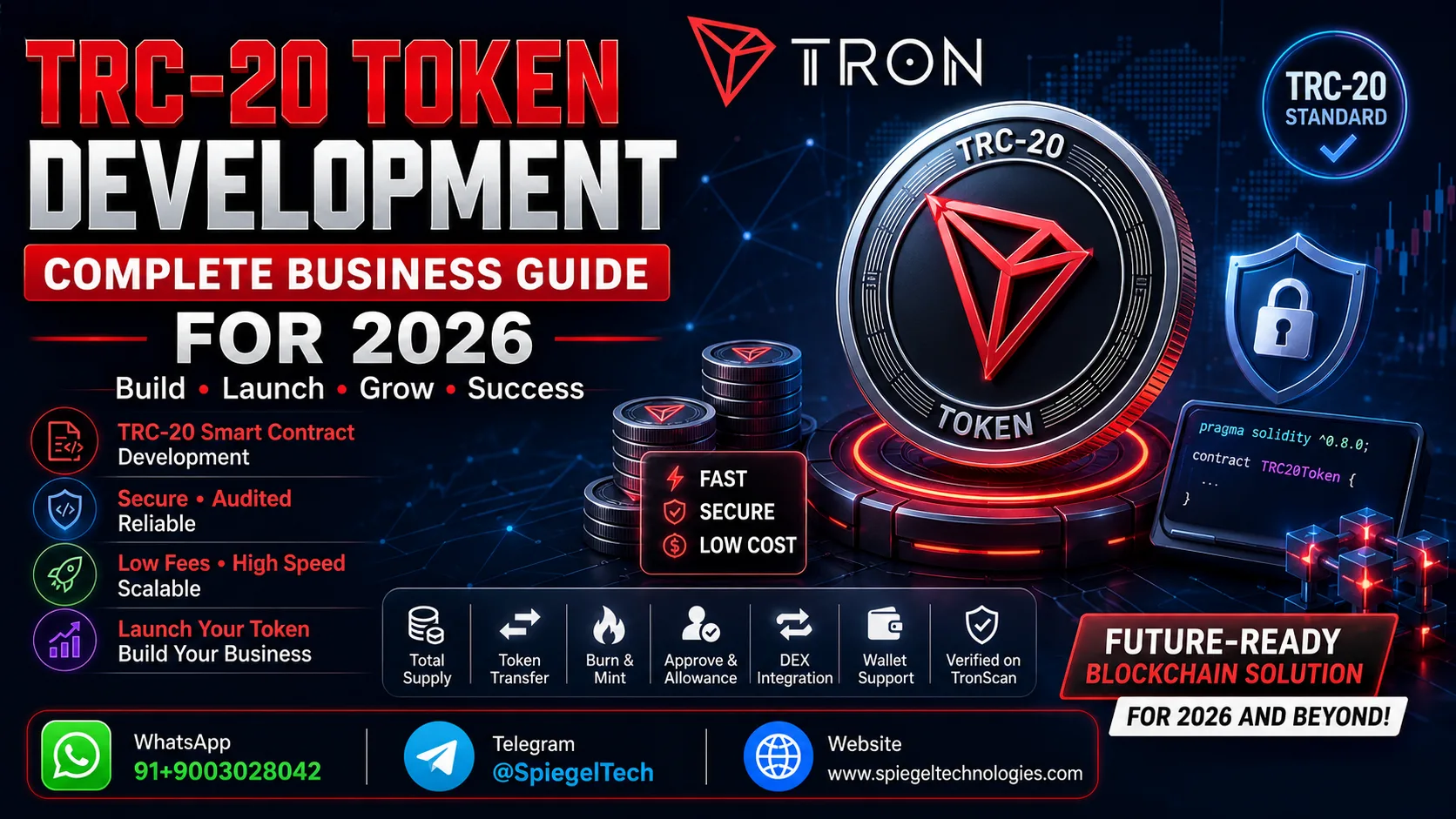
TRC-20 Token DevelopmentThe Complete Business Guide for 2026
Blockchain technology is fundamentally changing how businesses raise capital, manage assets, and build digital ecosystems. And among the many token standards competing for attention in today's crowded crypto landscape, TRC-20 tokens have carved out a distinct position — earning recognition for their speed, efficiency, and remarkably low transaction costs.
Built on the TRON blockchain, TRC-20 tokens give businesses a reliable, battle-tested framework for creating and managing digital assets at scale. For startups and enterprises mapping out their entry into the crypto space, TRC-20 crypto token development offers a strategic advantage that's hard to ignore: faster launches, lower operating costs, and seamless compatibility with one of the most active blockchain ecosystems in the world.
This guide covers everything you need to know — how TRC-20 tokens work, why businesses are choosing them in 2026, and how to navigate the development process from concept to launch.
Understanding the TRON Blockchain
Before diving into TRC-20 token specifics, it's worth understanding the infrastructure they run on.
TRON is a high-performance, decentralized blockchain platform originally designed to support digital content sharing and high-throughput applications. It uses a Delegated Proof-of-Stake (DPoS) consensus mechanism, which dramatically reduces the energy and computational overhead associated with older consensus models like Proof-of-Work.
The result is a network capable of processing thousands of transactions per second — significantly faster than Ethereum in its earlier iterations — while keeping transaction fees a fraction of what competing networks charge. TRON's native support for smart contracts means developers can build decentralized applications, DeFi protocols, and of course TRC-20 tokens with relative ease.
The ecosystem surrounding TRON has also matured considerably. Wallets, exchanges, DeFi platforms, and developer tooling all support TRC-20 token standards natively, giving any new crypto token development project a ready-made infrastructure to build on.
What Exactly Is a TRC-20 Token?
A TRC-20 token is a digital asset created on the TRON blockchain using a standardized protocol — essentially TRON's equivalent of Ethereum's ERC-20 standard. This protocol defines precisely how tokens are created, transferred, approved, and managed within the network, ensuring consistency and interoperability across every application that supports it.
At the technical level, TRC-20 tokens are governed by smart contracts. These self-executing programs automate token operations — transfers, approvals, balance checks — without requiring manual intervention or a trusted third party. Every rule is baked directly into the contract code, making the entire process transparent, auditable, and tamper-proof.
When a business decides to create a TRC-20 token, the development process involves defining several core parameters: total supply, token name and symbol, decimal precision, and the distribution model. Once deployed on the TRON blockchain, the token becomes a fully functional digital asset accessible to anyone within the ecosystem.
Why Businesses Are Choosing TRC-20 Crypto Token Development in 2026
The demand for efficient blockchain solutions isn't slowing down — it's accelerating. And in 2026, TRC-20 crypto token development has become one of the most practical responses to that demand. Here's why businesses are choosing TRON over competing standards:
Exceptionally Low Transaction FeesThis is often the deciding factor for businesses operating at scale. TRC-20 tokens allow companies to process enormous volumes of transactions — payments, rewards distributions, asset transfers — without the fee burden that makes Ethereum-based operations cost-prohibitive for high-frequency use cases. For payment systems and microtransaction platforms in particular, this cost efficiency is transformational.
High Throughput and ScalabilityTRON's architecture is built for volume. As a business grows and user demand increases, TRC-20 token infrastructure scales to meet that demand without performance degradation. This makes TRC-20 an ideal foundation for large-scale applications that expect rapid user growth.
Near-Instant Transaction ConfirmationSpeed matters in crypto. TRC-20 tokens offer near-instant transaction confirmation, creating the kind of seamless, responsive user experience that modern applications demand. Real-time payment processing, instant reward distributions, and rapid asset settlement are all achievable on TRON's infrastructure.
A Mature, Well-Supported EcosystemTRC-20 token development benefits from TRON's broad ecosystem of wallets, DEXs, DeFi protocols, and developer tools. This existing infrastructure means your token is immediately accessible to a global audience the moment it goes live — no need to build distribution from scratch.
Customization FlexibilityWhether you're building a utility token for a platform economy, a governance token for a DAO, a stablecoin, or a loyalty rewards currency, TRC-20 crypto token development accommodates virtually any use case with the customization flexibility to match your specific requirements.
Business Use Cases for TRC-20 Tokens
TRC-20 tokens aren't a one-size-fits-all solution — they're a flexible standard that different industries are adapting to their own needs. Here are the most active use cases in 2026:
Decentralized Finance (DeFi) Platforms
TRC-20 tokens are a foundational component of DeFi on TRON. Lending protocols, yield farming platforms, decentralized exchanges, and liquidity pools all use TRC-20 tokens to facilitate financial activity without traditional intermediaries. For businesses entering the DeFi space, TRON's low fees make it a more accessible entry point than Ethereum mainnet.
Cross-Border Payment SystemsThe combination of near-zero fees and near-instant settlement makes TRC-20 crypto token development a natural fit for payment platforms. Businesses building cross-border payment infrastructure can leverage TRC-20 tokens to dramatically reduce the cost and friction of international money movement.
Gaming and NFT EcosystemsTRC-20 tokens power in-game economies, reward systems, and digital ownership frameworks across gaming platforms. Whether as in-game currency, governance tokens for player-driven ecosystems, or utility tokens for NFT marketplace transactions, TRC-20 tokens are well-established in the gaming vertical.
Real-World Asset TokenizationOne of the most transformative applications of TRC-20 token development is the tokenization of real-world assets — real estate, commodities, intellectual property, and financial instruments. Tokenization enables fractional ownership, improves asset liquidity, and opens investment opportunities to a global pool of participants who would otherwise be locked out by high minimum investment thresholds.
Loyalty and Rewards ProgramsBusinesses outside of traditional crypto markets — retail, hospitality, SaaS — are increasingly using TRC-20 crypto token development to build loyalty economies. Custom tokens replace point systems with digital assets that users can trade, spend, or hold, creating genuine engagement incentives that outperform legacy loyalty mechanics.
Step-by-Step TRC-20 Token Development Process
Launching a TRC-20 token is a structured process that requires careful planning at every stage. Here's how a professional crypto token development engagement typically unfolds:
Step 1: Requirement Analysis and Strategic PlanningEvery successful TRC-20 token project starts with a clear definition of purpose. What problem does your token solve? Who is the target audience? What role does the token play within your broader business model? These questions shape every subsequent technical decision, so investing time here pays dividends throughout the project.
Step 2: Tokenomics DesignTokenomics — the economic model governing your token's supply, distribution, and incentive structure — is arguably the most important element of any crypto token development project. A well-designed tokenomics model balances supply and demand, aligns stakeholder incentives, and creates sustainable long-term value. A poorly designed one can undermine even a technically excellent token. Define your total supply, distribution schedule, vesting periods, and utility mechanics before a single line of code is written.
Step 3: Smart Contract DevelopmentWith requirements and tokenomics defined, developers build the smart contracts that govern your TRC-20 token's behavior. This involves writing Solidity-compatible code (TRON uses a Solidity-like language), implementing all transfer, approval, and minting functions per the TRC-20 standard, and adding any custom functionality specific to your use case.
Step 4: Security AuditingSmart contract vulnerabilities have cost the crypto industry billions of dollars in exploits. A rigorous, independent security audit is not optional for any serious TRC-20 crypto token development project — it's essential due diligence. Auditors review the contract code for logic errors, reentrancy attacks, overflow vulnerabilities, and access control weaknesses. Resolve all findings before deployment.
Step 5: Testing and Quality AssuranceBefore going live on mainnet, thorough testing on TRON's testnet environment validates that every function works exactly as intended. This includes unit testing of individual contract functions, integration testing with wallets and exchange interfaces, and load testing to verify performance under realistic transaction volumes.
Step 6: Mainnet DeploymentWith auditing and testing complete, your TRC-20 token is deployed to the TRON mainnet. This is the point of no return — smart contracts deployed on a public blockchain are immutable, which is why the preceding steps are so critical.
Step 7: Wallet and Exchange IntegrationPost-deployment, your TRC-20 token is integrated with compatible wallets (TronLink, Trust Wallet, etc.) and listed on exchanges — both decentralized (like SunSwap) and centralized. This step determines your token's accessibility and liquidity from day one.
Step 8: Ongoing Maintenance and Ecosystem GrowthTRC-20 token development doesn't end at launch. Monitoring smart contract performance, managing liquidity, engaging your token community, and iterating on the ecosystem based on user feedback are all ongoing responsibilities that determine whether a project sustains momentum beyond its initial launch.
Key Technical Features of TRC-20 Tokens
Understanding the technical characteristics that define TRC-20 tokens helps businesses make informed decisions during the crypto token development process:
Interoperability — TRC-20 tokens interact natively with any TRON-compatible wallet, exchange, or application, ensuring broad accessibility without custom integrations.
Security — Smart contract enforcement eliminates human error and unauthorized manipulation. All rules are coded, transparent, and automatically executed.
Efficiency — High transaction throughput with minimal latency makes TRC-20 tokens suitable for applications that require real-time or near-real-time settlement.
Transparency — Every transaction is permanently recorded on TRON's public blockchain ledger, providing an auditable history that builds user trust and satisfies regulatory scrutiny.
Programmability — Smart contracts can encode complex business logic — vesting schedules, access controls, governance mechanisms — directly into token behavior.
What Does TRC-20 Token Development Cost?
Cost is always a key consideration in crypto token development planning. Several factors influence the overall investment:
Development Complexity — A straightforward utility token with standard TRC-20 functions is significantly less expensive to build than a token with custom governance mechanisms, multi-tier vesting logic, or DeFi integration features.
Custom Features and Functionality — Each additional feature — staking modules, burn mechanics, snapshot voting, bridge compatibility — adds development time and corresponding cost.
Security Audits — Independent audits are a non-negotiable cost item for any serious project. The audit scope and the reputation of the auditing firm affect pricing.
Testing Depth — More comprehensive testing environments and edge case coverage increase time and cost but significantly reduce post-launch risk.
Ongoing Maintenance — Budget for continuous monitoring, security patches, and feature updates as part of the total cost of ownership rather than treating launch as a one-time expense.
Working with an experienced TRC-20 crypto token development partner allows businesses to optimize this investment — prioritizing high-value features while managing scope and timeline effectively.
Common Challenges in TRC-20 Token Development
Even with a clear plan, TRC-20 crypto token development involves real challenges that businesses should anticipate:
Regulatory Compliance — The regulatory landscape for digital assets continues to evolve across jurisdictions. Ensuring your token structure, distribution, and use case align with applicable securities, payments, and AML regulations is a legal and strategic necessity. Engage qualified legal counsel early.
Smart Contract Security — Vulnerabilities in contract code can result in irreversible losses. Cutting corners on auditing or testing to save time or money is among the most expensive mistakes a crypto token development project can make.
Liquidity Bootstrapping — A new TRC-20 token needs liquidity to be tradeable. Without a clear liquidity strategy — whether through DEX liquidity pools, market maker partnerships, or exchange listings — even a well-built token can struggle to gain traction post-launch.
Market Differentiation — The blockchain space is crowded. Your token needs a clear, compelling value proposition that distinguishes it from the thousands of other projects competing for user attention and capital.
How to Choose the Right TRC-20 Token Development Partner
Selecting the right development company is one of the most consequential decisions in your entire project. Here's what to evaluate:
Proven Portfolio — Look for demonstrated experience delivering TRC-20 crypto token development projects, not just blockchain work in general. TRON-specific expertise matters.
Smart Contract Depth — Your development partner should have deep competency in smart contract architecture, security best practices, and TRON's specific technical requirements.
Security-First Culture — Any reputable crypto token development company will treat security auditing as standard practice, not an optional add-on.
Transparent Communication — Regular updates, clear milestone definitions, and honest timelines separate reliable development partners from those who overpromise and underdeliver.
Post-Launch Support — The best partnerships extend beyond deployment. Ongoing maintenance, ecosystem development support, and responsive troubleshooting are signs of a partner invested in your long-term success.
The Future of TRC-20 Tokens Beyond 2026
The trajectory for TRC-20 token development looks consistently upward. Several macro trends reinforce this outlook:
The continued expansion of decentralized finance is driving demand for low-cost, high-throughput token infrastructure — precisely what TRC-20 delivers. The tokenization of real-world assets is emerging as one of the most significant institutional blockchain trends, with TRC-20 tokens well-positioned to support fractional ownership models across asset classes. Cross-border payment adoption is accelerating as businesses and consumers seek alternatives to expensive, slow traditional wire systems.
TRON's ecosystem is also maturing in parallel — with growing DEX liquidity, expanding DeFi protocols, and increasing exchange support — creating a more favorable environment for new TRC-20 projects than existed even two years ago.
Organizations that invest in TRC-20 crypto token development today are building on infrastructure that is proven, scalable, and increasingly integrated with both the DeFi world and the broader digital economy.
Conclusion: Why TRC-20 Crypto Token Development Makes Sense in 2026
TRC-20 tokens represent one of the most practical and cost-effective pathways into the blockchain economy for businesses of every size. Their low transaction costs, fast settlement times, smart contract flexibility, and strong ecosystem support make them a compelling choice for crypto token development projects across payments, DeFi, gaming, asset tokenization, and loyalty programs.
The development process requires careful planning — from tokenomics design through smart contract auditing — and partnering with experienced TRC-20 crypto token development specialists ensures that complexity is managed without compromising quality, security, or time to market.
In a digital economy that is increasingly being built on tokenised assets and decentralized protocols, getting your TRC-20 token development right from the start isn't just a technical decision. It's a strategic one that shapes your competitive position for years to come.
What is a TRC-20 token?
A TRC-20 token is a standardized digital asset on the TRON blockchain, enabling fast, low-cost, and interoperable token transactions via smart contracts.
Why choose TRC-20 token development over other token standards?
TRC-20 tokens offer high throughput, near-instant transactions, low fees, and compatibility with TRON’s ecosystem, making them ideal for payments, DeFi, gaming, and asset tokenization.
What industries benefit from TRC-20 tokens?
DeFi platforms, cross-border payment systems, gaming and NFT ecosystems, real-world asset tokenization, and loyalty/rewards programs.
How much does TRC-20 token development cost?
Costs vary depending on features, smart contract complexity, security audits, testing, and ongoing maintenance. A professional partner can optimize costs while delivering high-value features.
What is the step-by-step process for TRC-20 token development?
The process includes requirement analysis, tokenomics design, smart contract development, security auditing, testing, mainnet deployment, wallet/exchange integration, and ongoing ecosystem management.
How do I choose the right TRC-20 token development company?
Look for proven TRON-specific experience, smart contract expertise, security-first practices, transparent communication, and post-launch support.
Can TRC-20 tokens be used for real-world assets?
Yes, TRC-20 tokens can tokenize real estate, commodities, financial instruments, and other assets, enabling fractional ownership and global investment opportunities.
Is TRC-20 development secure?
When properly audited and tested, TRC-20 smart contracts are secure, transparent, and tamper-proof, ensuring safe and efficient token operations.