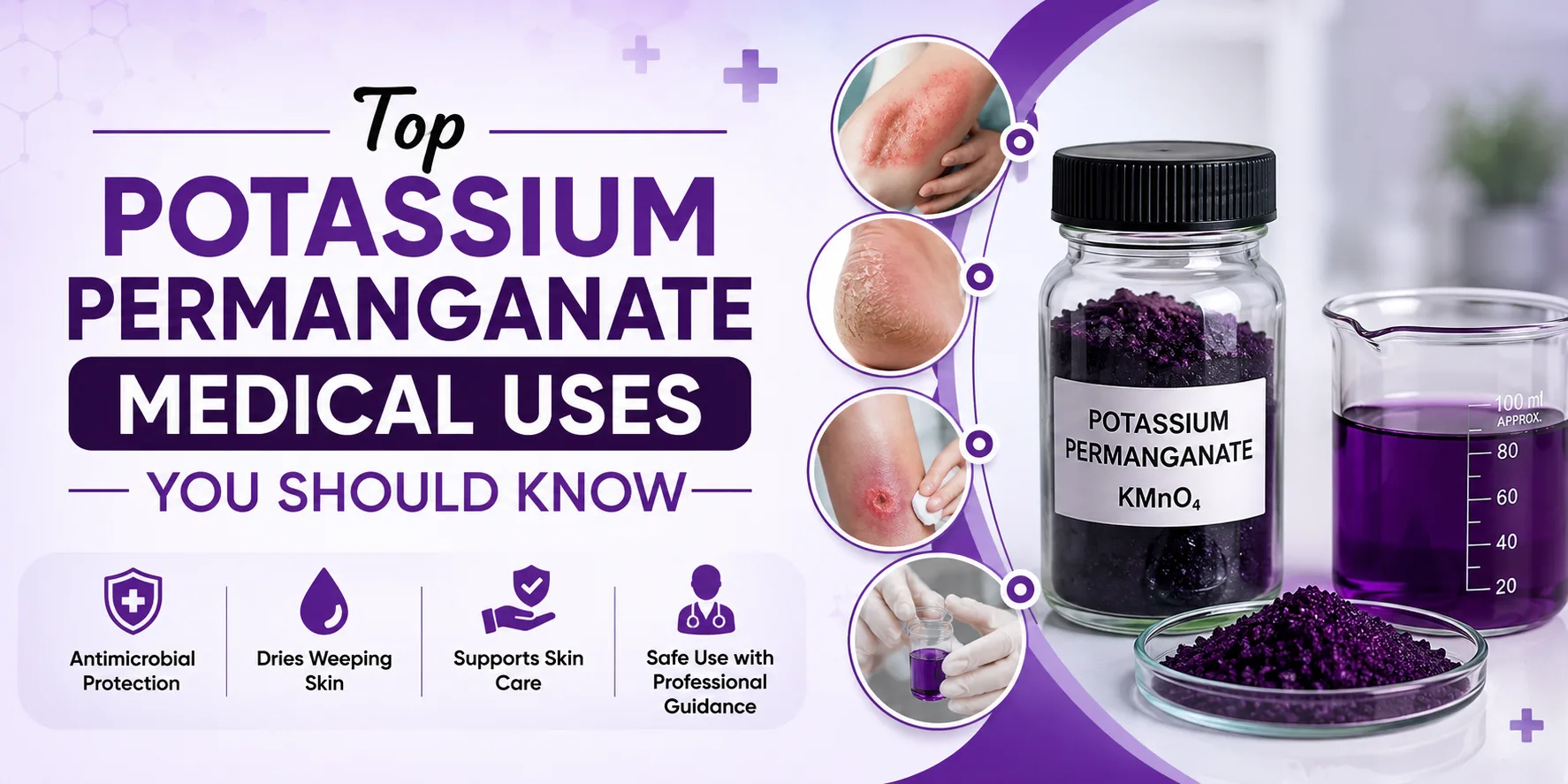
Potassium permanganate medical use is mainly associated with certain dermatological conditions where its dilute solution can help reduce microorganisms, dry weeping skin, and support skin care under professional guidance. Known by its chemical formula KMnO₄, potassium permanganate is a strong oxidizing compound that has been used in medicine for many years. This potassium permanganate medical use can be particularly relevant in supportive skin care when proper dilution and professional guidance are followed. Its purple crystals may look simple, but the chemical requires careful dilution and handling because concentrated solutions can irritate or damage skin.
What Is Potassium Permanganate?
Potassium permanganate is an inorganic chemical compound containing potassium, manganese, and oxygen. It is available as dark purple or almost black crystals and produces a purple solution when dissolved in water.
In medical settings, it has traditionally been used as a topical antiseptic and drying agent. It is not generally taken internally. Medical use involves very dilute solutions prepared according to appropriate instructions.
Because KMnO₄ is a powerful oxidizing agent, its action can help reduce microorganisms on the skin and dry areas where excessive moisture is present. However, the concentration matters greatly. A solution that is too strong may cause irritation, burns, or other skin damage.
1. Helps Manage Weeping or Oozing Skin Conditions
One of the better-known applications is the management of weeping or exudative skin conditions.
Some skin problems produce fluid, leaving the affected area wet or moist. Excess moisture can make the skin uncomfortable and may encourage microbial growth. A properly diluted potassium permanganate solution can have a drying effect.
Healthcare professionals may recommend dilute preparations for conditions where reducing moisture on the skin is useful. The exact method and concentration should depend on the condition being treated.
2. Supportive Care for Eczema
Certain forms of eczema can cause oozing, crusting, or irritated skin. In selected cases, a healthcare professional may recommend a dilute potassium permanganate soak or application as part of supportive skin care.
Its drying and antimicrobial properties can be useful when the skin is particularly moist. However, it does not cure eczema itself.
People with eczema should avoid experimenting with concentrated solutions. Eczema can already leave the skin barrier vulnerable, and excessive oxidation may make irritation worse.
3. Management of Infected or Colonized Skin
Another traditional potassium permanganate medical use involves situations where skin has become contaminated or colonized by microorganisms.
Its oxidizing action can help reduce microorganisms on the surface of the skin. For this reason, dilute preparations have historically been used as an adjunct in managing certain superficial skin problems.
It is important to understand that potassium permanganate is not a replacement for prescribed antibiotics or antifungal treatment when an infection requires specific therapy. A doctor needs to determine the cause of the infection and appropriate treatment.
4. Helps Dry Skin Lesions
Some dermatological conditions produce moist lesions that can be difficult to keep dry. Potassium permanganate's astringent and drying effect may help in selected circumstances.
A dilute solution can be used as a soak or topical preparation when recommended by a healthcare professional. Drying the affected area may improve comfort and make other topical treatments easier to apply.
This application is particularly relevant when excessive moisture is contributing to irritation.
5. Supportive Treatment for Certain Ulcerated Areas
Historically, dilute potassium permanganate preparations have also been used in the supportive care of some ulcerated or exuding skin areas.
The purpose is generally related to cleansing, reducing surface microorganisms, and controlling excessive moisture rather than directly healing the underlying ulcer.
Chronic wounds require proper medical assessment. Problems such as poor circulation, diabetes, pressure damage, or infection can delay healing, so self-treatment with chemical solutions is not advisable.
6. Helps Control Unpleasant Odor from Skin Lesions
Some moist or infected skin conditions can produce an unpleasant odor. Microbial activity and persistent moisture may contribute to this problem.
Because dilute potassium permanganate has antimicrobial and oxidizing properties, it has traditionally been used in some cases to help reduce odor associated with certain skin conditions.
Again, odor is often a symptom rather than the underlying problem. Persistent or worsening odor should be evaluated by a healthcare professional rather than treated only with an antiseptic solution.
7. Foot and Leg Soaks in Selected Conditions
Dilute potassium permanganate solutions have traditionally been used for foot or leg soaks when excessive moisture, weeping skin, or certain superficial skin problems are present.
A healthcare professional may recommend this approach when drying the affected skin is beneficial. The solution must be correctly diluted, and exposure should follow professional instructions.
It should never be assumed that a darker purple solution is more effective. Increasing the concentration can increase the risk of irritation and chemical burns.
8. Helps With Certain Fungal-Related Skin Problems
Potassium permanganate has antimicrobial properties and has been used as supportive treatment for some skin conditions associated with fungal organisms.
However, it should not be considered a primary antifungal medicine. Specific fungal infections may require medications designed to target the responsible organism.
A doctor or pharmacist can help determine whether potassium permanganate has a role in a particular case.
Why Is Potassium Permanganate Used on Skin?
The medical value of potassium permanganate comes largely from its oxidizing properties.
When appropriately diluted, it can:
- Reduce certain microorganisms on the skin
- Help dry moist or weeping areas
- Assist with cleansing of affected skin
- Reduce unpleasant odor in some situations
- Provide supportive care for selected dermatological conditions
These effects explain why dilute KMnO₄ preparations have had a place in dermatological care.
Is Potassium Permanganate Safe for Medical Use?
It can be used safely in appropriate circumstances when prepared and applied correctly. The key issue is concentration.
Undiluted or highly concentrated potassium permanganate can be harmful. It may cause:
- Skin irritation
- Redness
- Pain or burning
- Chemical burns
- Staining of skin and nails
- Eye irritation or injury if splashed
For this reason, people should not estimate the concentration by simply adding crystals to a bathtub, bucket, or container.
Medical instructions should be followed carefully, including the amount of chemical, volume of water, duration of exposure, and frequency of application.
Important Precautions
Anyone using potassium permanganate for a medical purpose should keep several precautions in mind.
Use only a properly diluted solution: Concentration is critical. Stronger does not mean better.
Avoid the eyes: Contact with the eyes can cause significant irritation and injury.
Do not swallow it: Potassium permanganate is not intended for internal consumption.
Keep crystals away from children: The crystals can be hazardous if swallowed or improperly handled.
Protect clothing and surfaces: The purple solution can leave brown or purple staining.
Stop if severe irritation develops: Burning, significant pain, blistering, or worsening redness requires medical attention.
Follow professional advice: The appropriate treatment depends on the condition, skin type, age, and other factors.
Potassium Permanganate vs. Other Antiseptics
Potassium permanganate is only one option for topical skin care. Modern medicine has many antiseptic and antimicrobial products, and the best choice depends on the condition.
For example, a bacterial infection may require a specific antibiotic, while a fungal infection may require an antifungal medication. Eczema may need moisturizers, corticosteroids, or other treatments rather than an oxidizing solution.
Therefore, potassium permanganate should be viewed as a specific supportive treatment, not a universal skin medicine.
Who Should Avoid Self-Treatment?
Self-treatment is particularly inappropriate when the skin is severely damaged, deeply ulcerated, extensively infected, or showing signs of a serious reaction.
People with persistent wounds, spreading redness, severe swelling, pus, fever, or significant pain should seek medical evaluation.
Children and people with sensitive or damaged skin should also use such preparations only when specifically advised by a qualified healthcare professional.
Final Thoughts
Potassium permanganate has a long history in dermatological care, particularly for weeping, moist, or superficially infected skin conditions. Its antimicrobial and drying properties explain many of its traditional medical applications. However, its effectiveness and safety depend heavily on correct dilution and appropriate use.
It should never be treated as an all-purpose medicine or used casually because concentrated KMnO₄ can damage the skin. Professional guidance is especially important for children, open wounds, chronic ulcers, severe infections, and sensitive skin.
For organizations looking for reliable chemical sourcing, choosing an experienced potassium permanganate manufacturer in India can help ensure consistent product quality and appropriate technical information.
Frequently Asked Questions
Can potassium permanganate be used directly on the skin?
No. Potassium permanganate should not be applied to skin in its concentrated crystal form. Medical applications generally involve a carefully diluted solution.
Is potassium permanganate an antibiotic?
No. It is an oxidizing antiseptic and should not be considered an antibiotic. It may reduce certain microorganisms on the skin but does not replace prescribed antimicrobial medicines.
Can potassium permanganate treat eczema?
It may provide supportive care for some forms of weeping or infected eczema by helping dry the skin and reduce surface microorganisms. It does not cure eczema and should be used only when appropriately recommended.
Does potassium permanganate remove skin infections?
It may help reduce microorganisms on the skin, but treatment depends on the type and severity of infection. Bacterial, fungal, and other infections may require specific medicines.
Can potassium permanganate cause skin burns?
Yes. Concentrated potassium permanganate can cause irritation and chemical burns. Correct dilution is essential for topical use.
Why does potassium permanganate stain the skin?
Potassium permanganate can leave brownish or purple staining because of its chemical reaction with organic material and formation of manganese compounds on surfaces.