AI copilots have evolved from simple conversational assistants into intelligent business systems capable of understanding context, retrieving enterprise information, automating repetitive tasks, and supporting employees across complex workflows. In 2026, businesses are increasingly exploring copilots to improve productivity, reduce operational friction, accelerate decision-making, and deliver better customer experiences.
This makes choosing the right AI copilot development company an important strategic decision. The ideal partner should understand your business objectives while having the technical capabilities to build, integrate, deploy, and maintain a reliable AI copilot.
What Is AI Copilot Development?
AI copilot development is the process of designing and developing an intelligent assistant that helps users perform specific business tasks using artificial intelligence, large language models, enterprise data, APIs, and automation technologies.
Unlike traditional chatbots that mainly respond to predefined questions, modern AI copilots can understand user intent, retrieve information, summarize documents, analyze data, recommend actions, and interact with connected business applications.
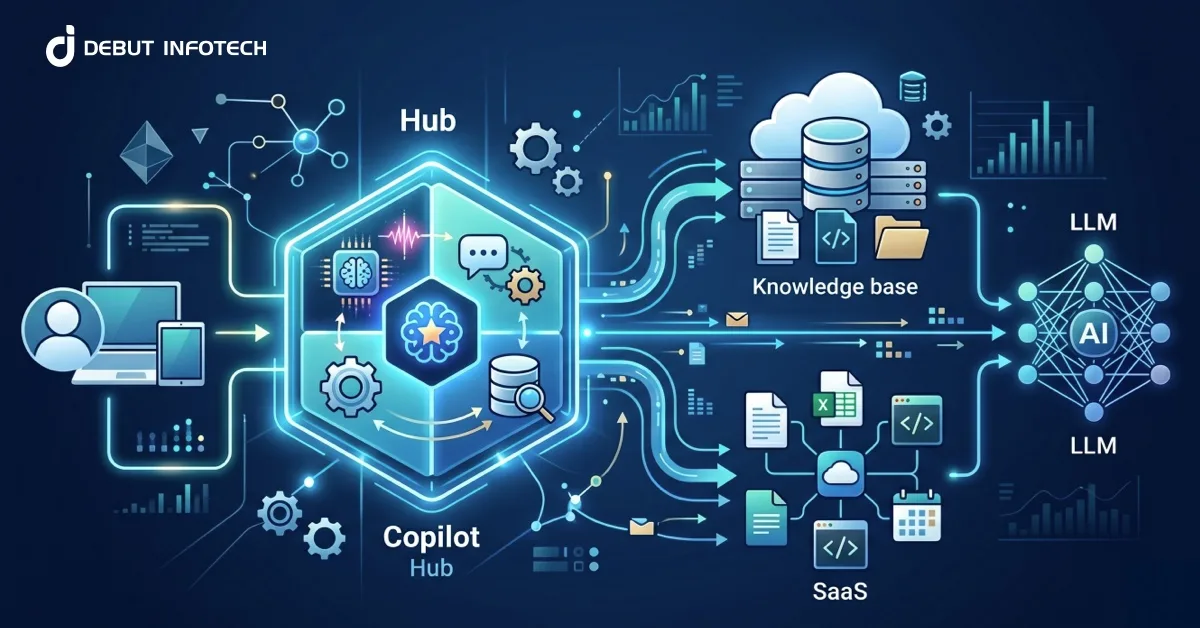
An enterprise copilot may combine:
- Large language models
- Retrieval-augmented generation
- Enterprise knowledge bases
- APIs and third-party integrations
- Workflow automation
- AI agents
The development process generally begins with identifying a business problem, defining the copilot’s responsibilities, preparing relevant data, selecting appropriate AI models, developing the user experience, integrating enterprise systems, testing the solution, and continuously improving its performance.
How We Evaluated These Companies
Selecting an AI copilot development partner requires looking beyond general software development experience. For this list, companies were evaluated based on capabilities that are particularly important for building production-ready AI copilots.
1. AI and LLM Expertise
We considered companies with capabilities in generative AI, large language models, natural language processing, machine learning, RAG, AI agents, and conversational AI.
2. Copilot Development Capabilities
The shortlisted companies demonstrate capabilities relevant to custom AI assistants, employee copilots, customer-facing copilots, workflow copilots, and industry-specific AI applications.
3. Enterprise Integration
A useful copilot must work with the systems employees already use. We considered experience with APIs, CRM platforms, ERP systems, databases, cloud environments, collaboration platforms, and internal applications.
4. Security and Data Management
Enterprise copilots may handle confidential business information. Security architecture, authentication, authorization, data governance, privacy, monitoring, and access controls are therefore important evaluation factors.
5. End-to-End Development
Companies offering strategy, design, development, integration, testing, deployment, maintenance, and optimization provide greater value for organizations looking for long-term AI partnerships.
6. Industry Experience
Experience across industries can help development teams understand different workflows, compliance requirements, customer expectations, and data environments.
Industries Where AI Copilot Development Makes a Measurable Impact
AI copilots can support nearly every industry, but their impact is especially significant in sectors where employees manage large volumes of information, repetitive processes, complex workflows, or customer interactions.
1. Healthcare
Healthcare organizations can use copilots for administrative assistance, clinical documentation, information retrieval, patient support, medical research, appointment workflows, and summarization.
Because healthcare involves sensitive information and high-impact decisions, human oversight and strong data security remain essential.
2. Banking and Financial Services
Financial institutions can deploy copilots for customer support, financial research, document analysis, compliance workflows, reporting, fraud investigation assistance, and internal knowledge retrieval.
Copilots can help employees access information faster while reducing repetitive manual work.
3. Retail and E-commerce
Retail companies can use AI copilots for customer support, product recommendations, inventory assistance, marketing workflows, order management, and sales support.
Customer-facing copilots can also provide personalized assistance based on customer preferences and purchase history.
4. Manufacturing
Manufacturing organizations can use copilots to provide employees with instant access to equipment documentation, maintenance information, production data, and troubleshooting procedures.
They can also support predictive maintenance and operational decision-making when connected to relevant systems.
5. Software and Technology
Developer copilots can assist with coding, documentation, debugging, testing, code review, technical research, and knowledge retrieval.
These tools can reduce repetitive development work and allow engineers to focus more heavily on architecture and problem-solving.
6. Legal Services
Legal teams can use copilots for contract analysis, document summarization, legal research assistance, knowledge retrieval, and matter management.
Human professionals remain responsible for legal judgment, but copilots can reduce time spent on repetitive information-processing tasks.
7. Logistics and Supply Chain
AI copilots can help logistics teams monitor shipments, analyze exceptions, retrieve supplier information, summarize operational data, and support planning activities.
When integrated with logistics platforms, copilots can provide employees with a centralized conversational interface for accessing operational information.
8. Sales and Marketing
Sales copilots can summarize customer conversations, prepare meeting briefs, identify potential opportunities, generate content drafts, assist with CRM updates, and provide account insights.
Marketing teams can also use copilots for research, campaign planning, content ideation, and performance analysis.
A successful enterprise copilot development process can follow this related blog: How to Build Enterprise AI Copilots: A Complete Guide for Business Leaders.
Top AI Copilot Development Companies in 2026
The following companies represent a mix of custom AI development providers, enterprise technology companies, and organizations with established AI and automation capabilities.
The ideal choice depends on your project scope, budget, industry, technology requirements, integration needs, and desired engagement model.
1. Debut Infotech
Debut Infotech is a custom AI and software development company offering AI development services for businesses looking to integrate intelligent assistants into their products and workflows.
The company focuses on developing customized copilots that can connect with business data, applications, APIs, and enterprise workflows. Its broader AI capabilities include generative AI, machine learning, conversational systems, automation, and enterprise application development.
Best for: Custom AI copilots, enterprise integrations, workflow automation, AI-powered applications, and businesses seeking tailored development solutions.
2. Microsoft
Microsoft has built a broad ecosystem around enterprise copilots, AI applications, cloud infrastructure, productivity tools, and business automation.
Its AI capabilities are particularly relevant for organizations already operating within the Microsoft ecosystem. Businesses can build and deploy copilots that work across productivity applications, enterprise systems, data sources, and business workflows.
Best for: Microsoft-focused enterprises, productivity copilots, business applications, and large-scale enterprise deployments.
3. IBM
IBM has extensive experience in enterprise AI, cloud computing, automation, data management, and AI governance.
Its enterprise-oriented approach makes it suitable for organizations operating in complex and highly regulated environments that require strong governance and integration capabilities.
Best for: Large enterprises, regulated industries, hybrid cloud environments, AI governance, and enterprise transformation.
4. Accenture
Accenture combines consulting, software engineering, cloud, data, automation, and AI capabilities.
Its strength lies in supporting organizations that want to integrate AI into broader digital transformation initiatives rather than developing an isolated AI application.
Best for: Large enterprises, consulting-led transformation, global organizations, and complex AI programs.
5. Deloitte
Deloitte provides consulting and technology services covering AI, data, cloud, cybersecurity, risk, and digital transformation.
Its combination of business consulting and technology expertise can be useful for organizations that need to redesign business processes while implementing AI.
Best for: Enterprise transformation, governance, risk management, and regulated industries.
6. LeewayHertz
LeewayHertz specializes in custom software and AI development, including generative AI, LLM applications, AI agents, RAG systems, and enterprise automation.
Its capabilities are relevant for businesses looking to develop customized AI assistants rather than relying entirely on standardized AI products.
Best for: Custom AI applications, AI copilots, RAG systems, AI agents, and enterprise automation.
7. EPAM
EPAM provides digital engineering, software development, cloud, data, AI, and digital transformation services.
Its engineering-focused approach makes it suitable for large organizations that want AI capabilities integrated into existing technology environments.
Best for: Enterprise software engineering, cloud transformation, AI integration, and large-scale technology programs.
8. TCS
Tata Consultancy Services provides enterprise consulting, software engineering, cloud, data, AI, and digital transformation services.
Its global delivery capabilities make it suitable for organizations planning large AI initiatives across multiple departments, locations, or business units.
Best for: Large enterprises, global AI implementations, cloud modernization, and enterprise transformation.
9. Infosys
Infosys provides AI, cloud, data, consulting, automation, and digital engineering services to enterprises.
The company is positioned for organizations that require AI adoption alongside broader modernization of their technology infrastructure and business processes.
Best for: Enterprise transformation, AI implementation, cloud modernization, and large-scale deployments.
10. C3 AI
C3 AI focuses heavily on enterprise artificial intelligence, predictive analytics, industry applications, and AI-powered decision systems.
Its approach is particularly relevant to organizations looking for AI applications across operationally complex industries.
Best for: Enterprise AI, predictive analytics, industrial applications, energy, manufacturing, and large-scale operations.
Core Services Provided by AI Copilot Development Companies
A reliable AI copilot development partner should provide more than basic chatbot development.
AI Copilot Strategy and Consulting
Development teams help businesses identify suitable use cases, evaluate AI readiness, define objectives, and create an implementation roadmap. The goal is to identify workflows where an AI copilot can create measurable value rather than implementing AI simply because it is a current trend.
Custom AI Copilot Development
Companies develop copilots around specific business requirements. These can include employee assistants, sales copilots, customer support copilots, developer assistants, finance copilots, and industry-specific solutions.
LLM Integration
AI development companies integrate appropriate language models based on factors such as performance, cost, latency, privacy, context requirements, and deployment preferences.
RAG and Knowledge Integration
Retrieval-augmented generation allows a copilot to retrieve relevant information from approved business sources before generating responses.
This can help organizations build copilots that work with internal documentation, knowledge bases, policies, product information, and other proprietary content.
Enterprise System Integration
Copilots can connect with CRM, ERP, HR, customer support, communication, analytics, databases, and other enterprise applications.
This enables the copilot to become part of an existing workflow instead of functioning as an isolated conversational interface.
AI Chatbot Development
AI-powered chatbot development interfaces remain an important component of many copilot solutions. However, advanced copilots combine conversational capabilities with enterprise knowledge, APIs, workflow automation, and controlled actions.
AI Agent and Workflow Development
More advanced copilots can use tools, perform multi-step operations, coordinate tasks, and execute approved workflows.
For example, a sales copilot could retrieve customer information, summarize recent interactions, create a proposal draft, and prepare a CRM update.
Why Choose Debut Infotech?
Selecting an AI copilot development partner is not simply about finding a company that can connect an LLM to an application. Businesses need a development team that understands their workflows, data environment, integration requirements, security expectations, and long-term objectives.
Debut Infotech focuses on developing customized AI solutions around specific business requirements. Its capabilities span AI development, generative AI, machine learning, enterprise applications, automation, and software engineering.
Businesses can work with Debut Infotech for:
- Custom AI copilot development
- Generative AI applications
- LLM integration
- RAG implementation
- AI agent development
- Enterprise system integration
- Workflow automation
Future Trends in AI Copilot Development
The AI copilot market is moving rapidly toward more autonomous, contextual, and integrated systems.
1. From Assistants to AI Agents
The next generation of copilots will increasingly move beyond answering questions and begin executing multi-step tasks.
Instead of simply telling an employee how to complete a process, a copilot may perform approved actions on the employee’s behalf.
2. Multi-Agent Systems
Organizations may use multiple specialized AI agents that work together.
For example, one agent could handle research, another could analyze financial data, and another could prepare a report for human approval.
3. Greater Model Flexibility
Businesses are likely to use multiple AI models depending on the task.
A smaller model may be appropriate for simple classification, while a more advanced model may be used for complex reasoning.
4. Context-Aware Copilots
Future copilots will become better at understanding user roles, organizational policies, previous interactions, business data, and workflow context.
This will allow them to provide more relevant responses and recommendations.
5. Stronger AI Governance
As copilots gain greater ability to access information and execute actions, businesses will place greater emphasis on security, permissions, auditability, monitoring, and responsible AI practices.
Conclusion
AI copilots are rapidly evolving from conversational assistants into intelligent systems capable of supporting employees, automating workflows, retrieving enterprise knowledge, and executing authorized business tasks. The companies covered in this guide represent different strengths. Some are suited to large-scale enterprise transformation, while others focus more heavily on custom AI engineering and specialized copilot development.
FAQs
Q1. What is an AI copilot?
An AI copilot is an intelligent assistant that uses artificial intelligence to understand user requests, retrieve information, provide recommendations, automate tasks, and potentially execute authorized actions.
Q2. What is the difference between an AI copilot and an AI chatbot?
A traditional chatbot primarily focuses on conversations and predefined interactions. An AI copilot can go further by accessing enterprise data, understanding workflow context, interacting with business systems, and performing approved actions.
Q3. How much does AI copilot development cost?
The cost depends on the copilot’s complexity, AI model, data requirements, integrations, security requirements, user volume, and functionality. A basic assistant generally costs less than a complex enterprise copilot connected to multiple systems.
Q4. How long does it take to develop an AI copilot?
A basic proof of concept may take several weeks, while a production-ready enterprise copilot can require several months. The timeline depends on data preparation, integrations, security, testing, and workflow complexity.
Q5. Can an AI copilot integrate with CRM and ERP systems?
Yes. Enterprise copilots can connect with CRM, ERP, databases, customer support platforms, communication tools, and other applications through APIs, connectors, and integration frameworks.