Recently, the pilot project for upgrading traditional lighting facilities within the main compound of the Comprehensive Operations Center at Tianjin TEDA Environmental Sanitation Company was successfully completed and commissioned. This initiative has established an intelligent operational mode-characterized by "automatic energy storage during the day and automatic illumination at night"-and constructed a "self-sufficient" green energy supply system.
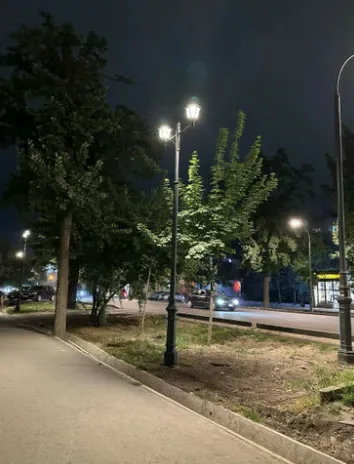
Addressing critical issues such as high energy consumption, short lifespans, and poor illumination performance associated with the original standard lighting fixtures across the facility's main thoroughfares, work sites, and public areas-as well as the high costs of electricity and maintenance, and the safety hazards posed by aging wiring-the company adopted a strategy of scientific planning and systematic coordination. By prioritizing the optimization of infrastructure support capabilities, they comprehensively upgraded the facility's lighting system. This involved replacing all aging standard fixtures with unified solar-powered smart lights, thereby resolving the pain points of high energy consumption and the shortcomings of traditional lighting management at the source, and achieving automated, intelligent light control operations.
The upgraded solar lighting system offers distinct advantages over standard lighting fixtures. Equipped with light-sensing and photovoltaic conversion capabilities, the system utilizes high-efficiency solar panels to harvest light energy during the day, converting it into electrical energy for storage. At night, it automatically senses the environment to switch on, adjusting its operation-including automatic activation and deactivation-based on ambient natural light levels. Independent of the grid, the system boasts outstanding advantages such as eco-friendliness, ample brightness, stable endurance, a long service life, a low failure rate, wireless installation, and minimal maintenance requirements. It achieves a "zero electricity cost" operation throughout its lifecycle, fully meeting the facility's diverse nighttime lighting needs for production operations, daily tasks, and security patrols. Operational statistics indicate that following the completion of this lighting upgrade, the duration of illumination provided by the solar lights has increased, brightness levels have significantly improved, and annual electricity consumption savings are projected to exceed 12,000 kilowatt-hours.
This solar lighting upgrade serves as both a concrete measure to put into practice the philosophy of green and low-carbon development, and a vivid demonstration of efforts to implement cost-reduction and efficiency-enhancement strategies. Moving forward, the company will continue to explore new models for green and low-carbon operations. By leveraging technological empowerment, they will systematically advance initiatives such as facility optimization and energy consumption management, taking steady and solid steps toward green and low-carbon development, and injecting "green momentum" into the company's sustainable growth. led explosion proof lights