Introduction
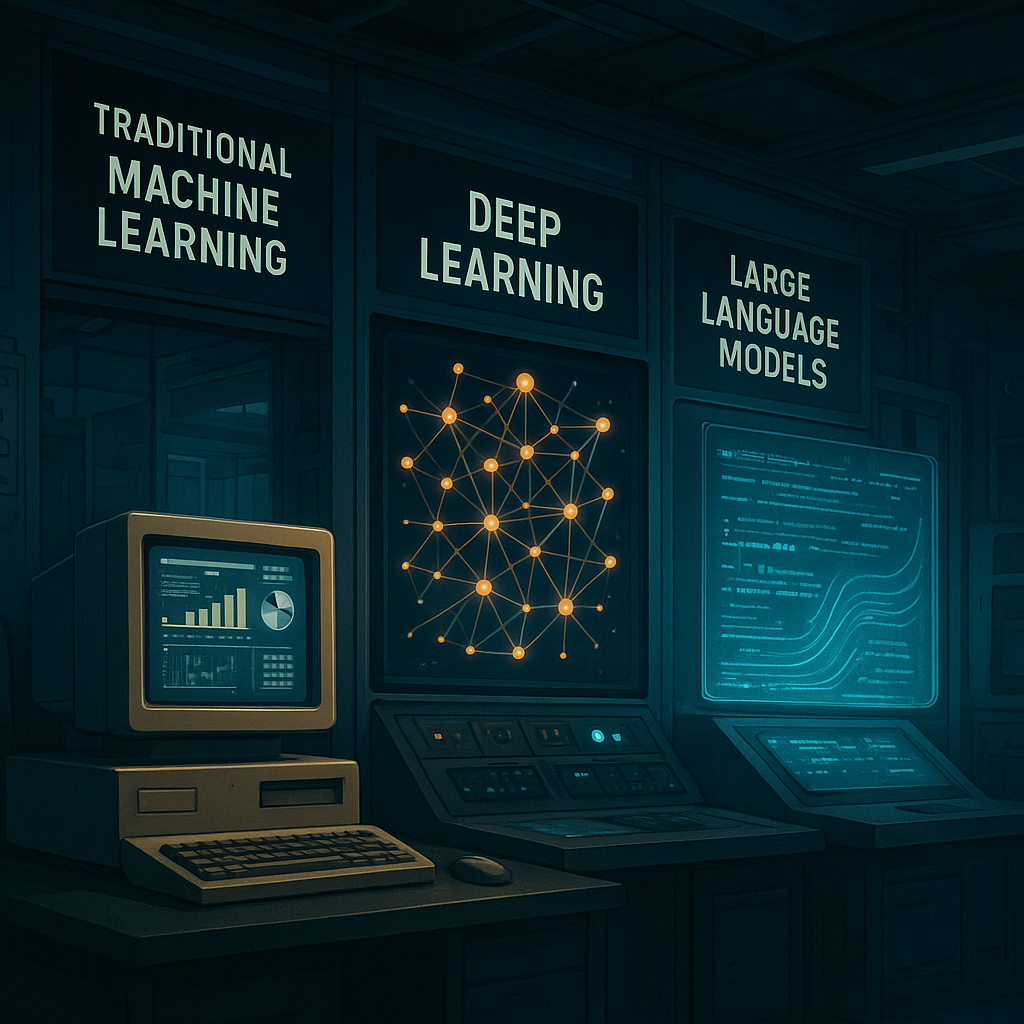
Data science has evolved dramatically over the past few decades, shaping the way we understand and interact with data. From simple statistical models to complex neural networks and now to large language models (LLMs), the field has entered what we can term as three distinct ages. Each age brings its own set of tools, techniques, and best use cases, depending on the problem at hand.
Understanding when to use traditional machine learning, deep learning, or a large language model can be daunting for both newcomers and seasoned practitioners. In this article, we explore these three ages of data science, providing clarity through one comprehensive example: predicting customer churn for a subscription-based streaming service. This example will help illustrate the strengths and limitations of each approach and guide you on which to choose depending on your specific needs.
The First Age: Traditional Machine Learning
Traditional machine learning (ML) refers to classical algorithms that were widely used before the deep learning revolution. These include techniques like linear regression, logistic regression, decision trees, support vector machines (SVM), and random forests. These models often require structured data and feature engineering — the process of manually selecting and transforming raw data into features that better represent the underlying problem.
Strengths of Traditional Machine Learning
- Interpretability: Many traditional ML models are interpretable, allowing data scientists to understand how features impact predictions.
- Less Data-Intensive: They perform well with smaller datasets, where deep learning models might underperform.
- Computationally Efficient: These algorithms generally require less computational power and can be trained quickly on standard hardware.
Limitations
- Feature Engineering Dependency: Success heavily depends on the quality and relevance of engineered features.
- Limited Capacity: They struggle to capture complex patterns like those found in unstructured data (images, audio, text).
Applying Traditional ML to Customer Churn Prediction
Consider a streaming service that wants to predict which customers are likely to cancel their subscriptions. The company has structured data such as:
- Demographics (age, location)
- Subscription plan type
- Viewing habits (hours watched per week)
- Customer service interactions
- Payment history
Using traditional ML, a data scientist might engineer features such as "average monthly viewing hours" or "number of support tickets raised in last 3 months." Models like logistic regression or random forest can then be trained on this data. The model’s outputs provide probabilities of churn, and thanks to their interpretability, the company can identify key churn drivers, such as low engagement or frequent billing issues.
This approach is beneficial when the data is clean, structured, and a relatively straightforward problem is at hand. It also provides actionable insights, which are valuable for business stakeholders.
The Second Age: Deep Learning
Deep learning, a subset of machine learning, leverages artificial neural networks with multiple layers to automatically learn representations and complex patterns from data. Deep learning excels at handling unstructured data such as images, audio, and text, where manual feature engineering is impractical or impossible.
Strengths of Deep Learning
- Automatic Feature Learning: Deep neural networks can automatically extract relevant features from raw data.
- Handling Unstructured Data: Deep learning is state-of-the-art for image recognition, speech processing, natural language understanding, and more.
- Scalability: Performance generally improves with more data and larger models.
Limitations
- Data Hungry: Requires large amounts of labeled data to train effectively.
- Computationally Intensive: Needs powerful hardware such as GPUs or TPUs.
- Interpretability Challenges: Often considered a "black box," making it harder to understand decision mechanisms.
Applying Deep Learning to Customer Churn Prediction
Suppose the streaming service now wants to incorporate additional data sources beyond structured logs. This could include:
- Raw text from customer support chats and emails
- User-generated reviews and feedback
- Audio snippets from calls
In this scenario, deep learning models such as convolutional neural networks (CNNs) for audio or recurrent neural networks (RNNs) and transformers for text data can be employed. These models can automatically learn rich representations from complex inputs, potentially discovering subtle churn indicators hidden in customer interactions.
For example, sentiment analysis on support chat transcripts might reveal frustration patterns correlated with churn. Combining these learned features with structured data in a multi-modal deep learning model could improve prediction accuracy significantly.
The Third Age: Large Language Models (LLMs)
Large language models, such as GPT-4 and beyond, represent a new frontier in data science. These models are pre-trained on massive corpora of text and can perform a wide range of natural language processing (NLP) tasks with minimal fine-tuning. LLMs can generate human-like text, answer questions, summarize documents, and even perform reasoning.
Strengths of LLMs
- Few-Shot or Zero-Shot Learning: LLMs can perform tasks with little or no task-specific training data.
- Contextual Understanding: They grasp nuances, idioms, and subtle meanings in text.
- Versatility: Useful for a broad range of applications beyond classification, including content generation and dialogue systems.
Limitations
- Computational Cost: Inference and fine-tuning can be expensive and resource-intensive.
- Potential for Hallucination: May generate incorrect or nonsensical outputs.
- Interpretability and Control: Difficult to fully control or explain their outputs.
Applying LLMs to Customer Churn Prediction
Imagine the streaming service wants to leverage an LLM to analyze customer feedback at scale. Instead of building a custom sentiment classifier, the company uses an LLM to:
- Extract customer sentiment and intent from free-form text reviews.
- Generate summaries of support conversations.
- Answer customer queries automatically, improving engagement.
- Identify emerging issues or trends in customer feedback dynamically.
By integrating LLM outputs with structured data, the company can enhance its churn prediction pipeline. Moreover, LLMs can assist data scientists by generating feature ideas, code snippets, or even model documentation, accelerating development.
A Unified Example: Predicting Customer Churn Using All Three Approaches
Let’s bring it all together with a step-by-step illustration of how a company might evolve its churn prediction system through the three ages of data science.
Step 1: Traditional ML Baseline
The company begins with well-structured subscription and usage data. They engineer features like "average watch time" and "payment delay frequency" and train a random forest classifier. This model achieves moderate accuracy and provides clear insights into drivers of churn.
This phase is fast, cost-effective, and provides a solid foundation.
Step 2: Incorporating Deep Learning for Unstructured Data
Recognizing the untapped value in customer support chats and call transcripts, the company builds a deep learning pipeline. They use transformer-based architectures to extract sentiment and behavioral cues from text, and CNNs to analyze audio sentiment from calls.
These learned features are combined with traditional structured data features in a multi-modal deep learning model, significantly boosting churn prediction performance.
Step 3: Leveraging LLMs for Advanced Text Analytics and Automation
The company integrates a large language model to automate complex NLP tasks like summarization, sentiment extraction, and customer query handling. The LLM can operate in zero-shot mode, requiring minimal labeled data, and can generate explanations for its outputs.
Additionally, the LLM assists the data science team by generating feature engineering suggestions, writing boilerplate code, and drafting model documentation, accelerating the entire analytics process.
With this approach, the company achieves state-of-the-art churn prediction accuracy and operational efficiency.
Choosing the Right Approach: Key Considerations
Deciding whether to use traditional machine learning, deep learning, or LLMs depends on multiple factors:
- Data Type: Structured data favors traditional ML; unstructured data calls for deep learning or LLMs.
- Data Volume: Smaller datasets benefit from traditional ML; large datasets unlock deep learning potential.
- Interpretability Needs: Regulatory or business requirements may favor interpretable traditional models.
- Computational Resources: Deep learning and LLMs require significant hardware investment.
- Task Complexity: Complex NLP tasks are better suited to LLMs.
For more detailed guidance on this topic, you may refer to our comprehensive piece When to Choose Traditional ML, Deep Learning, or LLMs: A Clear Guide.
Future Outlook: The Convergence of Ages
Looking ahead, the lines between these three ages are blurring. Hybrid models combining traditional feature engineering with deep learning embeddings and LLM-generated features are becoming common. Advances in explainability techniques are making deep models and LLMs more transparent.
For instance, recent research leverages LLMs not only for NLP but also for reasoning over structured data, effectively bridging the gap between traditional ML and deep learning. This convergence suggests a future where data scientists will choose and combine techniques fluidly to deliver the best results.
As data science continues to evolve, professionals must stay informed to select the right tools for their challenges. For insights into the broader impact of machine learning on industries and intelligence, see How Machine Learning Is Redefining Intelligence and Industry in 2026.
Conclusion
Data science has journeyed through three transformative ages: traditional machine learning, deep learning, and large language models. Each age offers unique advantages and suits different problem types. Using the example of customer churn prediction in a streaming service, we have illustrated when and why to choose each method.
Traditional ML remains invaluable for structured data and interpretability. Deep learning unlocks the power of unstructured data, and LLMs open new horizons in natural language understanding and automation. Embracing the strengths of each age and understanding their limitations will empower organizations to build smarter, more effective data-driven solutions.
For those intrigued by the differences and career opportunities in data science and artificial intelligence, our article Data Science vs. Artificial Intelligence: Key Differences, Careers, and How to Choose offers valuable insights.