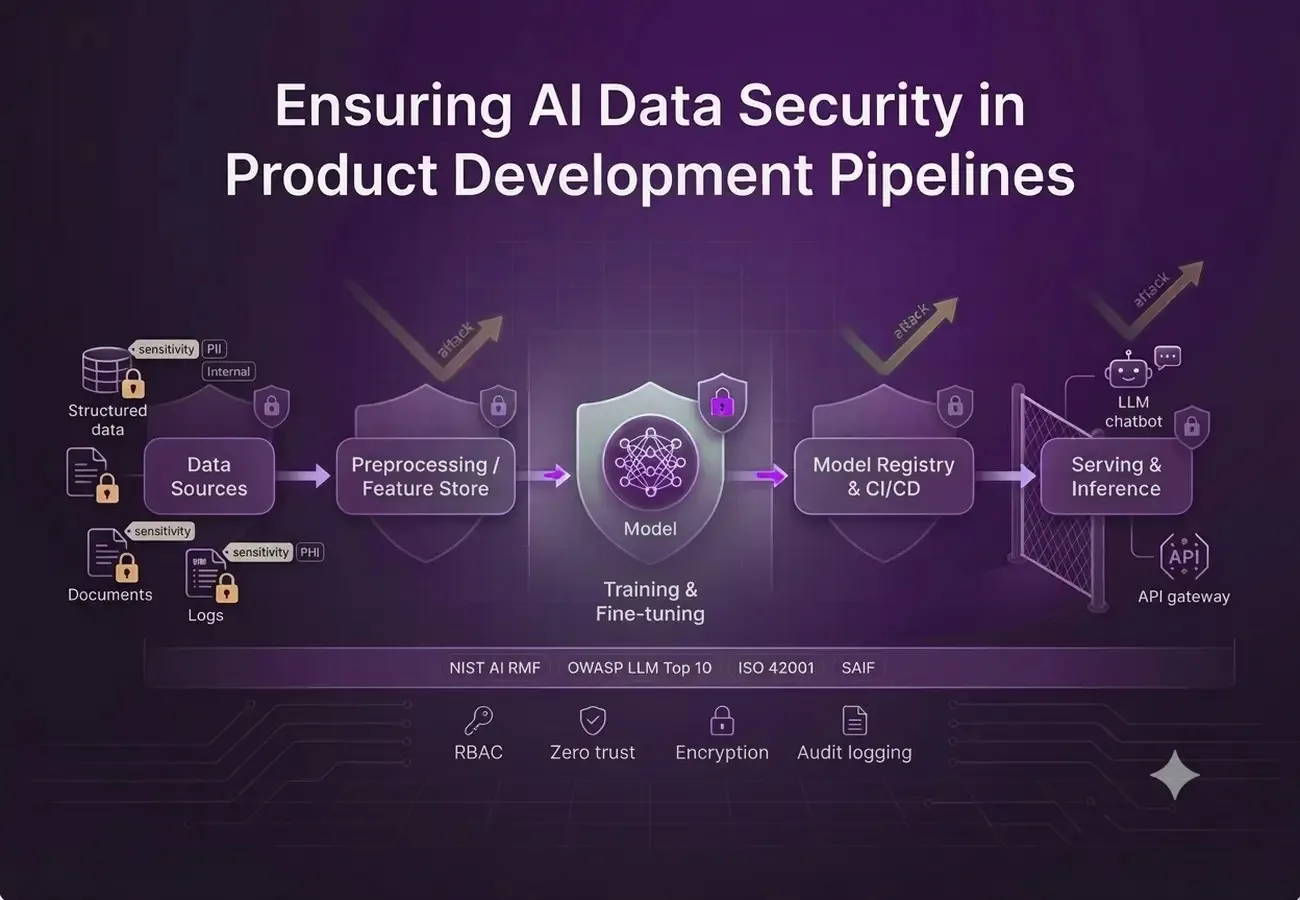
- AI data security is the discipline of protecting sensitive data, models, and pipelines across the entire AI development lifecycle.
- Development pipelines are the leading attack surface: training datasets, model artifacts, vector databases, and API endpoints all carry risk.
- NIST AI RMF, OWASP LLM Top 10, ISO 42001, and Google SAIF provide the foundational governance and control frameworks.
- Zero trust security, role-based access control (RBAC), data encryption, and secrets management are non-negotiable baseline controls.
- Generative AI and RAG applications introduce unique risks: prompt injection, data leakage through embeddings, and vector database exposure.
- Regulated industries (healthcare, BFSI, legal) face AI compliance requirements under GDPR, HIPAA, PCI-DSS, and the EU AI Act.
- A phased implementation, starting with discovery, then critical controls, then governance, is the most reliable path to secure AI development.
AI adoption is accelerating across enterprises, but one of the biggest challenges is securing data within AI development pipelines. Unlike traditional applications, AI systems rely heavily on large volumes of sensitive data—making them more vulnerable to leaks, misuse, and compliance risks. Ensuring strong data security across the entire AI pipeline is therefore critical. - An AI development pipeline typically includes multiple stages: data collection, preprocessing, model training, deployment, and inference. Each stage introduces unique risks. For example, unprotected data ingestion can expose personally identifiable information (PII), while poorly secured training environments can lead to data poisoning or unauthorized access. Even during inference, models can unintentionally reveal sensitive data through outputs if proper controls are not in place.
- One of the most common risks in modern AI pipelines—especially those using Retrieval-Augmented Generation (RAG)—is improper access control. If document-level permissions are not enforced, users may gain access to information they are not authorized to see. Similarly, prompt injection attacks can manipulate AI models into exposing hidden or sensitive data. These vulnerabilities highlight why security must be built into the architecture, not added later.
- To mitigate these risks, organizations must adopt a security-first approach. This begins with data protection practices such as encryption both at rest and in transit, along with anonymization or tokenization of sensitive data before it enters the pipeline. Strong identity and access management (IAM) is also essential, ensuring that only authorized users and systems can access specific data and services.
- Another key principle is Zero Trust architecture, where no user or system is trusted by default. Every interaction within the AI pipeline must be verified, authenticated, and logged. This minimizes the risk of lateral movement and unauthorized access within the system. Continuous monitoring and AI-specific security tools further help detect anomalies, model drift, and potential data leaks in real time.
- Governance and compliance also play a major role in AI data security. Organizations must align their AI systems with standards such as ISO 27001 or SOC 2, and implement clear policies around data usage, retention, and auditing. This ensures accountability and reduces regulatory risks, especially in industries like healthcare and finance.
- In summary, securing AI data pipelines requires a holistic strategy that spans data protection, access control, architecture, and governance. By embedding security into every stage of the AI lifecycle, enterprises can safely scale AI initiatives while protecting their most valuable asset—data.
👉 Want to build safer AI development pipelines? Explore the complete guide to AI data security and best practices.
AI Data Security: Is Your AI Pipeline Really Secure?