Understanding the Evolution: The Three Ages of Data Science
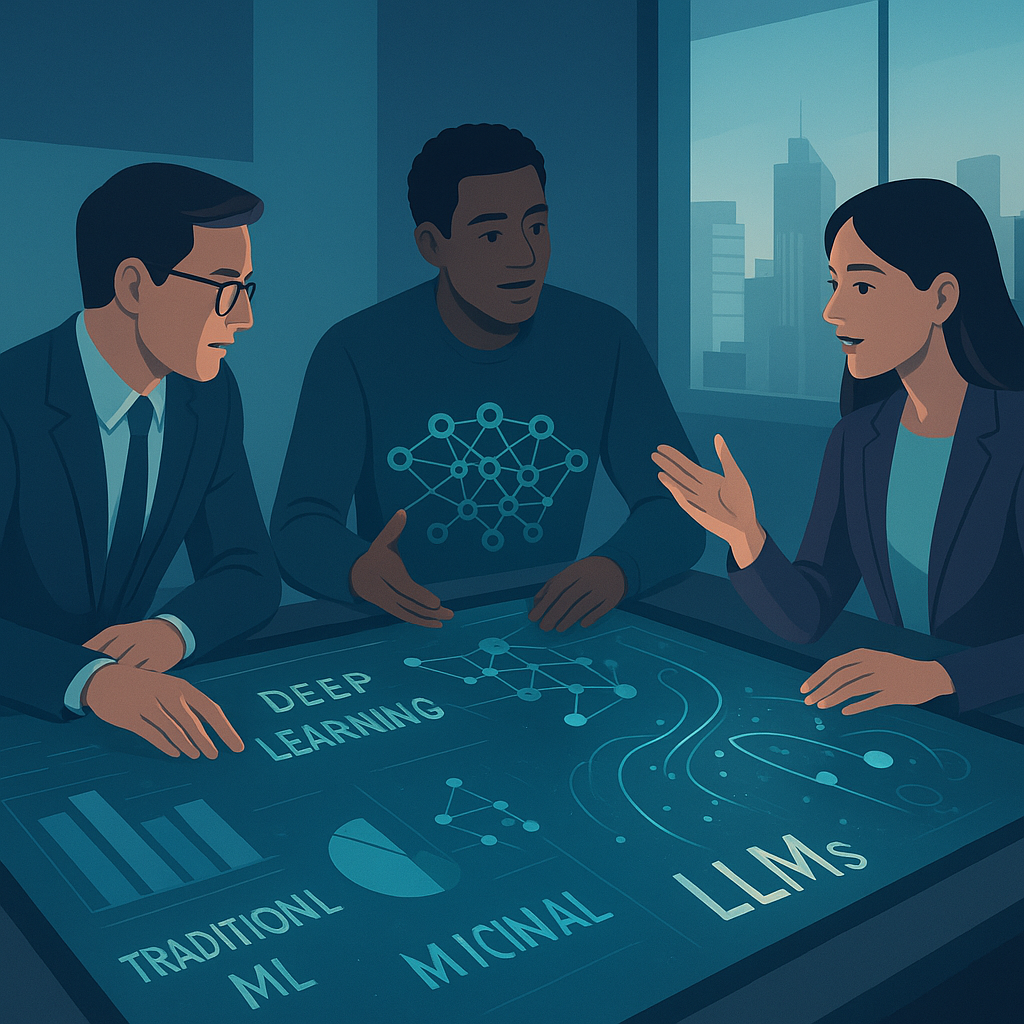
In the ever-shifting landscape of artificial intelligence, the tools and methods for extracting insights from data have undergone seismic shifts. Since the inception of data science as a discipline, three distinct phases have emerged: the era dominated by traditional machine learning, the rise of deep learning, and the current epoch shaped by large language models (LLMs). Each age reflects not just technological advancements but also new paradigms in how we approach complex problems with data.
To appreciate when to deploy each technique, it helps to begin with a concrete example: consider the task of detecting fraudulent credit card transactions. This challenge illustrates the strengths and limitations of these three data science approaches and highlights why understanding their proper application is critical for businesses and researchers alike.
"Choosing the right AI approach is no longer about using the latest model but aligning tools with problem complexity and data characteristics." – Dr. Elaine Porter, AI Strategist.
The Foundations: Traditional Machine Learning’s Reign
Traditional machine learning (ML) emerged prominently in the late 20th century, centered around algorithms like decision trees, support vector machines, and logistic regression. These models rely heavily on handcrafted features and domain expertise to transform raw data into inputs that algorithms can process effectively. In our fraud detection example, traditional ML approaches would involve engineering variables such as transaction amount thresholds, frequency counts, and merchant categories.
One of the core advantages of traditional ML is interpretability. Since models are often simpler and feature-driven, analysts can understand and explain why certain transactions are flagged. This is especially important in regulated industries like finance, where compliance demands transparency.
However, traditional ML methods have limits. They often struggle with unstructured data (like text or images) and require extensive feature engineering, which is time-consuming and dependent on expert knowledge. As data grew in volume and complexity, these constraints sparked the search for more automated methods.
Key Characteristics of Traditional Machine Learning
- Requires domain-driven feature engineering
- Works well with structured, tabular data
- Models like random forests and gradient boosting remain popular
- Offers strong interpretability and regulatory compliance benefits
The Deep Learning Revolution: Unlocking Complex Patterns
Deep learning, inspired by the human brain’s neural architecture, gained prominence in the 2010s due to advances in computational power and data availability. Unlike traditional ML, deep learning models automatically learn hierarchical features from raw data, sidestepping the need for manual feature crafting. This is especially powerful for image recognition, speech processing, and natural language understanding.
In fraud detection, deep learning can incorporate raw transactional data, sequences of user behavior, and even text fields describing the merchant or purchase context. Recurrent neural networks (RNNs), convolutional neural networks (CNNs), and transformers allow these models to capture subtle temporal and spatial patterns that traditional ML might miss.
Despite their accuracy, deep learning models often act as black boxes, making it difficult to explain decisions to stakeholders. Additionally, they demand significant computational resources and large labeled datasets, which can be barriers for smaller organizations.
"Deep learning transformed AI from handcrafted rules to models that learn representations — but interpretability remains a challenge." – Prof. Anna Lu, Computer Science Department.
Deep Learning’s Advantages and Constraints
- Excels with unstructured data like images, audio, and text
- Automatically extracts complex features
- Requires large datasets and high computation
- Lower interpretability compared to traditional ML
LLMs: The New Frontier in AI Understanding
Large language models (LLMs), built on advanced transformer architectures, represent the latest frontier in AI. By training on vast corpora of text from the internet, books, and specialized datasets, LLMs like GPT-5 and beyond have developed an astonishing ability to understand and generate human-like language. This capability extends beyond mere text generation — LLMs can perform classification, summarization, question-answering, and even reasoning tasks.
Returning to fraud detection, an LLM can analyze transaction descriptions, customer support chats, and even social media signals to detect suspicious activity with nuanced understanding. Moreover, LLMs can be fine-tuned or prompted to adapt to specific domains with relatively little new data, an advantage over deep learning models that require retraining.
However, LLMs are not a panacea. They require careful prompt engineering, may hallucinate facts, and still struggle with explainability. Furthermore, the enormous computational costs and environmental impact of training and deploying LLMs remain concerns.
LLMs in 2026: Features and Challenges
- Exceptional at processing and generating natural language
- Can generalize across multiple tasks with minimal retraining
- May produce plausible but inaccurate outputs (hallucinations)
- High computational and energy demands
Case Study: Choosing the Right Tool for Credit Card Fraud Detection
To illustrate these differences, consider a large financial institution faced with detecting fraudulent transactions in real-time. The company has access to millions of transactions daily, with structured data (amounts, times, locations) and unstructured data (merchant descriptions, customer complaints).
The initial approach leveraged traditional ML models such as gradient boosting machines using engineered features like transaction velocity and account age. This solution was efficient, interpretable, and integrated well with compliance requirements but showed limitations in detecting sophisticated fraud patterns.
To improve, the firm adopted deep learning models incorporating sequence data and raw inputs. The models achieved higher accuracy, detecting subtle behavioral anomalies. However, the black-box nature raised concerns with regulators, and the required computational infrastructure was costly.
Most recently, the institution experimented with LLMs to analyze transaction narratives, customer interactions, and external data sources. By combining LLMs with traditional models, they created a hybrid system balancing accuracy, interpretability, and contextual understanding.
"Our hybrid approach leverages the strengths of each AI age — interpretable features from traditional ML, pattern recognition from deep learning, and contextual insights from LLMs." – Chief Data Scientist, Leading Bank.
Current Developments in 2026: Hybrid Models and Democratized AI
The AI ecosystem in 2026 favors hybrid solutions that integrate traditional machine learning, deep learning, and LLMs. This synergy maximizes performance while mitigating individual weaknesses. For instance, explainable AI modules are increasingly layered on top of deep learning and LLM outputs to satisfy regulatory audits.
Moreover, the democratization of AI tools has accelerated. Cloud platforms now offer off-the-shelf LLM services optimized for specific industries, reducing barriers for small and medium enterprises. This trend is supported by open research communities sharing model architectures and datasets, fostering innovation.
Several companies are pioneering AutoAI frameworks that automatically select the best approach—traditional ML, deep learning, or LLMs—based on data characteristics and business goals, streamlining AI deployment.
Expert Perspectives and Industry Impact
AI leaders emphasize that no single technique dominates universally. According to Dr. Ravi Sethi, AI Research Director at a major tech firm, "Understanding the problem domain, data availability, and operational constraints is paramount to choosing the right AI method." The financial sector, healthcare, and manufacturing each exhibit distinct preferences shaped by risk tolerance and data types.
Industry analysts note that the rise of LLMs is reshaping roles within data science teams, with prompt engineering and model fine-tuning becoming critical skills alongside traditional data engineering and model development. This evolution stresses the importance of interdisciplinary collaboration between domain experts and AI specialists.
What to Watch: The Future of Data Science Methodology
Looking ahead, the lines between traditional ML, deep learning, and LLMs will continue to blur. Emerging techniques such as neuro-symbolic AI aim to combine neural networks with symbolic reasoning, potentially enhancing interpretability and robustness. Additionally, advances in federated learning and privacy-preserving AI will influence method selection under stringent data governance frameworks.
Organizations should focus on flexibility, investing in platforms that support multiple AI paradigms and continuously evaluate performance against evolving challenges. Understanding each method’s trade-offs, as outlined in this article, will remain essential for strategic AI adoption.
"The future belongs to adaptable AI systems that harness the unique strengths of each approach to deliver responsible, effective solutions." – AI Futurist, TheOmniBuzz.
For more insights on how machine learning continues to redefine intelligence and industry, see our detailed analysis in How Machine Learning Is Redefining Intelligence and Industry in 2026. Also, explore how AI algorithms, robotics, and machine learning converge in shaping the next frontier at Unlocking Intelligence: How Algorithms, Robotics, and Machine Learning Shape Our Future.