
Market Overview:
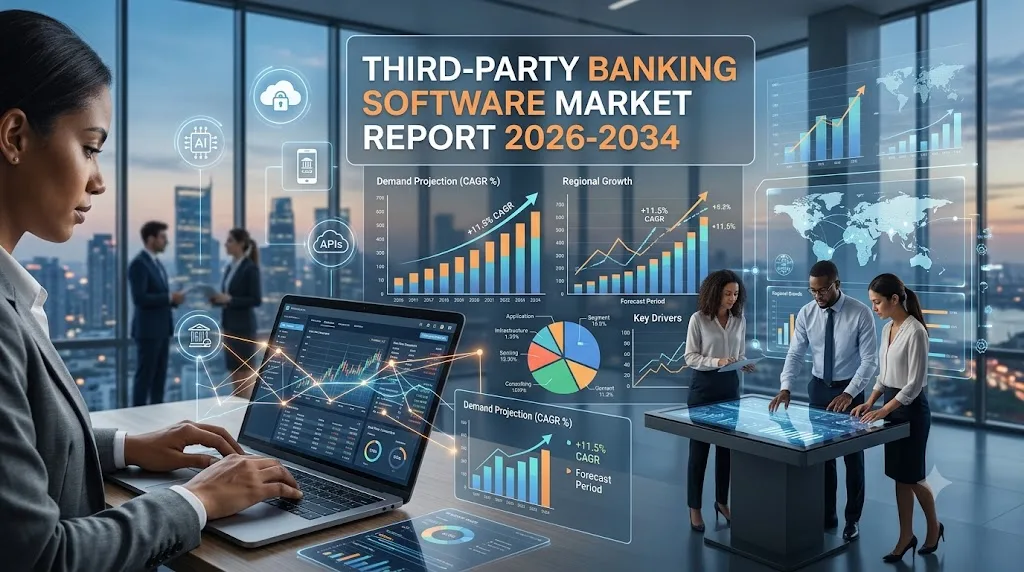
According to IMARC Group's latest research publication, "Third-Party Banking Software Market Size, Share, Trends and Forecast by Product, Deployment Type, Application, End User, and Region, 2026-2034", The global third-party banking software market grew from USD 33.0 Billion in 2025 to USD 35.7 Billion in 2026. Looking forward, IMARC Group estimates the market to reach USD 58.0 Billion by 2034, exhibiting a CAGR of 6.27% during 2026-2034.
This detailed analysis primarily encompasses industry size, business trends, market share, key growth factors, and regional forecasts. The report offers a comprehensive overview and integrates research findings, market assessments, and data from different sources. It also includes pivotal market dynamics like drivers and challenges, while also highlighting growth opportunities, financial insights, technological improvements, emerging trends, and innovations. Besides this, the report provides regional market evaluation, along with a competitive landscape analysis.
How Third-Party Banking Software Is Reshaping the Global Financial Sector
- North America leads the global market with a 36.6% share in 2025, driven by advanced technological infrastructure, a robust fintech ecosystem, and high digital banking adoption rates across commercial and retail banking segments.
- Core banking software dominates the product segment with a 37.3% market share in 2025, reflecting the rising demand for integrated, real-time banking solutions that streamline account management, daily transactions, and centralized data operations.
- On-premises deployment holds an 82.4% market share in 2025, as banks prioritize control over IT infrastructure, internal data security, and compliance with local data protection regulations over cloud-based alternatives.
- Risk management leads the application segment with 41.6% of the market in 2025, driven by increased complexity in financial markets, the rise of cyber threats, and the integration of AI and machine learning for proactive risk identification.
- Retail and trading banks account for 62.3% of the end-user segment in 2025, supported by growing demand for CRM software, AI-driven analytics, and omnichannel digital platforms to enhance customer engagement and service efficiency.
- In April 2025, Backbase launched an AI-powered banking platform that unified digital sales and customer service capabilities, with an AI Factory delivery model helping banks transition from legacy systems to AI-driven operations faster.
- India's fintech industry is currently valued at approximately USD 111 Billion and is projected to reach USD 421 Billion by 2029, making it the third-largest fintech ecosystem globally and a key growth engine for third-party banking software adoption across Asia Pacific.
Download a sample PDF of this report: https://www.imarcgroup.com/third-party-banking-software-market/requestsample
Key Trends in the Third-Party Banking Software Market
- Surge in Digital Banking Adoption Fueling Software Demand: The banking, financial services, and insurance sector is witnessing accelerating digital transformation, creating strong demand for third-party solutions. As of July 2024, there were 602 banks using UPI in India, with total digital transactions reaching 15.08 Billion, valued at Rs. 2,10,000 Crore. This reflects the broader global shift toward digital platforms and underscores the critical role of scalable third-party banking software in processing high volumes of transactions securely and efficiently.
- Cloud-Based Technology Accelerating Market Expansion: The integration of cloud-based applications into banking software is reshaping operational models across financial institutions. Cloud platforms reduce infrastructure costs, improve scalability, and enable seamless integration with existing banking systems. The expected growth in digital banking users in the United States to 216.8 Million highlights how large-scale cloud-native deployments are becoming essential for banks seeking to serve digitally native customers at scale without heavy capital expenditure.
- Strategic Acquisitions Driving Open Banking Capabilities: The market is seeing a marked shift toward acquisitions that expand open banking and API management capabilities. In October 2024, Axway's acquisition of Sopra Banking Software strengthened its platform to meet newly introduced Consumer Financial Protection Bureau regulations while enhancing secure data management for financial institutions. Such moves position software vendors to offer flexible, modular solutions that help banks comply with data-sharing mandates while unlocking new revenue streams.
- Cybersecurity Spending Driving Premium Software Investment: With cybercrime costs projected to reach USD 10.5 Trillion by 2025, financial institutions are accelerating investments in secure, adaptable banking software. U.S. bank executives plan to increase IT and technology spending by at least 10% in 2025 to enhance security measures following multiple data breaches in 2024. This heightened focus on cybersecurity compliance is directly driving demand for advanced third-party platforms equipped with biometric authentication, AI-based threat detection, and regulatory-grade encryption.
- ESG Integration Creating New Software Demand in Europe: European banks are increasingly embedding environmental, social, and governance considerations into their core operations, driving demand for analytical and reporting tools offered by third-party providers. The European Investment Bank Group signed nearly USD 96.6 Billion in new financing for over 900 projects in 2024, mobilizing around USD 380 Billion in investment and supporting approximately 5.8 Million jobs. This large-scale investment activity is accelerating digitization across European financial institutions and creating significant demand for scalable ESG-ready software solutions.
- Financial Inclusion Goals Driving Localized Software in Asia Pacific and MEA: Banks across emerging markets are deploying localized, multilingual third-party solutions to serve underbanked populations. Saudi Arabia's digital banking market was valued at USD 87.60 Million in 2024 and is projected to reach USD 278.19 Million by 2033, reflecting the region's growing appetite for mobile-optimized banking platforms. Similarly, over 70% of Brazilians now use digital banking services, pushing institutions to invest in third-party platforms that support real-time payments, alternative credit assessments, and inclusive financial tools.
We explore the factors propelling the third-party banking software market growth, including technological advancements, consumer behaviors, and regulatory changes.
Growth Factors in the Third-Party Banking Software Market
- Open Banking Regulations Creating New Integration Opportunities: Regulations from bodies such as the Consumer Financial Protection Bureau are compelling banks to give consumers simpler access to their financial data, directly accelerating the adoption of modular, API-based third-party software. This regulatory-driven momentum is encouraging financial institutions to replace legacy monolithic systems with flexible third-party platforms that support data-sharing compliance and integration with fintech applications.
- Rising Partnerships Expanding Platform Capabilities: Strategic partnerships are becoming a key growth mechanism in the market. In May 2025, Tietoevry Banking entered a strategic partnership with Lokalbank to deliver a comprehensive banking platform for the Norwegian market, integrating core banking, mobile banking, payment systems, card services, and anti-financial crime tools into a single scalable solution. Such partnerships enable financial institutions to streamline operations and focus on customer-facing services while relying on third-party vendors for backend complexity.
- Rapid Fintech Growth in Asia Pacific Accelerating Adoption: India's fintech sector, currently valued at USD 111 Billion and projected to reach USD 421 Billion by 2029, represents one of the largest opportunity pools for third-party banking software vendors. The need to serve digitally native consumers through mobile-first platforms, real-time payment processing, and multilingual digital onboarding is pushing banks across the region to rapidly deploy scalable third-party systems and replace legacy infrastructure.
- Latin America's Digital Shift Unlocking New Market Potential: Brazil's rapid digitization, with over 70% of its population now using digital banking services, is prompting financial institutions across Latin America to adopt technology-driven third-party platforms. The demand for solutions enabling real-time transactions, alternative credit scoring, and gamified financial services is expanding the market in this region, particularly among banks targeting underserved communities and mobile-first demographics.
- AI and Big Data Integration Enhancing Operational Value: The incorporation of big data analytics and artificial intelligence into third-party banking software is transforming how financial institutions make decisions. AI-powered tools enable real-time fraud detection, predictive risk modeling, and personalized customer engagement. Banks investing in these capabilities gain a measurable competitive advantage, making AI-integrated third-party platforms increasingly attractive to both commercial banks and retail banking institutions seeking to improve profitability and reduce operational risk.
Leading Companies Operating in the Global Third-Party Banking Software Industry:
- Accenture
- Capgemini
- Deltek
- IBM
- Infosys
- Microsoft Corporation
- NetSuite Inc.
- Oracle Corporation
- SAP SE
- Tata Consultancy Services
Third-Party Banking Software Market Report Segmentation:
Breakup by Product:
- Core Banking Software
- Multi-Channel Banking Software
- Business Intelligence Software
- Others
Core banking software leads with a 37.3% market share in 2025, driven by the need for integrated, real-time systems that support centralized account management, transaction processing, and regulatory compliance across financial institutions.
Breakup by Deployment Type:
- On-Premises
- Cloud-Based
On-premises deployment dominates with an 82.4% market share in 2025, as banks prioritize data privacy, internal system control, and compliance with local data protection regulations, especially in regions with strict financial sector governance requirements.
Breakup by Application:
- Risk Management
- Information Security
- Business Intelligence
- Others
Risk management leads the application segment with a 41.6% share in 2025, fueled by growing financial market volatility, rising cyber threats, and the integration of AI and machine learning tools for real-time risk identification and mitigation.
Breakup by End User:
- Commercial Banks
- Retail and Trading Banks
Retail and trading banks account for 62.3% of the market in 2025, driven by surging demand for CRM platforms, omnichannel digital solutions, real-time market analysis tools, and AI-powered portfolio management systems.
Breakup by Region:
- North America (United States, Canada)
- Asia Pacific (China, Japan, India, South Korea, Australia, Indonesia, Others)
- Europe (Germany, France, United Kingdom, Italy, Spain, Russia, Others)
- Latin America (Brazil, Mexico, Others)
- Middle East and Africa
North America holds the largest share at 36.6% in 2025, underpinned by advanced
financial infrastructure, a mature regulatory environment, strong fintech investment, and widespread adoption of AI-driven and cloud-native banking solutions across the region.
Recent News and Developments in the Third-Party Banking Software Market
- April 2025: Backbase introduced an AI-powered banking platform integrating real-time data insights and modular Agentic AI for task automation. The platform unified digital sales and customer service operations, while the AI Factory delivery model helped banks accelerate their shift from legacy systems to AI-driven workflows, significantly reducing implementation timelines.
- April 2025: Candescent opened a larger office in Bangalore, India, to expand its innovation capabilities and accelerate digital banking software development. The facility supported over 200 employees focused on next-generation user experiences, with plans to hire across product, design, and engineering functions to enhance customization and fintech platform integration.
- February 2025: Galoy launched Lana, a platform enabling banks to issue bitcoin-backed loans using open-source software. The solution offered customizable loan terms, collateral monitoring, and risk management capabilities, supporting banks entering the crypto lending space while addressing regulatory compliance requirements and integrating open banking tools to reduce borrowing costs.
Note: If you require specific details, data, or insights that are not currently included in the scope of this report, we are happy to accommodate your request. As part of our customization service, we will gather and provide the additional information you need, tailored to your specific requirements. Please let us know your exact needs, and we will ensure the report is updated accordingly to meet your expectations.
About Us:
IMARC Group is a global management consulting firm that helps the world's most ambitious changemakers to create a lasting impact. The company provides a comprehensive suite of market entry and expansion services. IMARC offerings include thorough market assessment, feasibility studies, company incorporation assistance, factory setup support, regulatory approvals and licensing navigation, branding, marketing and sales strategies, competitive landscape and benchmarking analyses, pricing and cost research, and procurement research.
Contact Us:
IMARC Group
134 N 4th St. Brooklyn, NY 11249, USA
Email: [email protected]
Tel No: (D) +91 120 433 0800
United States: +1-201-971-6302