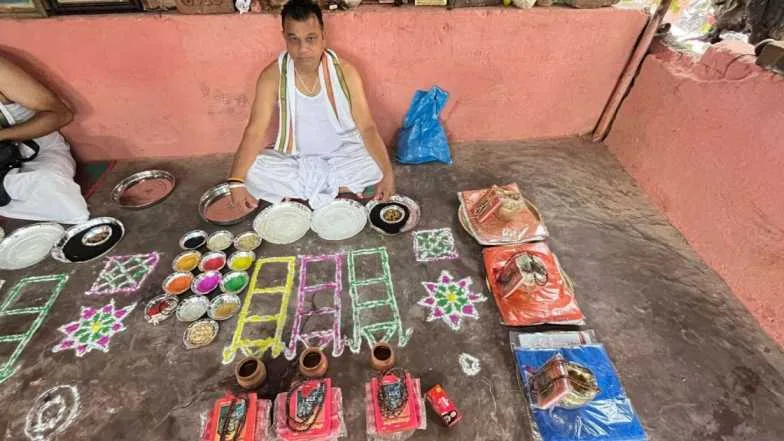
In a world that moves faster every year, it's easy to assume old rituals eventually fade — replaced by convenience, forgotten by busy schedules, or dismissed as something only "older generations" still care about. Yet Pind Daan, one of Hinduism's most significant ancestral rites, hasn't faded. If anything, interest in performing it correctly — at the right place, in the right way — has only grown, even among younger, more mobile generations spread across cities and countries far from where their families originated.
A Ritual Rooted in Continuity, Not Nostalgia
Pind Daan isn't performed out of nostalgia. It's rooted in a belief that has held for centuries: that the living carry a responsibility toward those who came before them, and that this responsibility doesn't end at death — it continues through remembrance and ritual. Gaya Ji, in Bihar, occupies a singular place in this belief system. Hindu tradition holds this land as uniquely sanctioned for ancestral liberation, with core ceremonies performed at the Vishnupad Temple, the Falgu River, and the ancient Akshayavat tree.
For families who take this seriously, the location isn't interchangeable. The spiritual weight of the ritual is tied specifically to these sites, which is part of why Gaya Ji continues to draw pilgrims from across India and increasingly from abroad, even as travel becomes more expensive and time more scarce.
The Details Most People Don't Know
What often surprises people learning about Pind Daan for the first time is how much nuance exists within it. It isn't a single fixed ceremony — different family situations call for different rites. A standard Shraddh suits most families, but Tripindi Shraddha exists specifically for cases where an ancestor's soul is believed to be unsettled. Pitru Dosha Shanti Puja addresses situations where a family has experienced recurring hardship that elders attribute to unresolved ancestral matters.
Even eligibility carries more nuance than commonly assumed. Many people still believe Pind Daan can only be performed by sons — a misconception the Garuda Purana directly contradicts. According to scripture, daughters and women hold full authority to perform these rites when there's no surviving male heir. Similarly, families who've lost track of their gotra over generations aren't excluded either; the ritual can be performed under the universal Kashyap Gotra instead.
Adapting the Logistics, Not the Meaning
What has genuinely changed in recent years isn't the ritual itself, but how families can access it. An Online E-Pind Daan option now allows devotees who can't travel — due to distance, health, or simply the realities of living abroad — to participate through a live, guided video ceremony. The family completes their sankalp remotely while a priest performs the physical rites at the actual holy site. Nothing about the scriptural process is shortened; only the requirement of physical presence has been removed.
Platforms coordinating these services, such as Pind Daan Puja Gaya Ji, have made this shift possible by connecting families with certified priests who understand both the ritual's traditional demands and the practical constraints modern families face — whether that's a tight travel schedule, an ageing relative who can't make the journey, or simply not knowing where to begin.
Why It Hasn't Disappeared
Perhaps the simplest explanation for why Pind Daan endures is that it answers something more universal than religious obligation — a need for closure, for acknowledgment, for a tangible way of saying thank you to people who are no longer there to hear it. Rituals that serve that need rarely disappear, no matter how much the world around them changes. They just find new ways to remain accessible, while staying exactly what they always were.