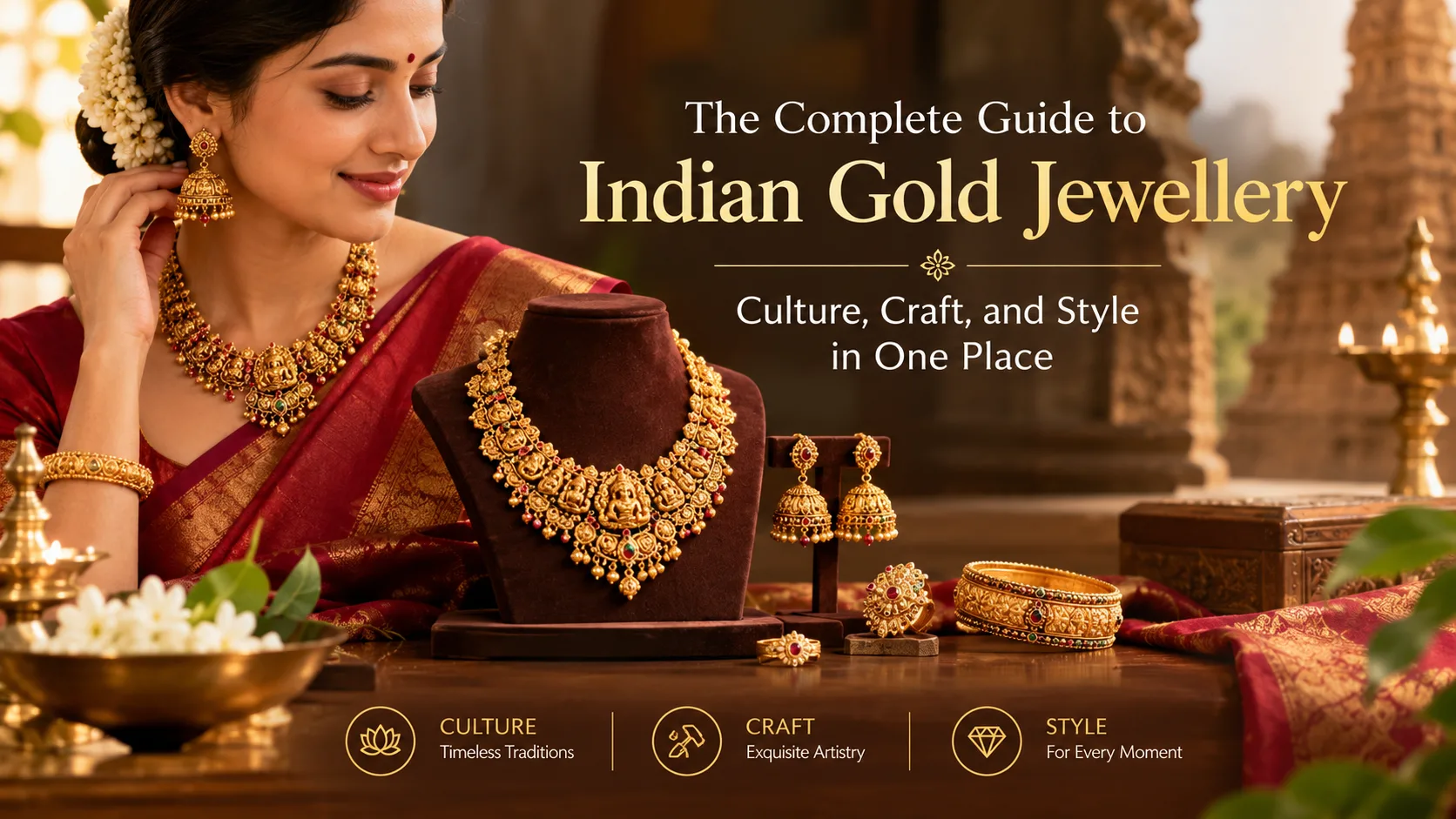
Gold in India is not a luxury. It is a language.
It speaks at births and weddings, at festivals and farewells. It moves from one generation to the next as inheritance, as blessing, as memory. No other country in the world has the same relationship with gold that India does — and that relationship is woven deep into culture, craft, and daily life in ways that go far beyond fashion or finance.
This guide covers everything you need to know about Indian gold jewellery — where it comes from, what it means, how it's made, and how to wear it well today.
The Cultural Significance of Gold in India
India is the world's second largest consumer of gold, and demand here is driven less by investment logic and more by emotion and tradition. Gold marks every significant moment in an Indian life:
- Birth — a baby's first gift is often a small gold bangle or pendant
- Coming of age — earrings, rings, and chains mark milestone birthdays
- Engagement and marriage — gold is central to wedding rituals across every community and region
- Festivals — Akshaya Tritiya, Dhanteras, Diwali, Onam, and Eid all carry gold-buying traditions
Death — gold is often passed down as inheritance, carrying the memory of the person who wore it
Gold is also deeply tied to ideas of auspiciousness, prosperity, and divine blessing. The goddess Lakshmi — the deity of wealth — is always depicted adorned in gold. Wearing gold is considered not just beautiful but spiritually significant in many Indian households.
Regional Jewellery Traditions Across India
One of the most fascinating aspects of Indian gold jewellery is how dramatically it varies from one region to another. Each state has its own distinct style, technique, and cultural symbolism.
South India — Weight, Purity, and Temple Traditions South Indian gold jewellery is known for its heaviness, its high purity (predominantly 22K), and its deep connection to temple art. Designs feature gods, goddesses, lotus motifs, and peacocks. The Lakshmi pendant, the long haram necklace, the jimikki earrings, and the vanki armlet are all iconic South Indian pieces. Gold here is worn generously — more is considered more.
North India — Kundan, Polki, and Mughal Influence North Indian jewellery carries the influence of Mughal artistry — elaborate, layered, and richly stone-set. Kundan work involves setting uncut gemstones in a gold framework using a lac base, creating bold pieces that catch light beautifully. Polki diamonds set in yellow gold are a signature of North Indian bridal jewellery. Maang tikkas, passa, and layered necklace sets are staples of the North Indian bridal look.
West India — Tribal Craft and Bold Silver-Gold Combinations Rajasthan and Gujarat bring bold tribal influences into jewellery — large, geometric pieces, heavy bangles, and intricate bead work alongside gold. Meenakari — the art of enamelling — is a Rajasthani speciality that produces breathtakingly colourful gold jewellery.
East India — Filigree and Delicate Craftsmanship Odisha and West Bengal are known for their filigree work — thin threads of gold twisted into intricate, lace-like patterns. These pieces look elaborate but are often surprisingly lightweight, making them ideal for daily wear. Bengali gold jewellery often features fish motifs, considered auspicious in that culture.
Kerala — Traditional Purity and the Distinctive Palakka Set Kerala gold jewellery is almost exclusively 22K and is characterised by clean, traditional designs. The Palakka necklace — a string of green leaf-shaped enamel pieces set in gold — is an icon of Kerala jewellery. The Kasumala (coin necklace), Manga Mala (mango motif necklace), and Pathakkam are other distinctive Kerala pieces that have become popular across India.
Each of these regional styles is now accessible online. When you buy gold ring online, you'll find designs rooted in these very traditions — from temple-inspired bands to Kundan-set solitaires — available with full karat and hallmark details listed upfront.
The Craft Behind Indian Gold Jewellery
Understanding how gold jewellery is made changes how you see the pieces you wear. Indian goldsmithing is one of the oldest and most skilled crafts in the world, and several traditional techniques are still practised today.
Casting The most common technique — molten gold is poured into a mould of the desired shape. Most machine-made jewellery uses casting, making it consistent and affordable. The finish is then refined by hand.
Filigree (Tarkashi) Fine wires of gold are twisted and soldered into intricate patterns. This labour-intensive technique produces lightweight, delicate pieces with extraordinary visual detail. Odisha and Andhra Pradesh are centres of filigree craftsmanship in India.
Kundan Setting A North Indian speciality — gemstones are pressed into a gold framework packed with lac (a natural resin), which holds them in place without prongs. The result is a flat, even setting that creates a seamless connection between stone and metal.
Meenakari (Enamelling) Coloured glass powders are applied to engraved gold surfaces and fired at high temperatures to fuse the enamel into the metal. Meenakari pieces are distinguished by their vivid colours — green, red, blue, and white — against yellow gold backgrounds.
Granulation Tiny spheres of gold are fused onto a gold surface to create texture and pattern. This ancient technique — dating back thousands of years in Indian jewellery history — produces beautifully tactile pieces.
Repoussé and Chasing Gold sheets are hammered and pushed from the back to create three-dimensional relief designs on the front. This handcraft technique is used for large temple jewellery pieces and ceremonial ornaments.
Karat Guide — What Purity Level Suits Each Piece
Indian gold jewellery is predominantly made in 22K, but 18K and 14K are increasingly common for contemporary and diamond-set pieces.
- 22K (91.6% pure) — the standard for traditional, festive, and bridal jewellery across most of India. Rich yellow colour, softer metal, best for necklaces and occasional-wear pieces
- 18K (75% pure) — stronger and more durable, ideal for daily-wear rings, diamond-set jewellery, and contemporary designs
- 14K (58.3% pure) — most hardwearing, lower price point, suitable for everyday earrings and budget-conscious buyers
Always look for BIS hallmarking regardless of karat — the six-character HUID code on the piece confirms the purity has been independently verified.
Karat also affects how gold necklace designs look in person. A 22K necklace carries that deep, warm yellow tone that photographs richly and sits beautifully against Indian skin tones. An 18K necklace in the same design reads slightly lighter — more contemporary, less traditional. Knowing the karat before you choose a design helps you pick something that genuinely suits the occasion and the look you're going for.
How to Wear Gold Jewellery Well — A Style Guide
Knowing your jewellery's cultural roots makes wearing it more intentional and more beautiful. Here are a few principles that cut across occasions and outfits:
Match the weight to the occasion Heavy, elaborate pieces are for weddings and major festivals. Lighter, simpler pieces suit daily wear, office environments, and casual occasions. Wearing a full bridal set to a birthday lunch feels out of place — and so does a tiny stud at a traditional ceremony.
Let one piece lead If you're wearing a statement necklace, keep earrings simple. If your earrings are dramatic, skip the necklace or choose something delicate. Letting one piece take centre stage almost always looks more elegant than competing pieces fighting for attention.
Match gold colour to your outfit's undertone Yellow gold pairs naturally with warm tones — red, orange, mustard, earth tones. White gold looks clean against cool colours — blues, greens, purples. Rose gold bridges both and works beautifully with pastels and neutrals.
Layer thoughtfully When stacking rings or layering necklaces, maintain at least a 2-inch gap between lengths and keep the overall combination to two or three pieces maximum. More than that starts to look cluttered rather than curated.
Buying Indian Gold Jewellery Today
The gold jewellery market in India has evolved significantly. Today, buyers can browse thousands of designs from the comfort of home, compare prices and weights, check hallmark details, and even try pieces on virtually before buying.
Earrings are among the most searched jewellery categories online. When you buy gold earrings online, you have access to the full breadth of India's regional variety — South Indian jimikkis, North Indian chandbalis, East Indian filigree drops, and contemporary geometric hoops — all in one place, with filters for karat, weight, and price that make narrowing down far easier than a showroom visit.
A reputable jeweller will always list karat, gram weight, making charges, and BIS hallmark status clearly on every product page. If any of these details are missing, that's reason enough to look elsewhere.
Why Brand and Trust Matter
In a market as large and varied as Indian gold jewellery, the brand you buy from matters. Hallmarking protects purity, but consistent craftsmanship, transparent billing, and reliable after-sales service — exchange policies, repair, and valuation — are things only a trusted brand can guarantee.
Jos Alukkas is one of India's most established jewellery brands, known for consistent 22K and 18K quality, BIS hallmarked collections, and a range that spans traditional regional designs to contemporary everyday pieces. Their Virtual Try-On feature allows buyers to see how a necklace, ring, or pair of earrings looks on them in real time — bridging the gap between online convenience and showroom confidence.
The Enduring Value of Indian Gold Jewellery
Indian gold jewellery has survived empires, trade routes, colonial periods, and globalisation. It has absorbed influences from Greece, Persia, and the Mughal courts while remaining unmistakably Indian in character.
What makes it endure isn't just the gold. It's the meaning layered into every piece — the craft passed down through generations of artisans, the cultural moments it marks, and the personal stories it carries forward.
When you wear Indian gold jewellery, you're not just wearing metal. You're wearing history.