Halal food for a wedding in Thailand starts with one worry from the couple. Some of our guests only eat halal, and we are worried the resort kitchen will mix everything together and no one will be able to tell what is safe. That worry is fair, and it has a clear answer.
The answer is a mixed menu handled properly, with labelling, a manifest and one kitchen principle that keeps every guest safe. Our planners run mixed menus often, and the method below is how we do it.
What is the mixed-menu problem?
Most Indian weddings in Thailand have a mixed guest list. Some guests only eat halal, most guests do not think about it at all, and the kitchen serves everyone from the same pass. That is where the risk sits.
The fear is simple. A halal dish sits next to a non-halal dish, a serving spoon moves between them, and a Muslim guest cannot tell what is safe to eat.
The fix is a system the kitchen follows for every function, not a promise made once and forgotten.
What is the one-kitchen principle?
People who do not eat halal can eat halal food. Muslims cannot eat the other way round. So when the whole order is halal, you order from one kitchen, and no dish can end up on the wrong table.
This principle comes from a Bangkok halal caterer whose kitchen cooks nothing but halal food, so there is no cross-contamination to explain to anyone.
Where the whole menu cannot be halal, the kitchen must keep the two streams apart. Separate preparation, separate serving, and labelled dishes, so a guest can see at a glance what is safe.
How does labelling keep guests safe?
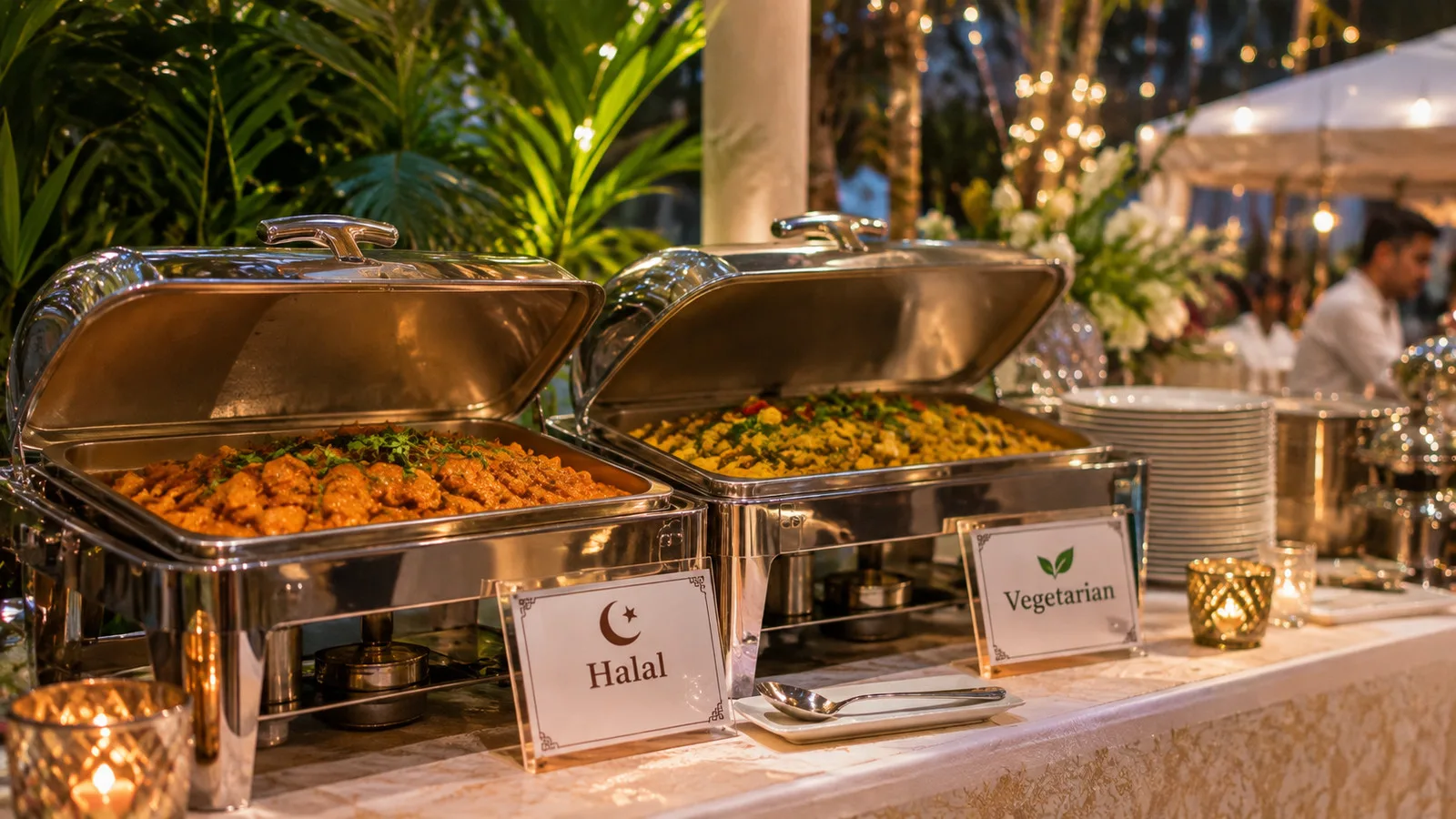
Every dish gets a label, and the label is visible from where the guest stands. Halal dishes are marked clearly, and the serving spoons stay with their own dish. A spoon that has touched one dish never moves to another.
Our coordinators check the labels before the first guest arrives. We walk the buffet with the caterer, we read every label, and we ask the kitchen to fix anything unclear. A label that only the chef understands is not a label.
What is the manifest rule?
Dietary and allergy needs travel on the manifest to every kitchen involved. The manifest is the guest list with each guest's food needs written beside their name, and it goes to the resort kitchen, the Indian caterer and the venue team.
Our planners build the manifest with the couple before the week begins, and we send the same list to every kitchen. No kitchen works from a different list, and no guest's need is lost between two teams.
How is halal different from Jain and vegetarian?
Halal, Jain and vegetarian are three different rule sets, and they must never be confused. Halal is about how the meat is sourced and prepared, and whether the kitchen keeps it apart from what is not halal.
Jain food follows its own rules, and vegetarian food follows its own rules. A vegetarian dish is not automatically halal, and a halal dish is not automatically Jain. Our planners ask the caterer to treat each rule set separately, with its own preparation and its own labels.
How do our planners agree the menu?
Menus are agreed in writing in advance. Our planners sit with the couple and the caterer, and we write down which dishes are halal, which are Jain, which are vegetarian, and how each will be prepared and served.
We verify halal certification with the venue, and we do not assume it. A kitchen that says it is halal must show it, and our planners ask to see it. That check happens before the wedding, not during it.
Frequently asked questions
How does halal food for a wedding in Thailand work when most guests do not eat halal?
The mixed menu is handled with labelling, a manifest and the one-kitchen principle. Guests who do not eat halal can eat halal food, so where the whole menu can be halal, make it halal, and where it cannot, keep the two streams apart with separate preparation and serving.
How can a guest tell which dishes are halal?
Every dish is labelled, and the label is visible from where the guest stands. Serving spoons stay with their own dish. Our coordinators check every label with the caterer before the first guest arrives.
Is halal the same as vegetarian or Jain?
No. Halal, Jain and vegetarian are three different rule sets. A vegetarian dish is not automatically halal, and a halal dish is not automatically Jain. Each needs its own preparation and its own labels.
How do we know the kitchen is really halal?
Ask for the certification and check it with the venue, rather than assuming it. Our planners verify halal certification with the venue before the wedding, and the menus are agreed in writing in advance.
If you want a planner who treats every guest's food needs as a promise, talk to Thailand Weddings. Our team runs mixed menus with labelling, a manifest and one clear kitchen rule.